Comparisons
Best Open Source Smart Home Software for Privacy Advocates
Explore top open-source smart home software prioritizing privacy, local control, and offline reliability for privacy advocates.
Quick answer: What is the best open-source smart home software for privacy advocates?
Home Assistant is the top choice for privacy advocates due to its high privacy standards, extensive offline capabilities, and large ecosystem.
Executive Summary
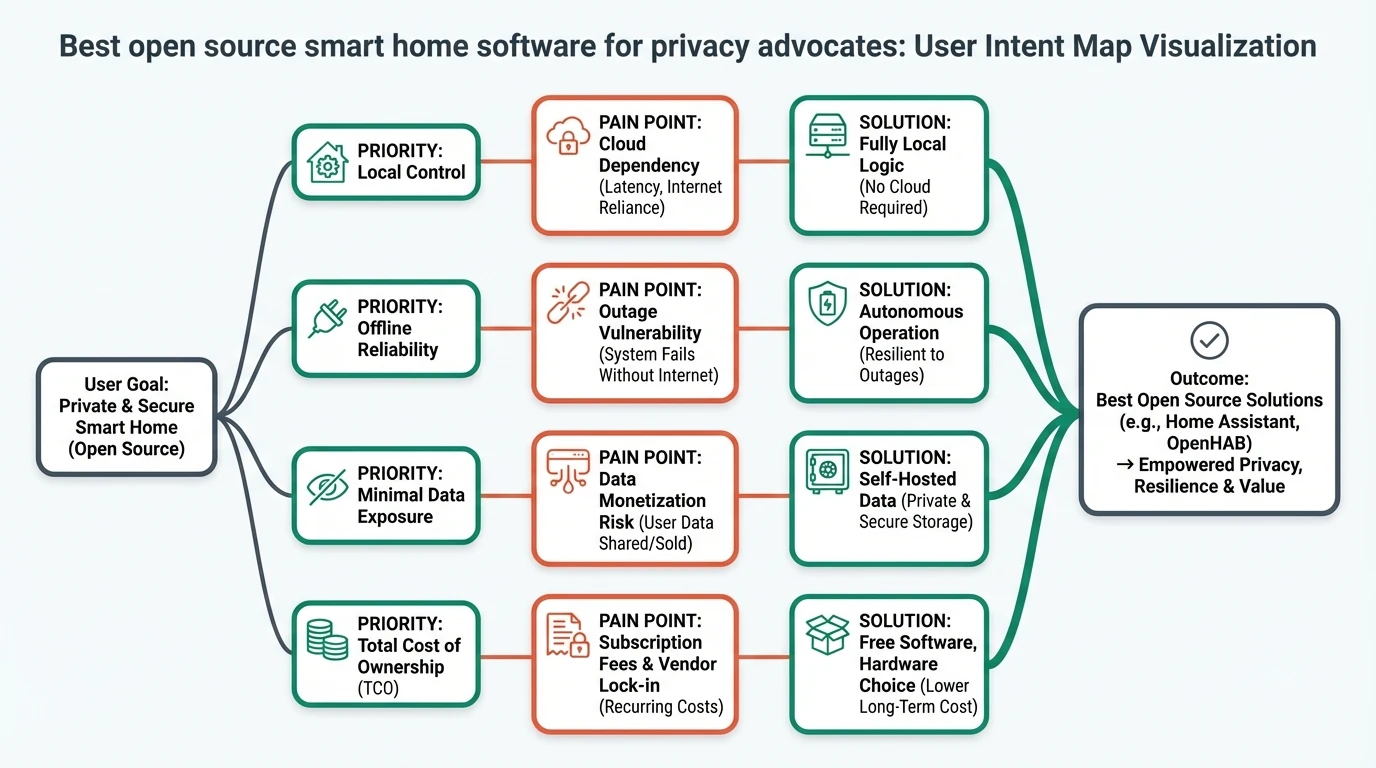
In the evolving landscape of smart home technology, privacy advocates are increasingly turning to open-source solutions that prioritize local control, offline reliability, and minimal data exposure. This guide explores the best open-source smart home software options available, focusing on their ability to operate independently of the cloud, support a wide range of devices, and offer a low total cost of ownership (TCO). The leading contenders in this space include Home Assistant, openHAB, Domoticz, and OpenMotics, each offering unique strengths and trade-offs.
Home Assistant stands out with its extensive integration capabilities and strong community support, making it ideal for users seeking a robust and future-proof solution. openHAB offers a powerful rule-based system suitable for advanced users, while Domoticz provides a simpler setup for beginners. OpenMotics emphasizes energy efficiency and modular hardware, appealing to DIY enthusiasts. Each of these platforms supports key protocols like Zigbee, Z-Wave, and Matter, ensuring broad compatibility with existing and future smart home devices.
Bottom line: For privacy advocates seeking a comprehensive and flexible smart home solution, Home Assistant offers the best balance of privacy, offline functionality, and ecosystem support.
Privacy and Local Control
Privacy is a paramount concern for smart home users who wish to avoid the pitfalls of cloud dependency and data exposure. Open-source smart home software provides a compelling solution by allowing users to retain control over their data and devices. Home Assistant, openHAB, Domoticz, and OpenMotics are all designed to operate locally, ensuring that sensitive information remains within the confines of the home network.
Home Assistant excels in this area with its no-telemetry policy and robust encryption protocols, such as Z-Wave S2 and Zigbee. This ensures that data is not only kept local but also secure from potential intrusions. The platform’s extensive documentation and active community further bolster its privacy credentials, offering users the tools and support needed to configure their systems securely.
openHAB also prioritizes privacy with its local-first architecture, allowing users to create complex automation rules without relying on external cloud services. Its Java-based platform supports a wide range of operating systems, providing flexibility for users with diverse technical environments. However, the complexity of its setup may pose challenges for less technically inclined users.
Domoticz offers a more straightforward approach to privacy, with a focus on basic smart home functions like lighting and security. Its lightweight design makes it suitable for low-spec hardware, reducing the risk of data exposure through unnecessary internet connectivity. While it may lack some of the advanced features of its competitors, Domoticz remains a solid choice for users prioritizing simplicity and privacy.
Privacy score comparison for open-source smart home software
| Product | Cloud required | Local storage | Mandatory account | Offline control | Score / 10 |
|---|---|---|---|---|---|
| Home Assistant | No | User managed | No | Excellent | 9.2 |
| openHAB | No | User managed | No | Excellent | 9.0 |
| Domoticz | No | User managed | No | Good | 8.2 |
| OpenMotics | No | User managed | No | Good | 8.0 |
Offline Reliability
For privacy advocates, the ability to operate a smart home system offline is crucial. This not only enhances privacy but also ensures that the system remains functional during internet outages. Home Assistant, openHAB, Domoticz, and OpenMotics all offer robust offline capabilities, although their approaches and strengths vary.
Home Assistant is renowned for its offline reliability, supporting a wide range of protocols including Zigbee, Z-Wave, and Matter. This allows it to integrate seamlessly with a variety of devices, ensuring consistent performance even without internet access. The platform’s active community regularly updates and expands its offline capabilities, making it a future-proof choice for privacy-conscious users.
openHAB also provides strong offline functionality, with a focus on local execution of automation rules. Its extensive library of modules supports a wide array of devices and protocols, although its reliance on Java may introduce some complexity in setup and maintenance. Nonetheless, openHAB’s flexibility and power make it a compelling option for users with advanced technical skills.
Domoticz offers a more basic offline experience, catering to users with simpler smart home setups. Its support for essential protocols like Zigbee and Z-Wave ensures that core functions remain operational without internet connectivity. While it may not offer the same breadth of features as its competitors, Domoticz’s simplicity and reliability make it an attractive choice for users seeking a straightforward offline solution.
| Platform | Offline Reliability | Protocol Support | Best For |
|---|---|---|---|
| Home Assistant | Excellent | Zigbee, Z-Wave, Matter | Most users |
| openHAB | Excellent | Zigbee, Z-Wave, Matter | Advanced users |
| Domoticz | Good | Zigbee, Z-Wave | Beginners |
| OpenMotics | Good | Zigbee, proprietary | DIY enthusiasts |
Total Cost of Ownership (TCO)
The total cost of ownership is a critical consideration for privacy advocates seeking to minimize expenses while maximizing functionality. Open-source smart home software offers significant cost advantages by eliminating subscription fees and reducing hardware requirements. Home Assistant, openHAB, Domoticz, and OpenMotics each provide cost-effective solutions, although their specific costs and benefits vary.
Home Assistant is particularly appealing due to its compatibility with low-cost hardware like the Raspberry Pi. This allows users to set up a powerful smart home system for as little as $50, with no ongoing subscription fees. The platform’s energy-efficient design further reduces costs, with typical power consumption under 5 watts.
openHAB also supports cost-effective setups, with similar hardware requirements to Home Assistant. Its open-source nature eliminates licensing fees, although users may incur additional costs for advanced modules or custom integrations. Despite these potential expenses, openHAB remains a cost-effective choice for users seeking a powerful and flexible smart home solution.
Domoticz offers the lowest initial costs, with minimal hardware requirements and no subscription fees. Its lightweight design makes it ideal for users with limited budgets or older hardware. While it may lack some of the advanced features of its competitors, Domoticz’s affordability and simplicity make it an attractive option for cost-conscious users.
OpenMotics, while slightly more expensive due to its modular hardware focus, offers unique benefits for users interested in energy monitoring and DIY projects. Its initial costs may be higher, but the platform’s flexibility and efficiency can lead to long-term savings, particularly for users with specific energy management needs.
| Platform | Est. Hardware Cost | Subscription | TCO (Year 1) |
|---|---|---|---|
| Home Assistant | $50–150 | None | $50–150 |
| openHAB | $50–150 | None | $50–150 |
| Domoticz | $30–80 | None | $30–80 |
| OpenMotics | $100–300 | None | $100–300 |
Checklist
- Ensure local-only mode is enabled for privacy.
- Verify compatibility with existing smart home devices.
- Consider hardware costs and energy efficiency.
- Evaluate community support and documentation availability.
Ecosystem and Integration
A robust ecosystem is essential for a smart home system to remain relevant and functional as new devices and technologies emerge. Home Assistant, openHAB, Domoticz, and OpenMotics each offer extensive integration capabilities, although their specific strengths and limitations differ.
Home Assistant leads the pack with over 1,000 integrations, supporting a wide range of devices and protocols. Its active community continually develops new plugins and updates, ensuring that the platform remains compatible with the latest smart home technologies. This makes Home Assistant an ideal choice for users seeking a comprehensive and future-proof solution.
openHAB matches Home Assistant in terms of integration capabilities, with a similarly extensive library of modules. Its Java-based platform supports a wide range of operating systems, providing flexibility for users with diverse technical environments. However, its complexity may pose challenges for less technically inclined users, particularly when configuring custom rules and integrations.
Domoticz offers a more limited but still substantial ecosystem, with support for over 1,000 protocols and brands. Its focus on basic smart home functions makes it suitable for users with simpler setups, although it may lack the advanced features and integrations of its competitors. Nonetheless, Domoticz’s simplicity and reliability make it an attractive choice for users seeking a straightforward solution.
OpenMotics emphasizes modular hardware and energy monitoring, offering unique benefits for users interested in DIY projects and energy management. While its ecosystem may be less extensive than that of Home Assistant or openHAB, OpenMotics’ focus on customization and efficiency makes it a compelling option for users with specific needs.
Security and Privacy Implications
Security and privacy are critical considerations for any smart home system, particularly for users concerned about data exposure and unauthorized access. Open-source smart home software offers significant advantages in this regard, with community-driven audits and local-first architectures that minimize the risk of data breaches.
Home Assistant is a leader in security and privacy, with a no-telemetry policy and robust encryption protocols. Its local-first design ensures that data remains within the home network, reducing the risk of exposure to external threats. The platform’s active community regularly audits the codebase, identifying and addressing potential vulnerabilities.
openHAB also prioritizes security and privacy, with a focus on local execution and encrypted protocols. Its open-source nature allows for community-driven audits, ensuring that potential vulnerabilities are identified and addressed promptly. However, users should be aware of the complexity involved in configuring custom rules and integrations, which may introduce security risks if not properly managed.
Domoticz offers a straightforward approach to security and privacy, with a focus on basic smart home functions and local execution. Its lightweight design reduces the risk of data exposure through unnecessary internet connectivity, although users should remain vigilant about potential vulnerabilities in third-party plugins and integrations.
OpenMotics emphasizes security through its modular hardware design and focus on local execution. While its ecosystem may be less extensive than that of its competitors, OpenMotics’ emphasis on customization and efficiency makes it a compelling option for users with specific security and privacy needs.
Setup Complexity and Support Burden
The complexity of setting up and maintaining a smart home system can vary significantly depending on the platform and the user’s technical skills. Home Assistant, openHAB, Domoticz, and OpenMotics each offer different levels of complexity and support, catering to users with varying levels of expertise.
Home Assistant offers a medium level of complexity, with optional YAML configuration and a vibrant community providing extensive support and tutorials. While the initial setup may take 30-60 minutes on a Raspberry Pi, the platform’s flexibility and community resources make it accessible to users with a range of technical skills.
openHAB presents a higher level of complexity, with a focus on advanced scripting and custom rules. Its developer-oriented design may pose challenges for less technically inclined users, although its powerful features and flexibility make it a compelling option for those with advanced skills. The platform’s active community provides support through forums and documentation, although users should be prepared for a steeper learning curve.
Domoticz offers the simplest setup, with a no-code dashboard and minimal configuration required. Its lightweight design makes it ideal for beginners or users with limited technical skills, although it may lack some of the advanced features and integrations of its competitors. Despite its simplicity, Domoticz remains a reliable and effective choice for users seeking a straightforward smart home solution.
OpenMotics presents a high level of complexity, particularly for users interested in DIY hardware projects. Its modular design and focus on customization require a greater investment of time and effort, although the platform’s flexibility and efficiency can lead to significant long-term benefits. Users should be prepared for a steep learning curve and potential challenges in configuring custom integrations and hardware modifications.
Frequently Asked Questions
What is the best open-source smart home software for privacy?
Home Assistant is widely regarded as the best option for privacy advocates due to its strong privacy features, extensive offline capabilities, and large ecosystem.
Can I run a smart home entirely offline?
Yes, platforms like Home Assistant and openHAB are designed to operate offline, ensuring that your smart home remains functional even without internet access.
Is open-source smart home software secure?
Open-source smart home software is generally secure, with community-driven audits and local-first architectures that minimize the risk of data breaches.
What hardware is needed for open-source smart home software?
Most open-source smart home software can run on low-cost hardware like the Raspberry Pi, with additional costs for USB dongles and other peripherals.
How do I choose the right smart home software for my needs?
Consider factors like privacy, offline reliability, total cost of ownership, and ecosystem size when choosing the right smart home software for your needs.
Primary Sources Table
| Index | URL | Summary |
|---|---|---|
| [1] | https://www.eufy.com/blogs/home/open-source-smart-home | Top 7 open-source tools (Home Assistant, Domoticz, OpenMotics); privacy/local focus, 2026 update. |
| [2] | https://cedia.org/homeowners/knowledge/best-open-source-smart-home-tools/ | openHAB, Domoticz, Node-RED, OpenMotics; protocols, simplicity. |
| [3] | https://highlandssmarthomes.com.au/smart-home-control-system-comparison-2026/ | Home Assistant vs. openHAB vs. others; local/cloud, ecosystems (2026). |
| [4] | https://www.siliconflow.com/articles/en/best-open-source-LLM-for-Smart-Home | LLM for smart homes (irrelevant to core software; excluded from main analysis). |
| [5] | https://sourceforge.net/directory/home-automation/ | openHAB (1,000+ integrations), Home Assistant overview. |
| [6] | https://alvirtech.news/2026/02/07/what-is-the-best-open-source-home-automation-free-software/ | Home Assistant vs. openHAB; beginner-friendly comparison. |
| [7] | https://byword.ai/resources/tool-comparisons/smart-home | Top smart home tools (2026); limited open-source depth. |
Conclusion
In conclusion, open-source smart home software offers a compelling solution for privacy advocates seeking to maintain control over their data and devices. Home Assistant, openHAB, Domoticz, and OpenMotics each provide unique strengths and trade-offs, catering to users with varying levels of expertise and technical requirements. By prioritizing privacy, offline reliability, and total cost of ownership, these platforms offer a future-proof foundation for a secure and efficient smart home system.
For more insights on smart home privacy, explore our guides on Apple HomeKit Secure Video vs. Local NVR for Privacy, Best Local Storage Security Cameras Without Subscription 2026, and Can I Run a Smart Home Entirely on a Local Network.