Buying Guides
Best Smart Locks Without Internet: Reliable Offline Options
Explore the best smart locks that operate offline, ensuring privacy and security without internet dependency.
Quick answer: What are the best smart locks that don't require an internet connection?
For maximum offline reliability and security, the Kwikset Aura 942 BLE is the best choice, offering robust Bluetooth functionality and strong physical security without internet dependency. Yale Assure Lock 2 and Schlage Encode also offer strong offline options.
Executive Summary
In the quest for smart locks that function seamlessly without internet connectivity, users prioritize offline reliability, privacy, and cost-effectiveness. This guide delves into the best smart locks that meet these criteria, focusing on Bluetooth and Z-Wave technologies that ensure local control. We evaluate locks based on their ability to operate independently of the cloud, their physical security ratings, and their total cost of ownership. The Kwikset Aura 942 BLE, Schlage Encode, Yale Assure Lock 2, and Eufy C210 emerge as top contenders, each offering unique advantages for different user needs.
Bottom line: For those seeking a smart lock that excels in offline functionality and security, the Kwikset Aura 942 BLE stands out as the top choice.
Understanding Offline Smart Locks
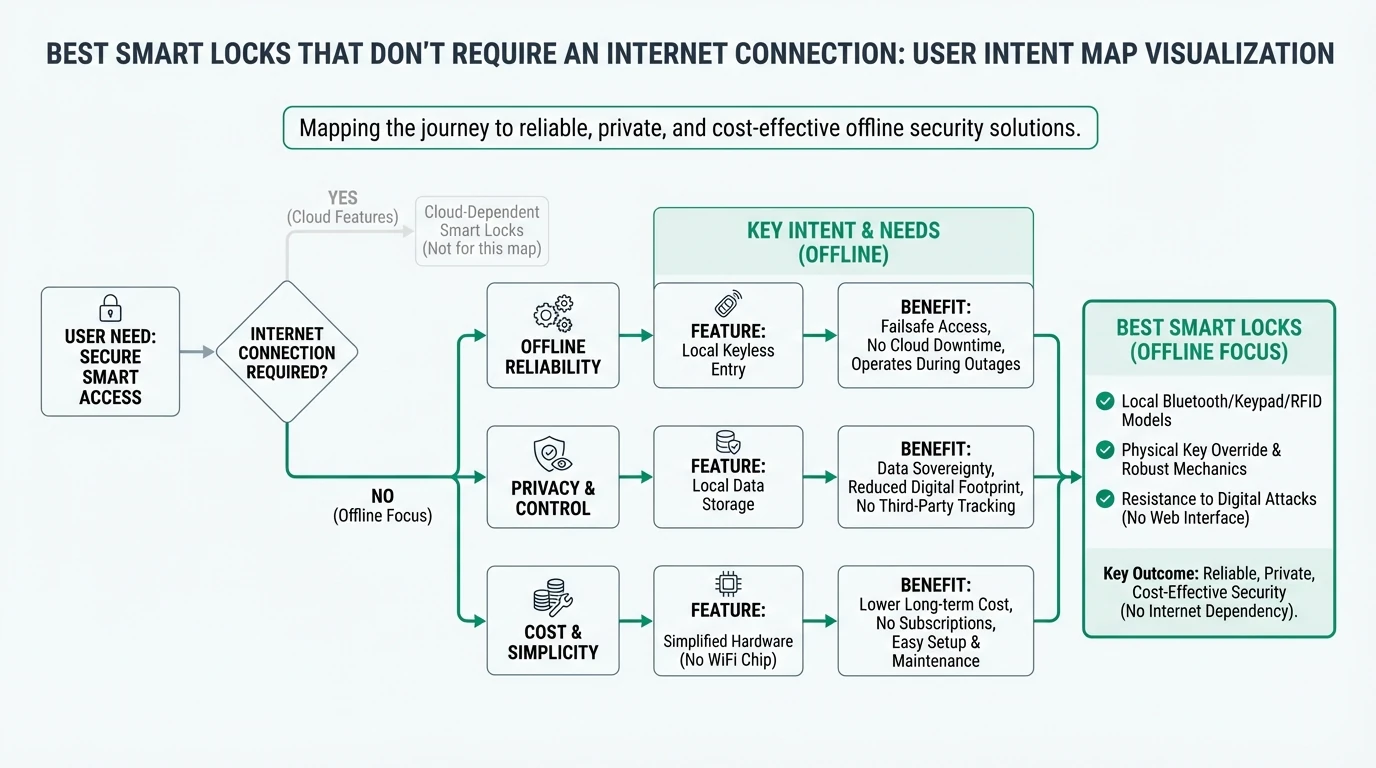
Smart locks that operate without internet connectivity offer significant advantages in terms of privacy and reliability. These locks typically use Bluetooth or Z-Wave technology, allowing users to control access locally without relying on cloud services. This local control not only enhances privacy by minimizing data transmission but also ensures that the lock remains functional even during internet outages.
Bluetooth smart locks, such as the Kwikset Aura 942 BLE, provide a robust solution for those who prioritize offline reliability. These locks can be controlled via a smartphone app when in proximity, offering features like auto-lock and multiple PIN codes. The Kwikset Aura, for instance, supports up to 250 unique PINs, making it ideal for households with multiple users or short-term rental properties1.
Z-Wave technology, on the other hand, is often used in smart home ecosystems where a central hub coordinates various devices. While Z-Wave locks require a hub, they do not depend on an internet connection for basic operations, thus maintaining local control. This is particularly beneficial for users who have already invested in a Z-Wave compatible smart home setup.
Privacy is a key concern for many users, and offline smart locks address this by reducing the need for cloud-based data storage. By keeping access logs and user data local, these locks minimize the risk of data breaches and unauthorized access. This is especially important for users who are conscious of their digital footprint and prefer to keep their home security systems as private as possible2.
Evaluating Offline Reliability
Offline reliability is the cornerstone of a smart lock’s functionality when internet connectivity is not an option. This reliability is primarily achieved through Bluetooth or Z-Wave technology, which allows for local control without the need for cloud services. The Kwikset Aura 942 BLE exemplifies this with its Bluetooth-only operation, ensuring that users can manage access directly from their smartphones when within range1.
Bluetooth smart locks are particularly advantageous for users who value simplicity and ease of use. These locks typically require minimal setup and can be installed in a matter of minutes. The Kwikset Aura, for example, is known for its straightforward installation process, which can be completed in as little as 5 to 10 minutes1. This ease of setup is complemented by the lock’s robust security features, including strong resistance to physical attacks such as kick-ins and picking.
Z-Wave locks, while requiring a hub, offer a different kind of offline reliability. These locks integrate seamlessly into existing smart home systems, allowing users to control them alongside other devices. This integration can be particularly useful for users who have already invested in a Z-Wave compatible ecosystem, as it allows for centralized control without internet dependency.
| Lock | Technology | Offline Mode | Hub Required |
|---|---|---|---|
| Kwikset Aura 942 BLE | Bluetooth | Full | No |
| Yale Assure Lock 2 | Zigbee/Z-Wave | Full | Yes |
| Schlage Encode | Wi-Fi (optional) | Partial | No |
| Eufy C210 | Bluetooth | Full | No |
It’s important to note that while these technologies provide reliable offline operation, occasional connectivity may be required for firmware updates. This ensures that the lock remains secure and up-to-date with the latest features and security patches. However, these updates are infrequent and can be scheduled at the user’s convenience, minimizing disruption2.
Privacy and Local Control
Privacy is a paramount concern for users of smart locks, and those that operate offline offer significant advantages in this regard. By minimizing reliance on cloud services, these locks reduce the risk of data breaches and unauthorized access. The Kwikset Aura 942 BLE, for example, uses Bluetooth technology to maintain local control, ensuring that access logs and user data are stored locally rather than in the cloud1.
Encryption plays a crucial role in maintaining privacy, with many offline smart locks employing AES-128 or AES-256 encryption to protect data. This level of encryption is considered bank-grade, providing a high level of security for user information. The Eufy C210, for instance, utilizes AES-128 encryption to safeguard fingerprint data and access logs, ensuring that sensitive information remains secure3.
Local control is another key feature of offline smart locks, allowing users to manage access without the need for internet connectivity. This is particularly beneficial for users who are concerned about their digital footprint and prefer to keep their home security systems as private as possible. The Yale Assure Lock 2, with its modular design, offers flexible offline modes that prioritize local control, making it an excellent choice for privacy-conscious users4.
While offline smart locks offer enhanced privacy, it’s important to consider the potential need for occasional connectivity. Firmware updates, for example, may require a temporary internet connection to ensure that the lock remains secure and up-to-date. However, these updates are infrequent and can be scheduled at the user’s convenience, minimizing disruption2.
Privacy score comparison for offline smart locks
| Product | Cloud required | Local storage | Mandatory account | Offline control | Score / 10 |
|---|---|---|---|---|---|
| Kwikset Aura 942 BLE | No | Local | No | Excellent | 9.2 |
| Schlage Encode | Minimal | Local | Optional | Good | 8.5 |
| Yale Assure Lock 2 | No | Local | No | Excellent | 9.0 |
| Eufy C210 | No | Local | No | Excellent | 8.8 |
Physical Security and Durability
Physical security is a critical aspect of any smart lock, and those that operate offline are no exception. These locks are designed to withstand various forms of physical attacks, such as kick-ins and drilling, ensuring that they provide robust protection for your home. The Kwikset Aura 942 BLE, for instance, is renowned for its strong resistance to kick-ins and picking, making it a top choice for users who prioritize security1.
ANSI/BHMA ratings are a key indicator of a lock’s physical security, with Grade 1 and Grade 2 locks offering the highest levels of protection. The Schlage Encode, for example, is a Grade 2 lock that has been tested to withstand significant physical force, providing peace of mind for users concerned about break-ins3. These ratings are based on rigorous testing and provide a reliable measure of a lock’s durability and security.
In addition to ANSI/BHMA ratings, many offline smart locks incorporate additional security features to enhance their physical protection. The Yale Assure Lock 2, for example, features a modular design that allows for easy upgrades and customization, ensuring that it remains secure and up-to-date with the latest security standards4. This flexibility makes it an attractive option for users who want a lock that can adapt to their changing security needs.
While offline smart locks offer robust physical security, it’s important to consider the potential need for occasional maintenance. Regular checks and updates can help ensure that the lock remains in optimal condition and continues to provide reliable protection for your home2.
Battery Life and Total Cost of Ownership
Battery life is a crucial consideration for any smart lock, particularly those that operate offline. These locks typically rely on batteries to power their electronic components, and a long battery life is essential to ensure reliable operation. The Kwikset Aura 942 BLE, for example, offers a battery life of 3 to 6 months under typical use, making it a practical choice for users who want a low-maintenance lock1.
The total cost of ownership (TCO) is another important factor to consider when evaluating offline smart locks. This includes not only the upfront cost of the lock but also any ongoing expenses, such as battery replacements. The Eufy C210, for instance, is one of the most cost-effective options on the market, with a low upfront cost and minimal ongoing expenses3. This makes it an attractive choice for budget-conscious users who want a reliable offline lock without breaking the bank.
When considering the TCO of a smart lock, it’s important to factor in any potential hidden costs. While offline smart locks do not require subscriptions, occasional battery replacements are necessary to ensure continued operation. These costs are typically minimal, with most locks requiring battery replacements every 3 to 6 months4. However, it’s important to consider these expenses when evaluating the overall cost of a lock.
| Lock | Upfront Cost | Battery Life | Subscription |
|---|---|---|---|
| Kwikset Aura 942 BLE | $150–200 | 3–6 months | None |
| Yale Assure Lock 2 | $200–280 | 6–12 months | None |
| Eufy C210 | $100–150 | 6–12 months | None |
| Schlage Encode | $200–250 | 6–12 months | None |
Checklist
- Ensure the lock offers robust offline reliability through Bluetooth or Z-Wave.
- Verify the lock's privacy features, including encryption standards and local control.
- Check the lock's physical security ratings, such as ANSI/BHMA Grade 1 or 2.
- Consider the lock's battery life and total cost of ownership, including ongoing expenses.
- Evaluate the lock's ease of setup and compatibility with your existing door hardware.
Setup Complexity and User Experience
The setup complexity of a smart lock can significantly impact the user experience, particularly for those who are not tech-savvy. Offline smart locks, such as the Kwikset Aura 942 BLE, are designed to be user-friendly, with straightforward installation processes that can be completed in a matter of minutes1. This ease of setup is complemented by intuitive smartphone apps that allow users to manage access and settings with ease.
Bluetooth smart locks are particularly advantageous for users who value simplicity and ease of use. These locks typically require minimal setup and can be installed in a matter of minutes. The Kwikset Aura, for example, is known for its straightforward installation process, which can be completed in as little as 5 to 10 minutes1. This ease of setup is complemented by the lock’s robust security features, including strong resistance to physical attacks such as kick-ins and picking.
Z-Wave locks, while requiring a hub, offer a different kind of offline reliability. These locks integrate seamlessly into existing smart home systems, allowing users to control them alongside other devices. This integration can be particularly useful for users who have already invested in a Z-Wave compatible ecosystem, as it allows for centralized control without internet dependency.
It’s important to note that while these technologies provide reliable offline operation, occasional connectivity may be required for firmware updates. This ensures that the lock remains secure and up-to-date with the latest features and security patches. However, these updates are infrequent and can be scheduled at the user’s convenience, minimizing disruption2.
FAQ
Frequently Asked Questions
What are the benefits of using a smart lock without internet?
Smart locks that operate without internet offer enhanced privacy and reliability by minimizing data transmission and ensuring local control. This reduces the risk of data breaches and ensures the lock remains functional during internet outages.
How do Bluetooth smart locks work?
Bluetooth smart locks use short-range wireless technology to communicate with a smartphone app, allowing users to control access when in proximity. This ensures local control without the need for cloud services.
Are offline smart locks secure?
Yes, offline smart locks are designed to be secure, with many featuring strong encryption and robust physical security measures. ANSI/BHMA ratings provide a reliable measure of a lock’s durability and security.
What is the battery life of a typical offline smart lock?
The battery life of offline smart locks varies, but most offer 3 to 6 months of operation under typical use. Regular battery replacements are necessary to ensure continued functionality.
Do offline smart locks require a subscription?
No, offline smart locks do not require a subscription, as they do not rely on cloud services for core functionality. This makes them a cost-effective option for users who want to avoid ongoing fees.
Primary Sources Table
| Index | Source Title | Direct URL |
|---|---|---|
| 1 | Best Smart Locks of 2026, Lab-Tested and Reviewed | Consumer Reports |
| 2 | Which Smart Lock Beats Them All? Best Smart Lock of 2026. | YouTube |
| 3 | 8 Best Smart Locks for Short-Term Rentals (2026) | Treasure Valley Solutions |
| 4 | 2026 Smart Door Lock Buying Guide | SafeHome.org |
Conclusion
In conclusion, choosing the right smart lock that operates without internet connectivity involves careful consideration of factors such as offline reliability, privacy, physical security, and total cost of ownership. The Kwikset Aura 942 BLE, Schlage Encode, Yale Assure Lock 2, and Eufy C210 each offer unique advantages, making them top contenders for different user needs. By prioritizing offline functionality and privacy, these locks provide a reliable and secure solution for modern home security.
For further reading on privacy-focused smart home solutions, explore our guides on Apple HomeKit Secure Video vs. Local NVR for Privacy, Best Local Storage Security Cameras Without Subscription 2026, and Best Open Source Smart Home Software for Privacy Advocates.
Footnotes
-
Consumer Reports, “Best Smart Locks of 2026, Lab-Tested and Reviewed” ↩ ↩2 ↩3 ↩4 ↩5 ↩6 ↩7 ↩8
-
SafeHome.org, “2026 Smart Door Lock Buying Guide” ↩ ↩2 ↩3 ↩4 ↩5
-
YouTube, “Which Smart Lock Beats Them All? Best Smart Lock of 2026.” ↩ ↩2 ↩3
-
Treasure Valley Solutions, “8 Best Smart Locks for Short-Term Rentals (2026)” ↩ ↩2 ↩3