Smart Home Privacy
Best Video Doorbells Without Cloud Subscription 2026
Best subscription-optional video doorbells in 2026 for privacy: microSD and hub storage, HomeKit Secure Video, RTSP to Frigate, and how to avoid forced cloud tiers.
Quick answer: Which video doorbells avoid mandatory cloud subscriptions in 2026?
Prioritize models with microSD or a local hub, RTSP or ONVIF to your NVR, or HomeKit Secure Video. Read each vendor’s fine print—some brands still gate AI features behind optional paid tiers.
Executive Summary
In 2026, the demand for video doorbells that do not require mandatory cloud subscriptions has surged, driven by privacy concerns and the desire for local data control. Pair doorbells with self-hosted doorbell + local storage, Frigate NVR comparisons, and blocking IoT from the internet once streams hit your LAN.
Bottom line: For privacy-conscious consumers, video doorbells with local storage and no mandatory cloud subscriptions offer the best balance of security, functionality, and cost-effectiveness.
| Priority | Look for |
|---|---|
| No recurring fee | microSD or hub with user-owned storage |
| NVR integration | RTSP, ONVIF, or HomeKit routing to your recorder |
| Trust | Firmware updates without forced cloud login |
Understanding Privacy and Local Storage in Video Doorbells
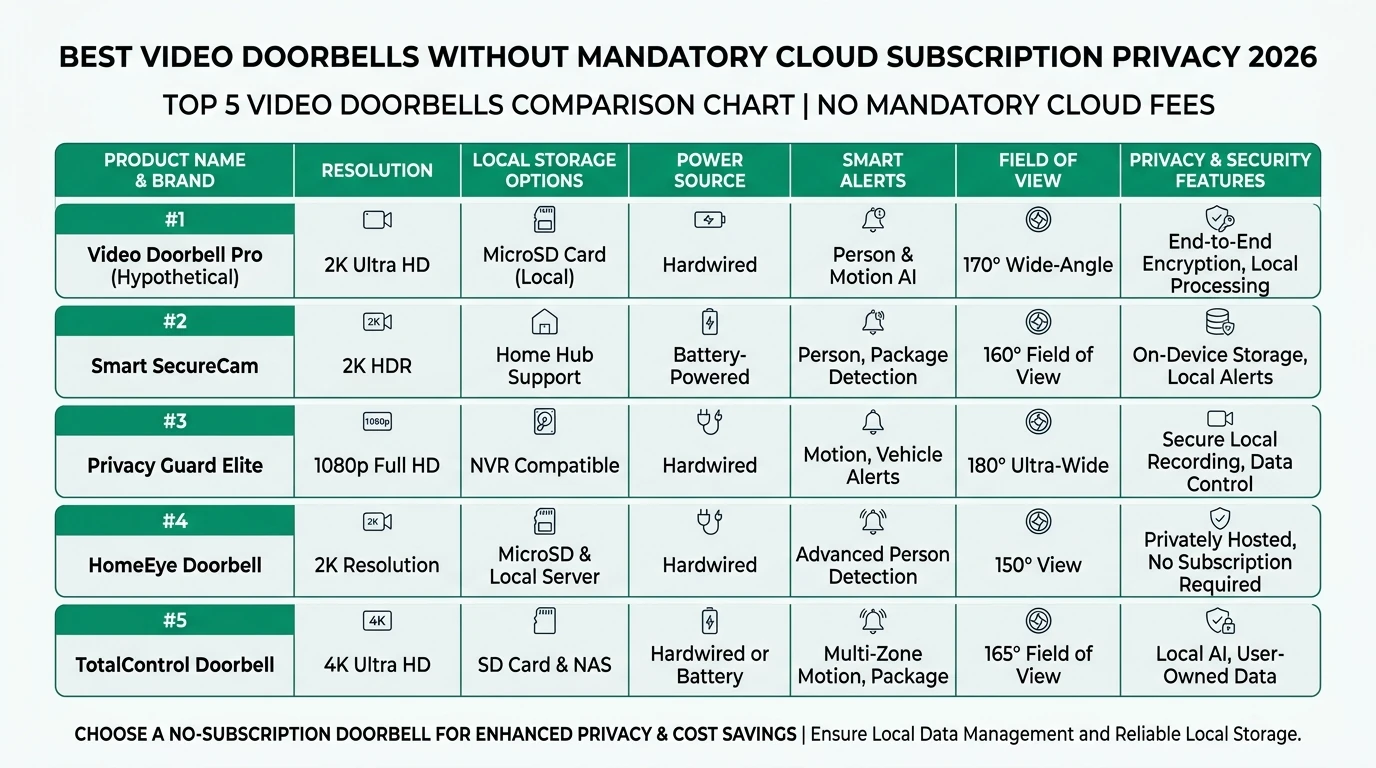
Privacy is a significant concern for many consumers when choosing a video doorbell. In 2026, the best models prioritize local storage, allowing you to store footage on a microSD card or a dedicated hub, thus eliminating the need for cloud storage. This approach not only enhances privacy but also reduces the risk of data breaches associated with cloud services.
Local storage options vary among models. For instance, the Lorex 2K/4K doorbell supports up to 256GB microSD cards, providing ample space for video recordings. Similarly, the Aqara G4 offers up to 512GB of storage, making it ideal for users who require extensive recording capabilities. These models ensure that your footage is stored securely on-site, accessible only to you.
Moreover, local storage doorbells often feature advanced encryption standards, such as Apple HomeKit Secure Video, which provides end-to-end encryption for added security. This means that even if someone were to access your footage, they would not be able to view it without the proper decryption keys. Such features make these doorbells a top choice for privacy-focused consumers.
In addition to privacy benefits, local storage doorbells offer offline reliability. Unlike cloud-dependent models, these doorbells continue to function even if your internet connection is disrupted. This ensures continuous monitoring and recording, providing peace of mind that your home is always protected.
Evaluating Offline Reliability and Total Cost of Ownership
When selecting a video doorbell, offline reliability is crucial. Models that rely solely on local storage can operate independently of an internet connection, ensuring uninterrupted service. This is particularly important in areas with unstable internet or for users who prefer not to rely on cloud services.
The Eufy E340, for example, offers robust offline capabilities with its HomeBase S380 hub, which supports local storage and advanced person/package detection. This setup ensures that your doorbell continues to function and record even during internet outages. Similarly, the Wyze V2 provides 24/7 recording via microSD, making it a reliable choice for budget-conscious users.
Total cost of ownership (TCO) is another critical factor. While the initial purchase price is important, consider additional costs such as storage expansions and potential upgrades. For instance, the Lorex 4K doorbell costs between $150-200, with microSD upgrades ranging from $20-50. In contrast, the Eufy E340, priced at $130-180, requires an additional $150 for the HomeBase, bringing the total to $280-330 over five years.
It’s essential to weigh these costs against the benefits of subscription-free operation. Unlike cloud-dependent models, these doorbells do not incur recurring fees, making them a cost-effective choice in the long run. By investing in a model with robust offline capabilities and local storage, you can enjoy comprehensive security without the burden of ongoing expenses.
Comparing Video Quality and Smart Alerts
Video quality is a key consideration when choosing a video doorbell. High-resolution models provide clearer images, making it easier to identify visitors and monitor your property. In 2026, most top models offer at least 2K resolution, with some, like the Lorex 4K, providing even higher clarity.
The Eufy E340 stands out with its dual-lens system, which enhances video quality and provides a wider field of view. This feature is particularly useful for monitoring package deliveries, as it allows you to see both the visitor and the package simultaneously. Similarly, the Aqara G4 offers excellent video quality, with 2K resolution and advanced night vision capabilities.
Smart alerts are another important feature, enabling your doorbell to notify you of specific events, such as person or package detection. These alerts are typically customizable, allowing you to set parameters based on your preferences. For instance, the TP-Link Kasa KD110 offers person alerts without requiring a subscription, ensuring you receive timely notifications without additional costs.
When evaluating video quality and smart alerts, consider how these features align with your security needs. High-resolution video and reliable alerts can significantly enhance your ability to monitor and protect your home, providing peace of mind and added security.
| Model | Resolution | Local Storage | Smart Alerts |
|---|---|---|---|
| Lorex 4K | 4K | Up to 256GB microSD | Person Detection |
| Eufy E340 | 2K Dual-Lens | 8GB base, expandable | Person/Package Detection |
| Aqara G4 | 2K | Up to 512GB microSD | Local Facial Recognition |
| Wyze V2 | 2K | microSD | Basic AI Alerts |
| TP-Link Kasa KD110 | 1080p | Local Storage | Person Alerts |
Ecosystem Compatibility and Setup Complexity
Compatibility with existing smart home ecosystems is a significant factor for many consumers. Video doorbells that integrate seamlessly with platforms like Google Assistant, Amazon Alexa, and Apple HomeKit offer added convenience and functionality. In 2026, models like the Lorex and Eufy are designed to work with multiple ecosystems, providing flexibility for users with diverse smart home setups.
The Aqara G4, for instance, is compatible with Apple HomeKit, offering end-to-end encryption and integration with other Apple devices. This makes it an excellent choice for users already invested in the Apple ecosystem. Similarly, the Eufy E340 supports both Google Assistant and Amazon Alexa, allowing for voice control and integration with other smart devices.
Setup complexity varies among models. Wired doorbells, such as the Lorex and Aqara, typically require a more involved installation process but offer greater reliability. These models often come with pre-installed microSD cards, simplifying the setup process. In contrast, battery-powered models like the Wyze V2 are easier to install but require regular battery replacements.
When choosing a video doorbell, consider how its ecosystem compatibility and setup requirements align with your needs. A model that integrates seamlessly with your existing devices and offers a straightforward setup process can enhance your overall smart home experience.
Checklist
- Ensure compatibility with your smart home ecosystem
- Consider setup complexity and installation requirements
- Evaluate the need for wired vs. battery-powered models
- Check for pre-installed storage options
- Assess integration with voice assistants like Alexa and Google Assistant
Privacy and Security Implications
Security is a top priority for video doorbell users, and models with local storage offer significant advantages in this regard. By storing footage locally, these doorbells reduce the risk of data breaches associated with cloud storage. This is particularly important for privacy-conscious consumers who want to ensure their data remains secure and private.
Models like the Lorex and Eufy score high on data security, with features such as person detection and local facial recognition. These capabilities operate offline, ensuring that your doorbell continues to function even if your internet connection is disrupted. Additionally, the Aqara G4 offers HomeKit Secure Video, providing end-to-end encryption for added peace of mind.
It’s important to verify claims of “no fees required” when selecting a video doorbell. Some models may offer subscription-optional features, but these can limit functionality without a paid plan. For example, while the SimpliSafe doorbell offers live view without a subscription, recording capabilities are restricted without a paid plan.
When evaluating privacy and security, consider how each model’s features align with your needs. A doorbell that offers robust local storage, advanced encryption, and offline functionality can provide comprehensive security without compromising your privacy.
FAQ
Frequently Asked Questions
What are the benefits of local storage in video doorbells?
Local storage keeps clips on your microSD, hub, or NVR so a vendor outage does not erase evidence. You still need physical security for the recorder and encrypted exports if you copy footage off-site.
How does video quality impact doorbell performance?
2K and 4K improve identification distance but increase bitrate—size your Wi-Fi or PoE path and SD card writes accordingly.
Are there hidden costs with subscription-free doorbells?
You may pay for larger cards, hubs, or advanced AI tiers. Budget spare batteries for wireless models and time for firmware hygiene.
Can I use these doorbells with Home Assistant or Frigate?
Yes when the vendor exposes RTSP or ONVIF, or when you bridge through HomeKit; verify integration notes before purchase.
Wired or battery for privacy-focused installs?
Wired supplies continuous power for 24/7 local recording; batteries simplify install but add maintenance and sometimes weaker continuous capture.
Primary Sources Table
| Index | Title/Description | Direct URL |
|---|---|---|
| 1 | A Guide to Subscription-Free Smart Doorbell Cameras | SafeHome.org | SafeHome.org |
| 2 | Best Doorbell Cameras 2026: Reviewed by Home Security Experts | Security.org |
| 3 | Top 5 Smart Doorbells of 2026 (YouTube) | YouTube |
| 4 | Best Video Doorbell Cameras Without a Subscription | Consumer Reports | Consumer Reports |
| 5 | Which Video Doorbell Should You Buy in 2026? (6-Way Comparison) (YouTube) | YouTube |
Conclusion
Choosing the right video doorbell in 2026 involves balancing privacy, functionality, and cost. Models with local storage and no mandatory cloud subscriptions offer significant advantages, providing enhanced privacy and offline reliability. By considering factors such as video quality, smart alerts, ecosystem compatibility, and total cost of ownership, you can select a doorbell that meets your security needs without compromising your privacy.
For further insights into smart home privacy, explore our guides on Alexa, Google Home, Apple Home vs Home Assistant Privacy 2026, Apple HomeKit Secure Video vs Local NVR for Privacy, Aqara vs Shelly vs Tuya Privacy 2026, ONVIF vs RTSP vs proprietary camera APIs, and how to use Wyze without a cloud subscription.