Smart Home Privacy
Cloudflare Tunnel vs DuckDNS vs Nabu Casa for HA
Compare Cloudflare Tunnel, DuckDNS, and Nabu Casa for secure Home Assistant remote access in 2026: trust boundaries, TLS, port forwarding risk, and TCO vs DIY reverse proxies.
Quick answer: Cloudflare Tunnel, DuckDNS, or Nabu Casa for Home Assistant remote access?
Nabu Casa is the lowest-friction hosted path. Cloudflare Tunnel avoids open inbound ports but places trust in Cloudflare’s edge. DuckDNS plus port forward keeps DNS under your control but exposes WAN attack surface if you misconfigure TLS or forwarding.
Source: Home Assistant Nabu Casa
Executive Summary
In 2026, choosing the right remote access method for Home Assistant (HA) involves balancing privacy, local control, offline reliability, and total cost of ownership (TCO). Cloudflare Tunnel, DuckDNS, and Nabu Casa each offer unique benefits and drawbacks. Stack this decision with Tailscale vs WireGuard vs ZeroTier, Caddy vs Traefik vs NGINX Proxy Manager, and Let’s Encrypt vs self-signed so TLS and reverse proxy layers stay coherent.
Bottom line: Your choice should align with your priorities: privacy and control with Cloudflare, local control with DuckDNS, or ease of use with Nabu Casa.
| Priority | Lean toward |
|---|---|
| Zero open ports | Cloudflare Tunnel |
| Minimal recurring fee | DuckDNS + reverse proxy |
| Fastest support path | Nabu Casa |
Privacy and Security: A Comparative Analysis
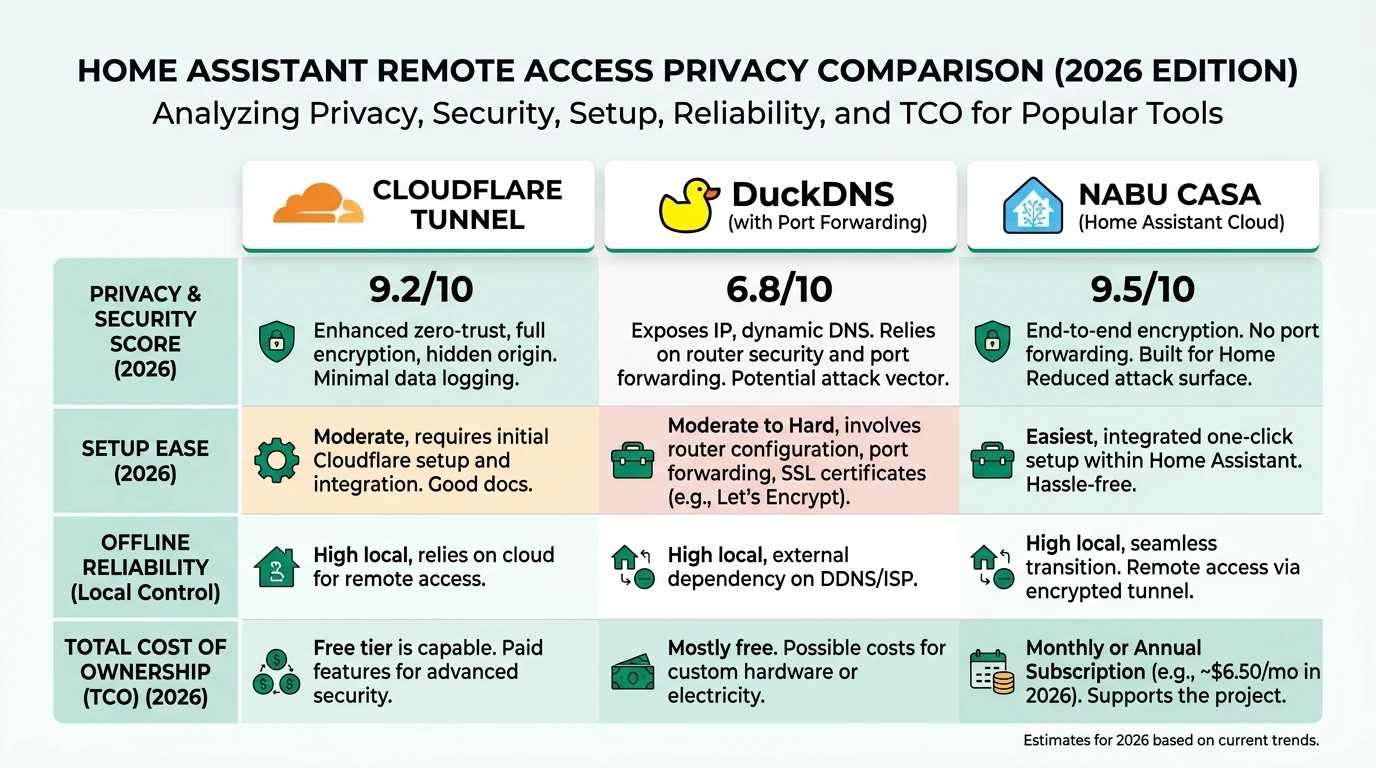
When considering remote access solutions for Home Assistant, privacy and security are paramount. Cloudflare Tunnel, DuckDNS, and Nabu Casa each approach these aspects differently, impacting your decision based on your specific needs.
Cloudflare Tunnel routes traffic through Cloudflare’s edge network, ensuring your home IP remains hidden. This setup inherently provides a layer of privacy, as external access to your network is minimized. The use of end-to-end encryption further secures data in transit, although the lack of explicit zero-knowledge proof means some trust in Cloudflare’s infrastructure is necessary12.
DuckDNS, on the other hand, relies on dynamic DNS and requires port forwarding, which can expose your home IP if not configured correctly. This method demands a higher level of technical expertise to maintain security, as misconfigurations can lead to vulnerabilities. However, DuckDNS keeps data local post-DNS, which can be a significant advantage for those prioritizing local control34.
Nabu Casa offers a cloud-based solution with end-to-end encryption, simplifying remote access setup. While this method is user-friendly, it involves routing all traffic through Nabu Casa’s servers, which could potentially inspect metadata. This trade-off between ease of use and privacy is crucial for users to consider, especially if cloud reliance is a concern13.
Local Control and Customization
Local control is a critical factor for many Home Assistant users who prefer self-hosting and customization. Each of the three solutions offers varying degrees of control, impacting how you manage your smart home setup.
Cloudflare Tunnel excels in providing local control, allowing users to integrate multiple services and utilize custom domains. This flexibility is ideal for those who want to tailor their remote access setup to specific needs, such as integrating other services like BitWarden or using personalized subdomains25.
DuckDNS also supports high local control, though it requires manual configuration of a reverse proxy and port forwarding. This DIY approach appeals to users who enjoy tinkering with their setup and have the technical skills to manage potential risks. The ability to keep everything local, without relying on third-party servers, is a significant advantage for privacy-conscious users63.
In contrast, Nabu Casa offers limited local control due to its cloud dependency. While it provides a seamless user experience with minimal setup, the lack of customization options may not suit users who prefer a more hands-on approach. The convenience of a zero-configuration remote UI is balanced by the trade-off in local autonomy15.
Offline Reliability and Internet Dependency
The ability to access your Home Assistant setup offline is a crucial consideration, especially for users in areas with unreliable internet connectivity. Each solution offers different levels of offline reliability, which can influence your choice significantly.
Cloudflare Tunnel requires an active internet connection to maintain the outbound tunnel to Cloudflare’s servers. This dependency means that if your internet goes down, remote access will be unavailable, although local network access remains unaffected27.
DuckDNS stands out for its offline reliability, as it allows local access to your Home Assistant setup even when the internet is down. Remote access, however, depends on your ISP’s uptime and the correct configuration of your network. This method provides a robust fallback for users who prioritize uninterrupted local control4.
Nabu Casa, being a cloud-based service, also requires an internet connection for remote access. In the event of an internet outage, remote access is lost, but local control remains intact. This reliance on cloud services is a trade-off for the ease of use and seamless integration it offers1.
Total Cost of Ownership (TCO) Over Three Years
Understanding the total cost of ownership (TCO) is essential for budgeting and long-term planning. Each solution presents different cost structures, impacting your decision based on financial considerations.
Cloudflare Tunnel offers a free tier with unlimited tunnels and up to 100,000 requests per day, making it a cost-effective choice for most personal users. However, if your usage exceeds these limits, you may need to consider Cloudflare’s paid Zero Trust plan, which could increase costs to $5-20 per month1.
DuckDNS is entirely free, with no direct costs associated with its use. However, there are hidden costs, such as the time required for setup and potential electricity costs for running a server. These factors should be considered when evaluating the overall expense of this method63.
Nabu Casa charges $65 per year, which includes features like text-to-speech and voice integrations. While this cost is higher than the other options, it provides a comprehensive package with minimal setup and maintenance, appealing to users who value convenience13.
Checklist
- Evaluate your budget for remote access solutions.
- Consider hidden costs such as time and electricity.
- Assess the value of included features like TTS and voice integrations.
Setup Complexity and Maintenance
The complexity of setting up and maintaining each remote access solution can vary significantly, affecting your choice based on your technical expertise and willingness to manage ongoing maintenance.
Cloudflare Tunnel requires a moderate setup process, involving the addition of your domain to Cloudflare and the installation of the Home Assistant add-on. Once configured, it requires minimal maintenance, making it a popular choice for users who prefer a set-it-and-forget-it approach125.
DuckDNS demands a more advanced setup, including port forwarding and certificate management via Let’s Encrypt. This complexity can be a barrier for less technically inclined users, but it offers a rewarding experience for those who enjoy a DIY approach. Ongoing maintenance involves monitoring IP changes and certificate renewals34.
Nabu Casa is the easiest to set up, requiring only a subscription and enabling the add-on. Its seamless integration with Home Assistant and low maintenance requirements make it an attractive option for users who prioritize ease of use over technical control13.
FAQ
Frequently Asked Questions
Which solution offers the best privacy for Home Assistant remote access?
Cloudflare Tunnel provides high privacy by hiding your home IP and using end-to-end encryption, making it a strong choice for privacy-conscious users.
Is DuckDNS suitable for users with limited technical skills?
DuckDNS requires advanced setup and maintenance, making it less suitable for users without technical expertise.
How does Nabu Casa simplify remote access for Home Assistant?
Nabu Casa offers a cloud-based solution with zero-configuration remote UI, making it easy to set up and maintain.
What are the hidden costs associated with DuckDNS?
While DuckDNS is free, hidden costs include the time for setup and potential electricity costs for running a server.
Can I use Cloudflare Tunnel without a custom domain?
Yes, Cloudflare Tunnel can be used without a custom domain, but using one enhances flexibility and control.
Primary Sources Table
| Index | Title/Description | Direct URL |
|---|---|---|
| 1 | Home Assistant Remote Access: Best Methods 2025 (comparison table) | Link |
| 2 | New Add-on: Cloudflare Tunnel Client - HA Community | Link |
| 3 | Best Home Assistant Add-ons 2026: The Essential Guide | Link |
| 4 | Performance: Nabu Casa vs Cloudflare Tunnel - HA Community | Link |
| 5 | Replicate Nabu Casa’s remote access - HA Community | Link |
| 6 | Switch from DuckDNS to Nabu Casa - HA Community | Link |
| 7 | Switch from DuckDNS to Nabu Casa (thread 2) - HA Community | Link |
| 8 | Nabu Casa vs DuckDNS and port forwarding - HA Community | Link |
Conclusion
Choosing the right remote access solution for Home Assistant in 2026 depends on your specific needs and priorities. Cloudflare Tunnel offers robust privacy and control, DuckDNS provides local control with some risks, and Nabu Casa ensures ease of use with cloud dependency. Evaluate your priorities carefully to make an informed decision.
Explore more about smart home privacy and security by checking out our related guides on Apple HomeKit Secure Video vs Local NVR for Privacy, Aqara vs Shelly vs Tuya Privacy 2026, Best Hardware for Local AI Smart Home 2026, and securing NAS remote access if certificates live on shared storage.
Footnotes
-
Home Assistant Remote Access: Best Methods 2025 (comparison table) ↩ ↩2 ↩3 ↩4 ↩5 ↩6 ↩7 ↩8
-
New Add-on: Cloudflare Tunnel Client - HA Community ↩ ↩2 ↩3 ↩4
-
Switch from DuckDNS to Nabu Casa - HA Community ↩ ↩2 ↩3 ↩4 ↩5 ↩6 ↩7
-
Nabu Casa vs DuckDNS and port forwarding - HA Community ↩ ↩2 ↩3
-
Performance: Nabu Casa vs Cloudflare Tunnel - HA Community ↩ ↩2 ↩3
-
Replicate Nabu Casa’s remote access - HA Community ↩