Comparisons
Domoticz vs Home Assistant: Privacy 2026
Explore Domoticz vs Home Assistant for privacy in 2026, focusing on local control, offline reliability, and TCO.
Quick answer:
Executive Summary
In 2026, choosing between Domoticz and Home Assistant for home automation hinges on privacy, local control, and offline reliability. Both platforms are open-source and prioritize local data storage, making them excellent choices for privacy-conscious users. Domoticz stands out for its simplicity and low total cost of ownership (TCO), while Home Assistant offers extensive integrations and support for emerging standards like Matter. This guide explores these aspects in detail, helping you make an informed decision based on your specific needs.
Bottom line: If you prioritize maximum privacy and simplicity, Domoticz is your best bet. For those who need extensive device compatibility and are willing to manage more complex configurations, Home Assistant is the way to go.
Privacy and Local Control
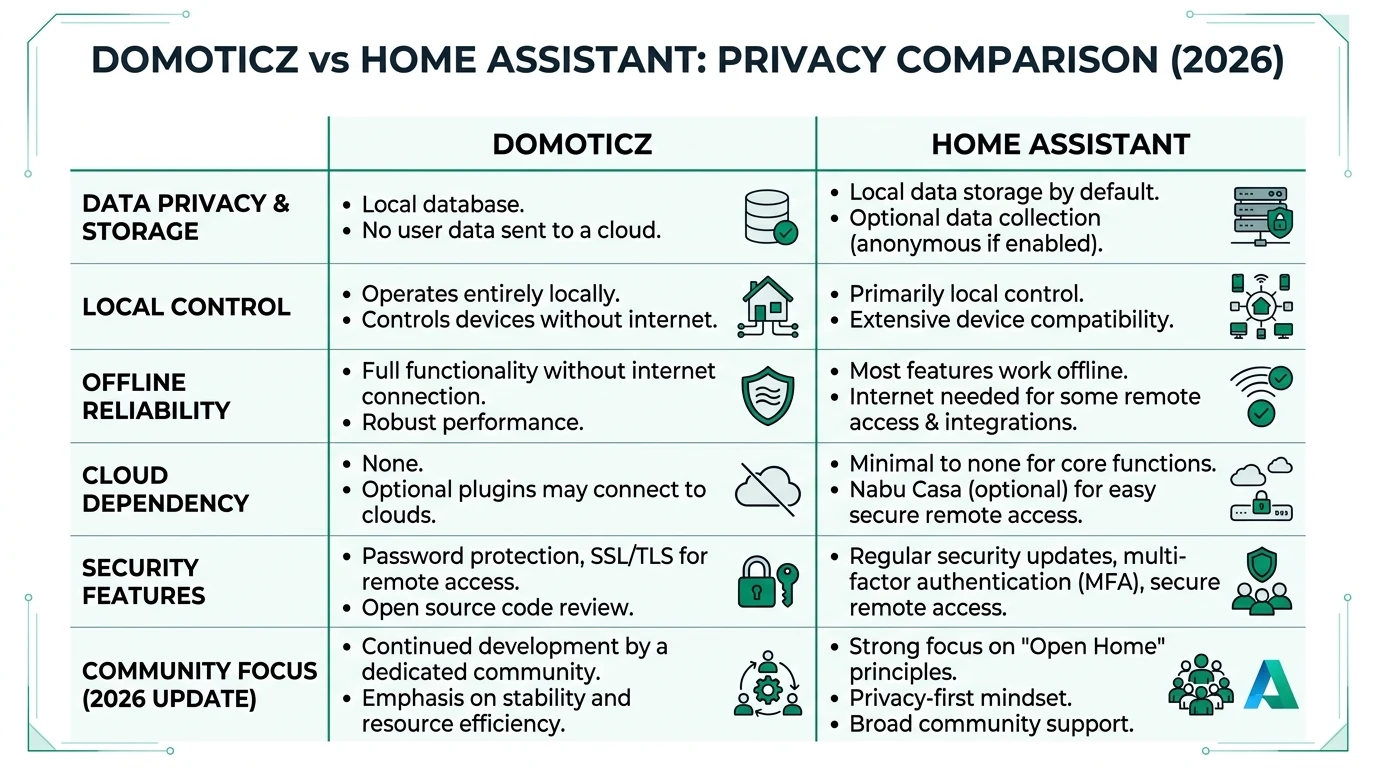
Privacy is a top concern for many smart home users, especially those looking to avoid cloud dependencies. Both Domoticz and Home Assistant offer robust local control, ensuring that your data stays within your home network. Domoticz operates fully locally by default, with no inherent cloud dependencies. This means that all your data and automation processes are handled on your local devices, minimizing exposure to external threats1.
Home Assistant also emphasizes local data storage, but it offers optional cloud services through Nabu Casa for users who want remote access without exposing their home network directly. This flexibility allows users to choose their level of cloud interaction, balancing convenience with privacy2. However, it’s important to note that using cloud services, even optional ones, introduces potential privacy risks, as data may be transmitted over the internet.
In terms of local control, both platforms support a wide range of devices through local protocols like MQTT and Zigbee2MQTT. This ensures that your smart home can function independently of the internet, providing resilience against outages and enhancing privacy by keeping operations within your local network3.
Offline Reliability
Offline reliability is crucial for maintaining a functional smart home during internet outages. Domoticz excels in this area, known for its stability and ability to manage over 200 devices on a Raspberry Pi 3 without failure. This makes it a reliable choice for users who prioritize uninterrupted operation4. Domoticz’s lightweight architecture ensures that it can run efficiently on low-power hardware, further enhancing its offline capabilities.
Home Assistant, while also capable of offline operation, tends to trade some stability for the sake of supporting new devices and features. Its frequent updates and YAML-based configuration can introduce complexity, potentially affecting stability if not managed carefully5. However, Home Assistant’s auto-discovery feature simplifies the initial setup, making it easier to integrate new devices without extensive manual configuration.
Both platforms offer auto-restoration of device states after power outages, ensuring that your smart home returns to its previous state without manual intervention. This feature is particularly valuable for maintaining the continuity of your home automation routines6.
Total Cost of Ownership (TCO)
When evaluating the total cost of ownership, both Domoticz and Home Assistant are free to use, with no licensing fees. However, the costs associated with hardware and optional services can vary significantly. Domoticz is known for its low hardware requirements, running efficiently on devices like the Raspberry Pi, which can be obtained for €35-€1007. This makes it an economical choice for users looking to minimize expenses.
Home Assistant also runs on similar hardware, but users may incur additional costs if they opt for the Nabu Casa cloud service, priced at €6.50 per month or approximately €78 per year[^8]. This service provides convenient remote access and over-the-air updates, which can be appealing for users who value ease of use over strict cost control.
Hidden costs for both platforms may include additional hardware like USB sticks for Zigbee or Z-Wave integration, typically ranging from €30-€50. These costs should be considered when planning your smart home setup, as they can impact the overall budget[^9].
| Criteria | Domoticz | Home Assistant |
|---|---|---|
| Privacy/Local Control | Fully local; no cloud by default; user-managed remote access (e.g., Domoproxy). | Fully local data storage; 2,000+ integrations, but optional cloud (Nabu Casa) for remote. |
| Offline Reliability | High stability; manages 200+ devices on Raspberry Pi3 without failure; auto-restores device states. | Good auto-discovery, but YAML config and frequent updates trade stability for new devices. |
| TCO (Hardware/Software) | Free; low requirements (Raspberry Pi/NAS); no subs; €0 base beyond Pi (~€35-€100). | Free; similar Pi hardware; optional €6.50/mo Nabu Casa for cloud/remote (~€78/yr). |
Setup Complexity and Support
Setting up a smart home system can be daunting, especially for those new to home automation. Domoticz offers a relatively straightforward installation process, with a web-based GUI that simplifies configuration for beginners. Its stable platform is well-suited for users who prefer a set-it-and-forget-it approach[^10]. However, Domoticz lacks native auto-detection for new devices, requiring manual setup for each component.
Home Assistant, on the other hand, features an auto-discovery function that detects compatible devices on your network, streamlining the initial setup. This feature is particularly beneficial for users with a large number of devices, as it reduces the manual configuration burden[^11]. However, Home Assistant’s reliance on YAML for advanced configurations can be challenging for those unfamiliar with coding, potentially increasing the support burden.
Both platforms have active communities and forums where users can seek help and share experiences. Domoticz’s plugin-based extensions allow for customization, while Home Assistant’s large community and frequent updates provide a wealth of resources for troubleshooting and expanding functionality[^12].
Checklist
- Evaluate your privacy needs
- Consider offline reliability
- Assess total cost of ownership
- Determine setup complexity
- Explore community support
Security and Privacy Implications
Security is a critical aspect of any smart home system, and both Domoticz and Home Assistant prioritize protecting user data. Domoticz’s lightweight architecture minimizes its attack surface, reducing the risk of vulnerabilities[^13]. However, users must manually configure MQTT for secure communication, and remote access requires careful router configuration to avoid exposure[^14].
Home Assistant emphasizes local data storage and supports a wide range of devices, enhancing its security profile. The introduction of Z-Wave JS in beta form in 2025 has further improved its security capabilities[^15]. However, the platform’s extensive integrations can increase the risk of configuration errors, which may compromise security if not managed properly.
Neither platform has undergone official security audits, so users should remain vigilant and follow best practices for securing their networks. Community forums are valuable resources for staying informed about potential security issues and solutions[^16].
Primary Sources Table
| ID | Source Title/Description | Direct URL |
|---|---|---|
| 1 | OpenHab vs Home Assistant vs Domoticz - Best Open Source Home Automation | Link |
| 2 | domoticz compared to homeassistant - Domoticz Community Forum | Link |
| 3 | Domoticz vs Home Assistant - Home Automation Support & Discussion | Link |
| 4 | Top 10 Home Automation Software Tools in 2026: Features, Pros, Cons Comparison | Link |
| 5 | Raspberry Pi automation or Homey? Compare Domoticz, Home Assistant, Homey | Link |
| 6 | Top 7 Open Source Home Automation Tools for 2026 - eufy US | Link |
| 7 | Domoticz vs Home Assitant - Home Assistant Community | Link |
Conclusion
Choosing between Domoticz and Home Assistant for your smart home in 2026 depends on your priorities. Domoticz is ideal for those who value simplicity, low cost, and maximum privacy, while Home Assistant offers extensive integrations and support for new standards, albeit with more complexity. Both platforms provide robust privacy features and offline reliability, making them excellent choices for privacy-conscious users.
Explore more about smart home privacy with our guides on Apple HomeKit Secure Video vs Local NVR for Privacy, Best Hardware for Local AI Smart Home 2026, and Best Local LLMs for Home Automation 2026.
Frequently Asked Questions
Which platform offers better privacy, Domoticz or Home Assistant?
Both platforms offer excellent privacy features with local data storage. Domoticz operates fully locally by default, while Home Assistant offers optional cloud services for remote access.
Is Home Assistant more complex to set up than Domoticz?
Yes, Home Assistant can be more complex due to its YAML-based configuration and frequent updates, though it offers auto-discovery for easier device integration.
What are the hidden costs associated with these platforms?
Hidden costs may include additional hardware for device integration and optional cloud services for Home Assistant, such as Nabu Casa.
Can both platforms operate offline?
Yes, both Domoticz and Home Assistant can operate offline, ensuring your smart home remains functional during internet outages.
How do these platforms handle security?
Both platforms prioritize security with local data storage and support for secure protocols. However, users should follow best practices to secure their networks.
Footnotes
-
OpenHab vs Home Assistant vs Domoticz - Best Open Source Home Automation ↩
-
domoticz compared to homeassistant - Domoticz Community Forum ↩
-
Domoticz vs Home Assistant - Home Automation Support & Discussion ↩
-
Top 10 Home Automation Software Tools in 2026: Features, Pros, Cons Comparison ↩
-
Raspberry Pi automation or Homey? Compare Domoticz, Home Assistant, Homey ↩
-
Top 7 Open Source Home Automation Tools for 2026 - eufy US ↩
-
Domoticz vs Home Assitant - Home Assistant Community ↩