Smart Home Privacy
ESPHome vs Tasmota: Best Firmware for Local-Only Devices
Compare ESPHome and Tasmota for local-only smart devices in 2026, focusing on privacy, reliability, and cost.
Quick answer: Should I flash ESPHome or Tasmota for local-only control?
Choose ESPHome when you want encrypted Home Assistant native API, YAML-first customization, and no MQTT broker. Choose Tasmota for quick OTA setup on commercial devices, broad device templates, and MQTT-centric ecosystems. Both run fully offline.
Source: ESPHome project documentation
Executive Summary
In the evolving landscape of smart home technology, choosing the right firmware for local-only smart devices is crucial for ensuring privacy, reliability, and cost-effectiveness. As of 2026, ESPHome and Tasmota stand out as leading contenders for those seeking to maintain control over their smart devices without relying on cloud services. This guide provides a comprehensive comparison of these two firmware options, focusing on key factors such as privacy, offline reliability, and total cost of ownership (TCO). See also how these stacks fit into MQTT-centric home automation and broader hub comparisons without mandatory cloud accounts.
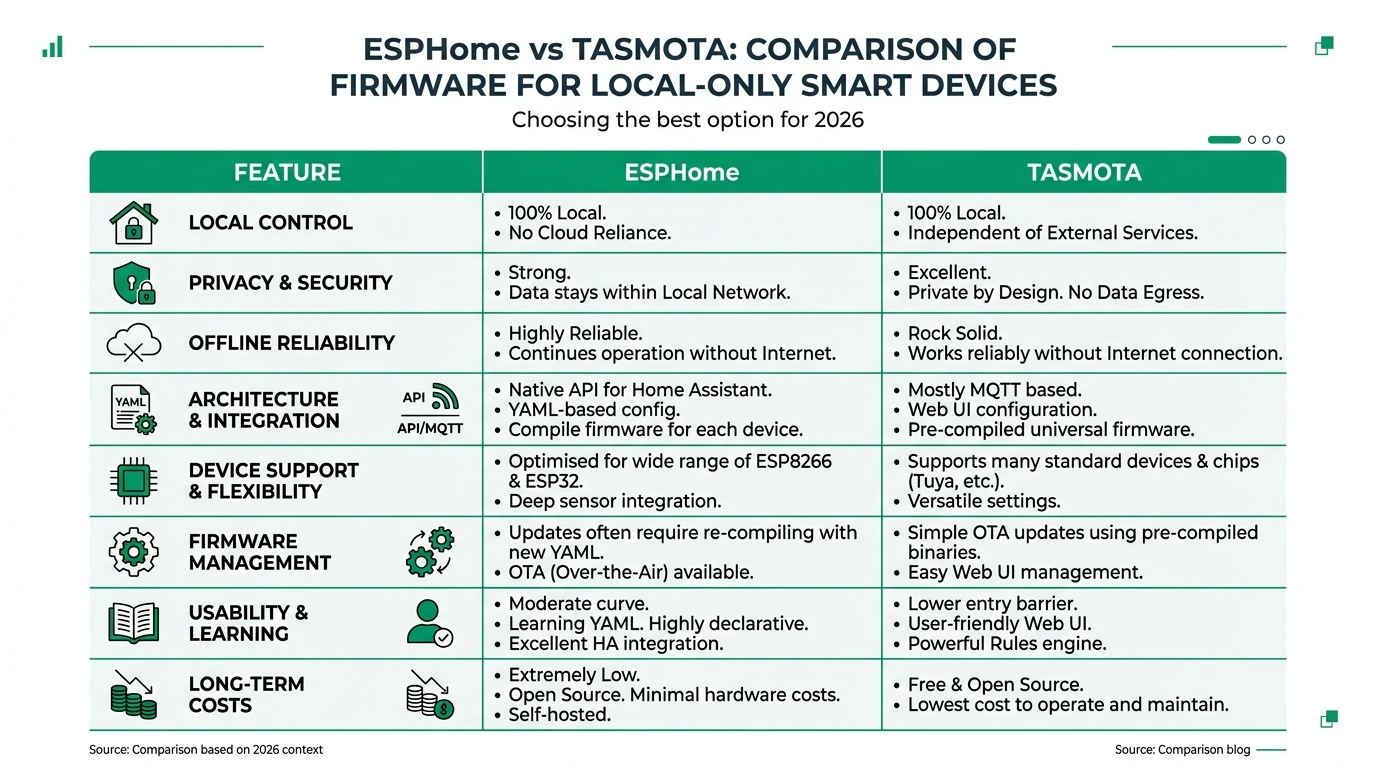
ESPHome is renowned for its tight integration with Home Assistant, offering an encrypted native API that enhances privacy by eliminating the need for an external MQTT broker — reference the official ESPHome changelog for release cadence. Tasmota is celebrated for its broad compatibility with commercial devices and ease of setup; the Tasmota project on GitHub remains the canonical source for firmware capabilities, with runtime configuration and MQTT-first integration across multiple home automation stacks.
Bottom Line: If your primary concern is privacy and you are deeply integrated with Home Assistant, ESPHome is the superior choice. However, if you require broader device compatibility and a simpler setup process, Tasmota may be more suitable.
Privacy and Local Control: ESPHome vs Tasmota
Privacy is a paramount concern for users seeking local-only smart device solutions. ESPHome and Tasmota offer distinct approaches to achieving local control, each with its own strengths and weaknesses.
ESPHome utilizes a native API that is encrypted, providing a significant privacy advantage by eliminating the need for an external MQTT broker. This means that communications between your devices and Home Assistant are secure and less susceptible to interception. The native API also simplifies the setup process, as it doesn’t require additional configuration for encryption, unlike MQTT, which is often unencrypted by default.
In contrast, Tasmota relies on MQTT for communication, which can be a double-edged sword. While MQTT offers flexibility and compatibility with a wide range of devices and platforms, it requires careful configuration to ensure encryption and privacy. Without proper setup, MQTT communications can be intercepted, posing a potential security risk. However, Tasmota’s support for multiple home automation systems makes it a versatile choice for users with diverse device ecosystems.
Ultimately, the choice between ESPHome and Tasmota for privacy and local control depends on your specific needs and technical comfort level. If you prioritize security and a seamless integration with Home Assistant, ESPHome’s encrypted native API is the clear winner. However, if you value flexibility and are willing to invest time in configuring MQTT securely, Tasmota offers broader compatibility.
Offline Reliability and Stability
When it comes to offline reliability, both ESPHome and Tasmota have made significant strides to ensure that smart devices remain functional without an internet connection. However, there are notable differences in their approaches and performance.
ESPHome’s strength lies in its ability to compile custom firmware tailored to specific devices, reducing bloat and optimizing performance. The 2026.1 update further enhances offline reliability by increasing the number of entities per packet by 42% and improving reconnection speeds. Additionally, ESPHome’s YAML-based configuration allows for detailed customization, including deep sleep modes that conserve energy and maintain device stability.
Tasmota, on the other hand, is known for its mature deep sleep capabilities and fewer breaking changes, which contribute to its reputation for stability. The firmware’s runtime configuration allows for quick adjustments without the need for recompilation, making it easier to maintain a stable setup. User reports often highlight Tasmota’s reliable over-the-air (OTA) updates, particularly for older devices like Sonoff.
In terms of offline reliability, both ESPHome and Tasmota offer robust solutions. ESPHome’s customizable firmware and recent updates make it a strong contender for users with large device fleets, while Tasmota’s stability and ease of maintenance appeal to those seeking a hassle-free experience.
| Criterion | ESPHome | Tasmota | Winner (Local-Only) |
|---|---|---|---|
| Privacy/Local Control | Native API (encrypted, HA-only); no MQTT broker needed. | MQTT (unencrypted by default; requires broker). | ESPHome12 |
| Offline Reliability | Custom compiles reduce bloat; 2026.1: 42% more entities/packet, faster reconnects. Deep sleep via YAML. | Mature deep sleep (e.g., “DeepSleepTime 120”); fewer breaking changes. | Tie134 |
| TCO (Est. 5-yr) | Free; compile time ~1-5 min/device; updates every 2-3 months for 70+ devices. | Free; OTA faster, no recompiles. Broker setup ~$0-50/yr if self-hosted. | Tasmota (less dev time)15 |
Total Cost of Ownership (TCO)
Understanding the total cost of ownership (TCO) is essential for making informed decisions about smart home firmware. Both ESPHome and Tasmota are open-source and free to use, but there are hidden costs and considerations that can impact long-term expenses.
ESPHome’s TCO is influenced by the time investment required for compiling and configuring firmware. While the software itself is free, users must account for the time spent on YAML configuration and compiling firmware for each device. This can be a significant upfront investment, especially for large setups. However, once configured, ESPHome’s updates are relatively infrequent, recommended every 2-3 months, which minimizes ongoing maintenance.
Tasmota, in contrast, offers a more streamlined setup process with its runtime configuration and OTA updates, reducing the time and effort required for maintenance. However, users may incur costs associated with setting up and maintaining an MQTT broker, which can range from free (self-hosted) to $10-50 per year for hosted solutions. Tasmota’s broader device compatibility can also lead to savings on hardware purchases, as it supports a wide range of commercial devices.
When evaluating TCO, consider your willingness to invest time in configuration and maintenance. ESPHome may have a higher initial time cost but offers long-term stability and efficiency, particularly for Home Assistant users. Tasmota’s ease of setup and maintenance makes it a cost-effective choice for users with diverse device ecosystems.
Checklist
- Consider initial setup time for ESPHome.
- Evaluate MQTT broker costs for Tasmota.
- Assess device compatibility needs.
- Factor in long-term maintenance efforts.
- Test both on a small scale before full deployment.
Device Compatibility and Ecosystem Integration
Device compatibility and ecosystem integration are critical factors when choosing firmware for local-only smart devices. ESPHome and Tasmota each offer unique advantages in these areas, catering to different user needs and preferences.
ESPHome is tightly integrated with Home Assistant, making it an excellent choice for users who rely heavily on this platform. Its YAML-based configuration allows for extensive customization, enabling users to fine-tune sensors and devices to their specific requirements. The 2026.1 update introduces WiFi roaming and reduces RAM usage by 33%, enhancing performance for large setups with 50 or more devices.
Tasmota, on the other hand, boasts broader compatibility with commercial devices, such as those from Sonoff. Its support for multiple home automation systems via MQTT makes it a versatile option for users with diverse ecosystems. Tasmota’s runtime configuration eliminates the need for recompiling firmware, simplifying the setup process and reducing the technical barrier for new users.
When considering device compatibility and ecosystem integration, assess your current and future needs. If you are deeply embedded in the Home Assistant ecosystem and require extensive customization, ESPHome is the ideal choice. However, if you prioritize compatibility with a wide range of commercial devices and seek a simpler setup process, Tasmota may be more suitable.
Security and Privacy Implications
Security and privacy are paramount when managing local-only smart devices. Both ESPHome and Tasmota offer solutions that cater to different security needs, but their approaches and implications vary significantly.
ESPHome excels in privacy by utilizing an encrypted native API, which ensures that communications between devices and Home Assistant are secure. This eliminates the need for an external MQTT broker, reducing the attack surface and enhancing overall security. ESPHome’s integration with Home Assistant “just works” offline, providing a seamless and secure experience for users prioritizing privacy.
Tasmota, while offering broader device compatibility, relies on MQTT for communication. This can introduce potential security risks if not configured properly, as MQTT is often unencrypted by default. Users must take additional steps to secure their MQTT setup, such as enabling encryption and using strong authentication methods. Despite these challenges, Tasmota’s flexibility and support for multiple home automation systems make it a popular choice for users with diverse device ecosystems.
When evaluating security and privacy implications, consider your technical expertise and willingness to configure secure communications. ESPHome offers a more straightforward and secure solution for Home Assistant users, while Tasmota requires additional configuration but provides greater flexibility.
Setup Complexity and Support Burden
The complexity of setting up and maintaining firmware for local-only smart devices can significantly impact the user experience. ESPHome and Tasmota each present unique challenges and benefits in this regard.
ESPHome requires users to engage with YAML-based configuration and compile firmware for each device, which can present a steep learning curve for newcomers. However, this approach allows for extensive customization and optimization, particularly for Home Assistant users. ESPHome’s centralized dashboard simplifies management, providing a single point of control for all devices. While the initial setup may be time-consuming, the ongoing maintenance burden is relatively low, with updates recommended every 2-3 months.
Tasmota, in contrast, offers a more user-friendly setup process with its runtime configuration and web-based console. This eliminates the need for recompiling firmware, allowing for quick adjustments and reducing the technical barrier for new users. Tasmota’s community support is extensive, providing a wealth of resources for troubleshooting and customization. However, users may encounter more frequent updates and potential breaking changes, which can increase the maintenance burden over time.
When considering setup complexity and support burden, assess your technical expertise and willingness to invest time in configuration and maintenance. ESPHome offers greater customization and long-term stability, while Tasmota provides a simpler setup process and broader community support.
| Decision | Lean ESPHome | Lean Tasmota |
|---|---|---|
| Primary platform | Home Assistant first | Multi-controller via MQTT |
| Time budget | OK compiling YAML per device | Need 10-minute console setup |
| Privacy posture | Native encrypted API | MQTT TLS + broker hardening required |
FAQ
Frequently Asked Questions
Is ESPHome more private than Tasmota?
ESPHome’s encrypted native API avoids a broker by default, which reduces attack surface for typical Home Assistant setups. Tasmota can be equally private, but you must secure MQTT (TLS, ACLs, VLAN) yourself.
Can Tasmota run without MQTT?
Tasmota is MQTT-centric; you can pair it with Home Assistant via MQTT but not via the same native API path as ESPHome. For broker-free setups, ESPHome is usually simpler.
Which firmware updates more often?
Both ship frequent releases. ESPHome users should plan for YAML recompiles; Tasmota users often OTA without recompiling, but should watch breaking changes in community threads.
Which is better for Sonoff hardware?
Tasmota is the fastest path for many Sonoff devices. ESPHome is excellent when you want full YAML control and deep integration with Home Assistant entities.
Do I need a Raspberry Pi for either?
No. Flashes happen from your laptop; runtime targets include ESP8266/ESP32 modules. Your Home Assistant host (Pi vs mini-PC) is separate from the device firmware.
Primary Sources Table
| ID | Source Title/Description | Direct URL |
|---|---|---|
| 1 | ESPHome stability vs Tasmota (HA Community) | Link |
| 2 | ESPHome vs Tasmota Speedtests (YouTube) | Link |
| 3 | Tasmota vs ESPHome Migration (Gadget Wisdom) | Link |
| 4 | Tasmota vs ESPHome DIY Sensors (YouTube) | Link |
| 5 | Tasmota vs ESPHome Forum | Link |
| 6 | ESPHome 2026.1.0 Changelog | Link |
| 7 | Tasmota GitHub Discussion | Link |
Conclusion
In conclusion, both ESPHome and Tasmota offer compelling solutions for local-only smart devices in 2026, each with its own strengths and weaknesses. ESPHome is the preferred choice for users prioritizing privacy and seamless integration with Home Assistant, while Tasmota excels in device compatibility and ease of setup.
For further insights into smart home privacy and security, explore our guides on Apple HomeKit Secure Video vs Local NVR for Privacy, Aqara vs Shelly vs Tuya Privacy 2026, Best Hardware for Local AI Smart Home 2026, and smart lighting without cloud for related device-class choices.