Buying Guides
Eufy Privacy Breach 2026: Best Local Alternatives
Explore the best local alternatives to Eufy security cameras, focusing on privacy, offline reliability, and low total cost of ownership.
Quick answer: What are the best local alternatives to Eufy security cameras in 2026?
For users concerned about Eufy's privacy issues, the best local alternatives include Home Assistant with Zigbee cameras, Reolink PoE cameras, and UniFi Protect systems. These options offer enhanced privacy, offline reliability, and lower total cost of ownership compared to cloud-dependent systems.
Executive Summary
In light of past privacy breaches associated with Eufy security cameras, many users are seeking local alternatives that emphasize privacy, offline reliability, and low total cost of ownership (TCO). While no specific breach was reported in 2026, concerns persist due to historical issues and settlements, such as the 2022 New York Attorney General’s settlement over false encryption claims. This guide explores viable alternatives like Home Assistant with Zigbee cameras, Reolink PoE systems, and UniFi Protect, each offering unique benefits in terms of local control and privacy.
Bottom line: For those prioritizing privacy and offline functionality, local alternatives to Eufy provide robust solutions without the dependency on cloud services.
Understanding the Eufy Privacy Concerns
Eufy, a brand under Anker Innovations, has faced scrutiny over privacy breaches, notably in 2021 when a bug exposed live camera feeds to unauthorized users. This incident affected a small percentage of users but significantly impacted trust in the brand’s security claims. The breach was attributed to a software error that allowed users to view strangers’ camera feeds, highlighting vulnerabilities in cloud-dependent systems12.
The 2022 settlement with the New York Attorney General further underscored these concerns. Eufy was found to have falsely advertised end-to-end encryption (E2EE) capabilities, leading to a $450,000 settlement. This incident revealed that video streams were not fully encrypted, exposing users to potential unauthorized access34. These events have prompted users to seek alternatives that offer genuine privacy assurances and local control.
Despite improvements and promises of enhanced security measures, Eufy’s reliance on cloud services remains a point of contention. Users are increasingly aware of the risks associated with cloud storage, such as data breaches and unauthorized access. As a result, the demand for local, offline-capable security systems has grown, with users prioritizing solutions that offer robust privacy features and do not depend on external servers.
To address these concerns, this guide evaluates local alternatives that provide enhanced privacy and offline reliability. These systems leverage local storage, open standards, and end-to-end encryption to ensure user data remains secure and accessible only to authorized individuals. By focusing on these criteria, users can mitigate the risks associated with cloud-dependent systems and regain control over their security infrastructure.
Evaluating Local Alternatives: Privacy and Control
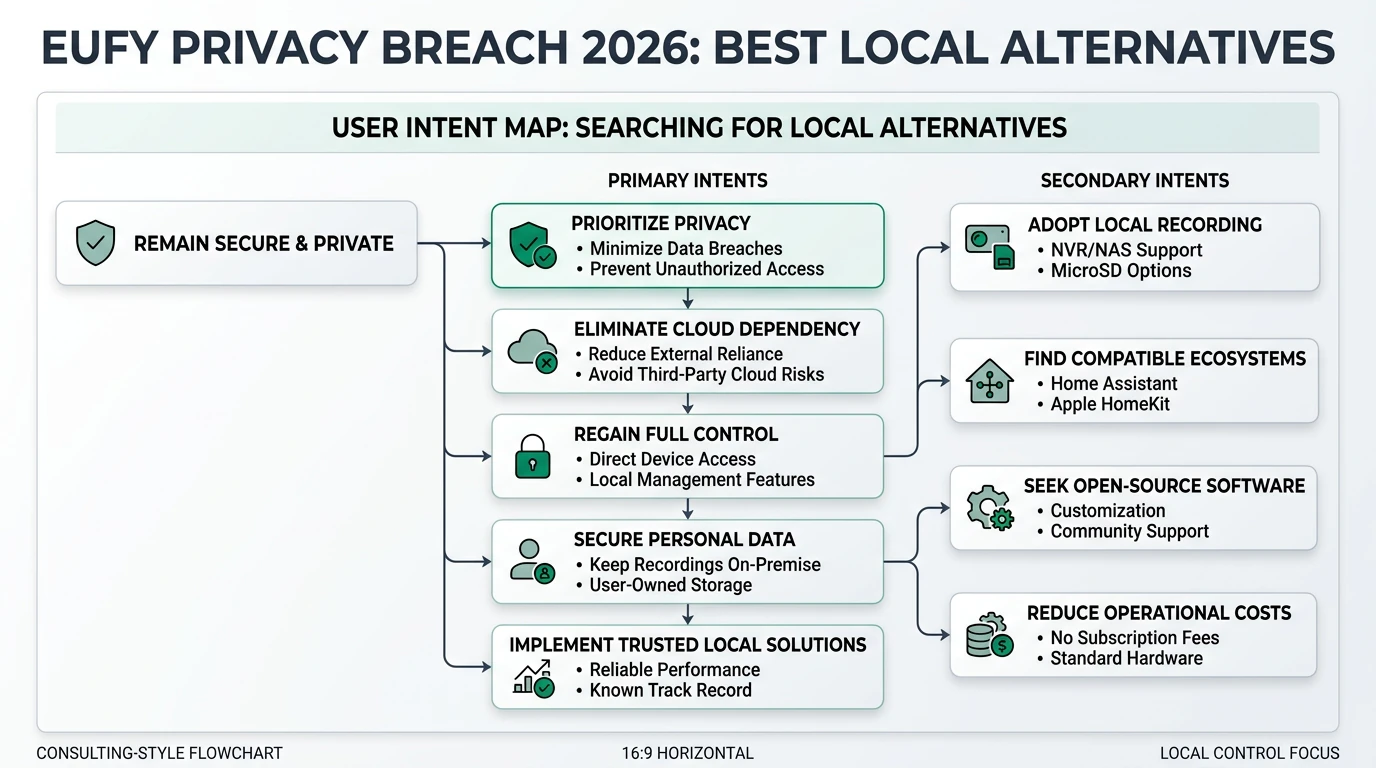
When considering alternatives to Eufy, privacy and local control are paramount. Users need systems that ensure data is stored and processed locally, minimizing exposure to external threats. This section explores key alternatives that prioritize these aspects, offering a secure and reliable solution for home security.
Home Assistant with Zigbee Cameras is a popular choice for those seeking a customizable and privacy-focused solution. By integrating Zigbee cameras like the Aqara G3 with Home Assistant, users can achieve full local processing and storage. The Frigate NVR addon enhances this setup by providing advanced video processing capabilities, all without relying on cloud services. This system supports multiple cameras and can be run on affordable hardware like the Raspberry Pi 5, making it an accessible option for privacy-conscious users5.
Reolink PoE Cameras offer another robust alternative, known for their ease of installation and local storage capabilities. These cameras support RTSP and ONVIF standards, allowing for seamless integration with various network video recorders (NVRs) and local storage solutions. With options for both PoE and battery-powered models, Reolink cameras provide flexibility in deployment while ensuring data remains within the user’s control. The absence of cloud dependencies further enhances their appeal for those prioritizing privacy5.
UniFi Protect Systems cater to users seeking enterprise-grade reliability with local storage. These systems utilize Ubiquiti hardware and offer comprehensive local control through their NVR solutions. With support for high-capacity storage and advanced video analytics, UniFi Protect provides a scalable solution for users with more extensive security needs. The system’s closed but local-only architecture ensures that data remains secure and accessible only to authorized users, making it a strong contender for privacy-focused individuals5.
In evaluating these alternatives, it’s crucial to consider the specific needs and preferences of the user. Each system offers unique advantages, from the flexibility and customization of Home Assistant to the plug-and-play simplicity of Reolink and the enterprise reliability of UniFi Protect. By prioritizing privacy and local control, users can select a solution that aligns with their security goals and mitigates the risks associated with cloud-dependent systems. The Home Assistant project and Reolink’s local-first approach are well-documented for privacy-conscious users.
| Alternative | Privacy | Offline | Setup | Best For |
|---|---|---|---|---|
| Home Assistant + Zigbee | Excellent | Yes | Complex | Tech-savvy users |
| Reolink PoE | Excellent | Yes | Easy | Plug-and-play |
| UniFi Protect | Excellent | Yes | Medium | Enterprise-grade |
| Feature | Home Assistant | Reolink | UniFi Protect |
|---|---|---|---|
| Local Storage | Yes | Yes | Yes |
| Cloud Optional | Yes | Yes | Yes |
| Open Standards | Yes | RTSP/ONVIF | Proprietary |
Privacy score comparison
| Product | Cloud required | Local storage | Mandatory account | Offline control | Score / 10 |
|---|---|---|---|---|---|
| Home Assistant + Zigbee | No | Yes | No | Yes | 9.5 |
| Reolink PoE | No | Yes | No | Yes | 9.0 |
| UniFi Protect | No | Yes | Optional | Yes | 8.5 |
Offline Reliability: Ensuring Continuous Operation
Offline reliability is a critical factor for users transitioning from cloud-dependent systems like Eufy to local alternatives. Ensuring that security systems remain operational without internet connectivity is essential for maintaining continuous surveillance and protection. This section examines how local alternatives achieve offline reliability and the benefits they offer.
Reolink PoE Cameras are renowned for their offline capabilities, providing reliable operation even in the absence of internet connectivity. These cameras store footage locally on microSD cards or network-attached storage (NAS), ensuring that video data is always accessible. The PoE models are particularly advantageous, as they receive both power and data through a single Ethernet cable, simplifying installation and reducing potential points of failure5.
Home Assistant with Zigbee Cameras offers offline reliability through its decentralized architecture. By processing and storing data locally, this system remains fully functional without internet access. The integration of Zigbee cameras with Home Assistant allows for seamless operation, even during network outages. Users can access live feeds and recorded footage directly from their local network, ensuring continuous surveillance and control5.
UniFi Protect Systems provide enterprise-grade offline reliability, with local storage solutions that ensure data is retained even during internet disruptions. The system’s NVR can store large volumes of footage, allowing for extended retention periods without relying on cloud services. This capability is particularly beneficial for users with extensive security needs, as it guarantees that critical data remains secure and accessible5.
The offline reliability of these systems not only enhances security but also reduces the risk of data breaches associated with cloud storage. By maintaining control over their data, users can ensure that their security systems remain operational and effective, regardless of external network conditions. This reliability is a key advantage for those seeking to transition from cloud-dependent systems to more secure, local alternatives.
Total Cost of Ownership: Long-Term Savings
When evaluating local alternatives to Eufy, the total cost of ownership (TCO) is an important consideration. Users need to assess not only the upfront costs but also the long-term expenses associated with maintaining their security systems. This section explores the TCO of various local alternatives, highlighting potential savings compared to cloud-dependent systems.
Reolink PoE Cameras offer a cost-effective solution with minimal ongoing expenses. The upfront cost of these cameras is competitive, and the absence of subscription fees further reduces long-term costs. With local storage options like microSD cards, users can avoid the recurring expenses associated with cloud storage, resulting in significant savings over time5.
Home Assistant with Zigbee Cameras provides a scalable solution with a relatively low TCO. While the initial setup may require an investment in hardware like the Raspberry Pi and Zigbee cameras, the absence of subscription fees and the ability to leverage existing infrastructure can lead to substantial savings. Additionally, the system’s flexibility allows users to expand their setup without incurring significant additional costs5.
UniFi Protect Systems have a higher upfront cost due to the need for specialized hardware, but they offer long-term savings through their local storage capabilities. By eliminating the need for cloud subscriptions, users can achieve a lower TCO over time. The system’s scalability and enterprise-grade reliability make it a worthwhile investment for users with extensive security needs5.
In comparing these alternatives, it’s clear that local systems offer significant cost advantages over cloud-dependent options. By eliminating subscription fees and leveraging local storage, users can achieve substantial savings while maintaining robust security and privacy. This cost-effectiveness is a key factor for those seeking to transition from Eufy to more secure, local alternatives.
Key Considerations for Choosing Local Alternatives
- Evaluate privacy features and local control capabilities.
- Assess offline reliability and continuous operation.
- Consider the total cost of ownership and potential savings.
- Ensure compatibility with existing infrastructure.
- Prioritize systems that offer scalability and flexibility.
Setup Complexity and Support
Transitioning to local security systems involves understanding the setup complexity and available support options. Users need to be aware of the installation process and the resources available to assist them in maintaining their systems. This section examines the setup complexity and support for various local alternatives.
Reolink PoE Cameras are known for their straightforward installation process. The PoE models are particularly easy to set up, requiring only a single Ethernet cable for both power and data. This plug-and-play approach minimizes setup complexity and allows users to quickly deploy their security systems. Reolink also offers a comprehensive support network, including forums and a two-year warranty, ensuring users have access to assistance when needed5.
Home Assistant with Zigbee Cameras involves a more complex setup process, particularly for users unfamiliar with open-source platforms. Installing Home Assistant on a Raspberry Pi and integrating Zigbee cameras requires some technical knowledge, but the extensive community support available can help users navigate this process. With over a million users, the Home Assistant community provides a wealth of resources and guidance for those willing to invest the time in setting up their systems5.
UniFi Protect Systems offer a balance between complexity and support. The initial setup involves adopting the NVR and configuring the cameras, which can be completed in about 30 minutes. Ubiquiti provides enterprise-grade support through its online portal, offering users access to comprehensive resources and assistance. This support infrastructure makes UniFi Protect a viable option for users seeking reliable and well-supported security solutions5.
Understanding the setup complexity and support options is crucial for users transitioning to local alternatives. By selecting a system that aligns with their technical expertise and support needs, users can ensure a smooth transition and maintain effective security without relying on cloud services.
FAQ
Frequently Asked Questions
What are the main privacy concerns with Eufy cameras?
Eufy cameras have faced scrutiny due to past privacy breaches, including a 2021 incident where a bug exposed live feeds to unauthorized users. Additionally, a 2022 settlement revealed that Eufy falsely advertised end-to-end encryption capabilities, leading to concerns about data security.
How do local alternatives ensure privacy and offline reliability?
Local alternatives like Home Assistant with Zigbee cameras, Reolink PoE systems, and UniFi Protect offer privacy by storing and processing data locally. These systems operate independently of cloud services, ensuring continuous operation even during internet outages.
What is the total cost of ownership for local security systems?
The total cost of ownership for local systems is generally lower than cloud-dependent options. By eliminating subscription fees and leveraging local storage, users can achieve significant savings over time while maintaining robust security.
How complex is the setup for local security systems?
Setup complexity varies among local systems. Reolink PoE cameras offer straightforward installation, while Home Assistant with Zigbee cameras requires more technical knowledge. UniFi Protect provides a balance between complexity and support, making it accessible for most users.
Are there any hidden costs associated with local security systems?
Local security systems typically have fewer hidden costs compared to cloud-dependent options. Users should consider potential expenses like hardware upgrades and electricity costs, but these are generally lower than ongoing subscription fees associated with cloud services.
Primary Sources Table
| ID | Title/Description | Direct URL |
|---|---|---|
| 1 | MacRumors: Eufy camera privacy breach (2021) | MacRumors |
| 2 | TechBrew: Eufy breach details (0.001% affected) | TechBrew |
| 3 | HomeKitNews: Eufy response to breach | HomeKitNews |
| 4 | TechHive: Eufy pledges security upgrades (712 users) | TechHive |
| 5 | NY AG: $450K Eufy settlement (no E2EE) | NY AG |
| 6 | Hunton: NY AG Eufy settlement details | Hunton |
| 7 | Eufy Privacy Policy (2026 update) | Eufy |
| 8 | Eufy: Detecting hacked cameras (general security) | Eufy Blog |
Conclusion
In conclusion, transitioning from Eufy to local security alternatives offers significant benefits in terms of privacy, offline reliability, and total cost of ownership. By choosing systems like Home Assistant with Zigbee cameras, Reolink PoE systems, or UniFi Protect, users can regain control over their security infrastructure and mitigate the risks associated with cloud-dependent systems. These local alternatives provide robust solutions for privacy-conscious individuals seeking to enhance their home security.
For further insights, consider exploring our guides on Apple HomeKit Secure Video vs Local NVR for Privacy, Best Local Storage Security Cameras Without Subscription 2026, and Best Open Source Smart Home Software for Privacy Advocates.