Comparisons
Home Assistant vs OpenHAB vs Homebridge Privacy 2026
Compare Home Assistant, OpenHAB, and Homebridge for privacy and local control in 2026.
Quick answer:
Executive Summary
In 2026, the demand for privacy-centric smart home solutions has never been higher. As users increasingly prioritize local control and offline reliability, open-source platforms like Home Assistant, OpenHAB, and Homebridge have become pivotal. These platforms offer varying degrees of privacy, offline functionality, and integration capabilities, making them suitable for different user needs. Home Assistant stands out for its extensive integrations and user-friendly interface, OpenHAB is lauded for its stability and low-latency operations, while Homebridge remains a favorite for those deeply embedded in the Apple ecosystem.
Bottom line: For most users seeking a balance of privacy, ease of use, and extensive device support, Home Assistant is the recommended choice in 2026.
Privacy and Local Control: A Deep Dive
Privacy is a paramount concern for smart home enthusiasts in 2026. The ability to control devices without relying on cloud services is not just a preference but a necessity for many. Home Assistant, OpenHAB, and Homebridge each offer unique approaches to ensuring user data remains local.
Home Assistant is designed with privacy at its core, allowing users to operate their smart home systems entirely offline. This is achieved through its robust local control capabilities, which eliminate the need for cloud authentication. Users can integrate a wide range of devices using protocols like Zigbee and MQTT, ensuring that data processing occurs locally. This local-first approach not only enhances privacy but also improves response times for device interactions.
OpenHAB also emphasizes local control, utilizing a plugin-based architecture that isolates device interactions within the local network. This design minimizes the risk of data exposure to external servers. OpenHAB’s “Things/Channels/Items” model provides a structured way to manage devices, ensuring that all operations can be conducted offline. This makes it a reliable choice for users who prioritize privacy and stability over frequent updates.
Homebridge, while primarily a bridge for HomeKit devices, also supports local control. It allows non-HomeKit devices to be integrated into the Apple ecosystem without sending data to the cloud. However, its reliance on plugins means that users must carefully manage and update these components to maintain privacy. Despite this, Homebridge remains a popular choice for users who want to extend HomeKit’s capabilities while keeping data local.
Offline Reliability: Ensuring Uninterrupted Operation
Offline reliability is crucial for smart home systems, particularly in scenarios where internet connectivity is unstable or unavailable. Each platform offers varying degrees of offline functionality, which can significantly impact user experience.
Home Assistant excels in offline reliability, thanks to its native support for MQTT and WebSocket protocols. These allow for near-instantaneous communication between devices, even when the internet is down. Users can create complex automations and control devices without any cloud dependency, ensuring that their smart home continues to function seamlessly.
OpenHAB is renowned for its stability and low-latency operations, making it a strong contender for users who require reliable offline performance. Its headless operation mode, accessible via REST and Karaf console, allows for efficient management of devices without a graphical interface. This can be particularly advantageous for advanced users who prefer a command-line approach to smart home management.
Homebridge, while capable of operating offline, is somewhat limited in terms of automation complexity. It relies heavily on the Home app for creating automations, which can restrict its functionality when compared to Home Assistant and OpenHAB. However, for users who primarily need a bridge to integrate non-HomeKit devices, Homebridge offers sufficient offline reliability.
Total Cost of Ownership: Evaluating Long-Term Expenses
When considering a smart home platform, it’s essential to evaluate the total cost of ownership (TCO) over time. This includes hardware costs, potential subscription fees, and the time investment required for maintenance and updates.
Home Assistant is free to use, with the primary cost being the hardware required to run it. A Raspberry Pi 5, priced around $100, is a popular choice for hosting Home Assistant. While there are optional cloud services like Nabu Casa, which costs $77.76 per year, these are not necessary for local operation. The community-driven nature of Home Assistant means that users have access to a wealth of free add-ons and integrations.
OpenHAB is similarly free, with the main expense being the hardware. It can run on a variety of platforms, including Raspberry Pi, Docker, and Synology NAS. OpenHAB’s stability means that users can expect fewer updates and less maintenance over time, reducing the time cost associated with managing the system.
Homebridge also has no direct costs, but users should be aware of the time investment required to maintain plugins and configurations. The hardware cost is similar to the other platforms, with a Raspberry Pi being a common choice. While Homebridge does not have any subscription fees, the reliance on community plugins means that users may need to invest time in troubleshooting and updates.
| Criterion | Home Assistant | OpenHAB | Homebridge |
|---|---|---|---|
| Privacy/Local Control | Fully local, offline-first; exposes to HomeKit via add-on. | Local network, plugin-based; strict modeling for isolation. | Local bridge for HomeKit; plugin-dependent, no native automations. |
| Offline Reliability | Native MQTT/WS; “near-instant” internal, but higher e2e latency in tests. | Lower e2e latency (WLED test); headless REST/Karaf. | Local web service; reliable for plugins but automation via Home app only. |
| TCO (est. 3-yr, Raspberry Pi 5) | Free core + $100 HW + $0 cloud opt.; community add-ons. | Free; $100 HW; stable, fewer updates. | Free; $50-100 HW; plugin maintenance burden. |
Migration Paths and Beginner Feasibility
Transitioning from a cloud-dependent smart home system to a local-first platform can be daunting, especially for beginners. Fortunately, each of these platforms offers pathways for migration and varying levels of user-friendliness.
Home Assistant is often praised for its beginner-friendly interface and rapid onboarding process. Its UI-first approach allows new users to quickly discover and integrate devices without delving into complex configurations. The platform’s extensive documentation and active community provide ample support for those transitioning from cloud-based systems.
OpenHAB, while more complex, offers a robust framework for users who require precise control over their smart home environment. Its headless operation mode and detailed configuration options make it ideal for users with technical expertise. However, beginners may find the learning curve steep, necessitating a commitment to understanding its unique architecture.
Homebridge is primarily aimed at users within the Apple ecosystem, offering a straightforward way to integrate non-HomeKit devices. Its reliance on plugins means that users must be comfortable with managing configurations and updates. While it lacks native automation capabilities, its simplicity makes it accessible for those who primarily need a bridge to extend HomeKit functionality.
Checklist
- Evaluate current cloud dependencies
- Identify compatible devices
- Choose a platform based on privacy needs
- Plan for hardware setup
- Test migration in a controlled environment
Integration with Smart Home Standards
In 2026, interoperability with smart home standards like MQTT and WebSocket is crucial for a seamless user experience. Each platform supports these standards to varying degrees, influencing their suitability for different setups.
Home Assistant offers extensive support for a wide range of protocols, including Zigbee, Thread, and MQTT. This makes it highly versatile, allowing users to integrate a diverse array of devices and services. Its service-call oriented architecture enables complex automations and interactions, making it a powerful tool for advanced users.
OpenHAB also supports MQTT and WebSocket, providing a flexible framework for integrating devices. Its “Things/Channels/Items” model allows for precise control over device interactions, making it ideal for users who require detailed customization. The platform’s Karaf console offers low-level access to system operations, appealing to technically inclined users.
Homebridge, while primarily focused on bridging devices to HomeKit, also supports MQTT through plugins. This allows users to extend HomeKit’s capabilities by integrating devices that do not natively support Apple’s ecosystem. However, its reliance on plugins means that users must carefully manage these components to ensure compatibility and functionality.
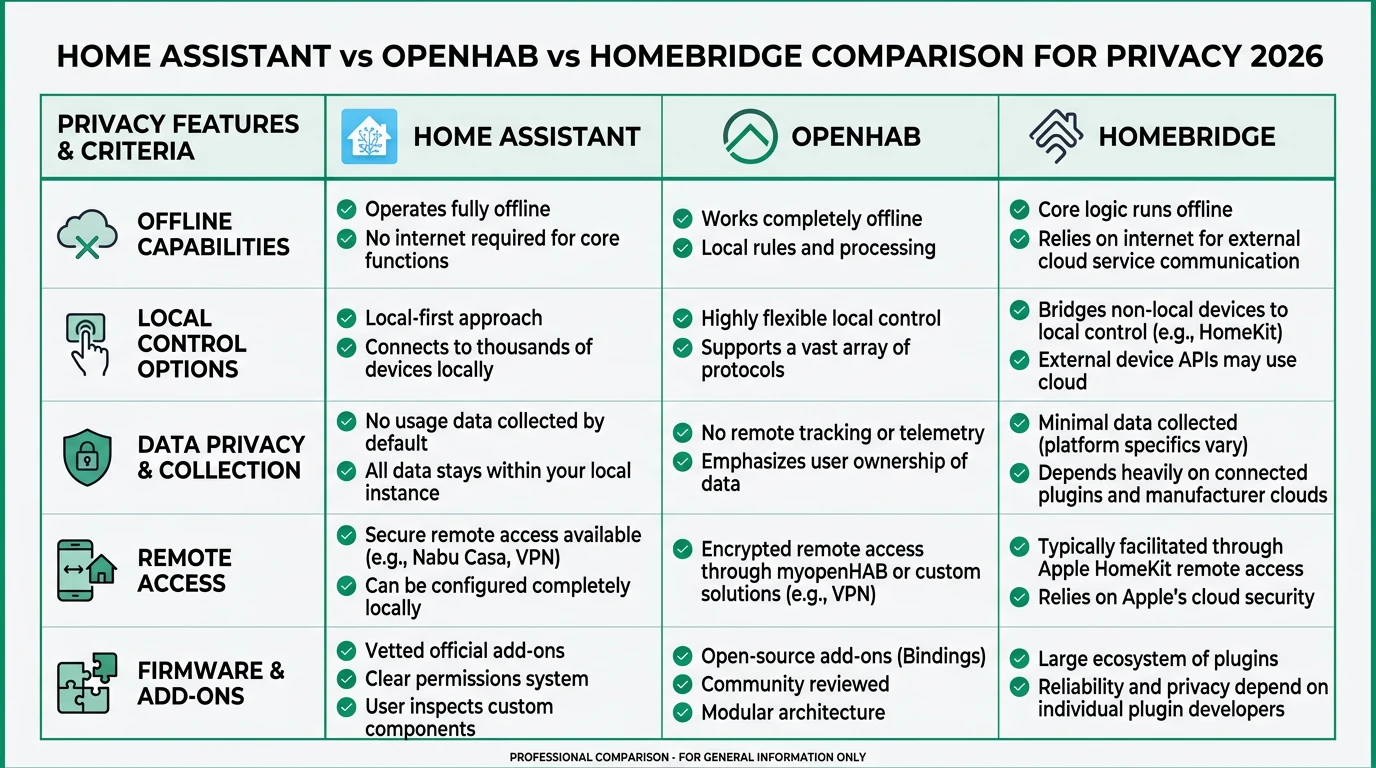
Security and Privacy Implications
Security and privacy are intertwined concerns for smart home users, particularly when it comes to data handling and system vulnerabilities. Each platform offers distinct advantages and challenges in this regard.
Home Assistant prioritizes local control, ensuring that user data is processed on the local network rather than being sent to the cloud. This significantly reduces the risk of data breaches and unauthorized access. However, the platform’s frequent updates can introduce breaking changes, requiring users to stay vigilant about system maintenance.
OpenHAB’s plugin-based architecture enhances privacy by isolating device interactions within the local network. Its stability and “set it and forget it” nature make it a reliable choice for users who prioritize security. The platform’s active community provides support for implementing security tweaks and addressing potential vulnerabilities.
Homebridge operates within the local network, emulating the HomeKit API to integrate non-HomeKit devices without relying on Apple’s cloud services. This local operation boosts privacy, but users must manage plugins carefully to avoid security risks. While Homebridge does not have official privacy audits, its community-driven nature means that users can benefit from shared knowledge and best practices.
FAQ
Frequently Asked Questions
Which platform offers the best privacy?
Home Assistant, OpenHAB, and Homebridge all prioritize local control, but Home Assistant offers the most extensive privacy features with its local-first design.
Can I run these platforms without an internet connection?
Yes, all three platforms can operate offline, ensuring that your smart home remains functional even without internet access.
What are the hardware requirements for these platforms?
A Raspberry Pi is a common choice for all three platforms, with costs ranging from $50 to $200 depending on the model and setup.
How do these platforms handle updates and maintenance?
Home Assistant requires frequent updates, OpenHAB is more stable with fewer updates, and Homebridge requires plugin management.
Is there a cost associated with using these platforms?
All three platforms are free to use, with the primary costs being hardware and any optional cloud services.
Primary Sources Table
| ID | Title/Description | Direct URL |
|---|---|---|
| 1 | Top 5 Home Assistant Alternatives (Reolink, incl. table) | Reolink |
| 2 | OpenHAB vs. Home Assistant: Faster/Easier (Better Devices) | Better Devices |
| 3 | HA Community: Migration from OpenHAB/Homebridge | Home Assistant Community |
| 4 | YouTube: OpenHAB vs Home Assistant (2026) | YouTube |
| 5 | YouTube: Home Assistant or Homebridge Unbiased | YouTube |
| 6 | OpenHAB Community: Comparison to HA | OpenHAB Community |
| 7 | XDA: Homebridge to Replace HA | XDA Developers |
| 8 | HA Community: Running Homebridge in 2026 | Home Assistant Community |
Conclusion
In 2026, choosing the right smart home platform involves balancing privacy, offline reliability, and integration capabilities. Home Assistant, OpenHAB, and Homebridge each offer unique strengths, making them suitable for different user needs. Home Assistant is ideal for those seeking extensive integrations and a user-friendly interface, OpenHAB excels in stability and low-latency operations, while Homebridge is perfect for HomeKit users looking to expand their ecosystem without compromising privacy.
For further exploration of smart home privacy, consider reading our guides on Apple HomeKit Secure Video vs Local NVR for Privacy, Best Hardware for Local AI Smart Home 2026, and Best Local LLMs for Home Automation 2026.