Smart Home Privacy
IFTTT Alternatives for Local Automation 2026
Explore privacy-focused, self-hosted IFTTT alternatives for local home automation with Node-RED and Home Assistant.
Quick answer: What replaces IFTTT for private, local automations?
Use Home Assistant for device integrations and automations entirely on your LAN, and add Node-RED (or HA’s built-in automations) when you need visual flow logic. Both avoid IFTTT’s cloud execution path and keep credentials off third-party servers.
Source: Home Assistant project
Executive Summary
In the evolving landscape of smart home automation, privacy and local control have become paramount. As users seek alternatives to IFTTT, which relies heavily on cloud services, solutions like Home Assistant and Node-RED stand out. These platforms offer robust, self-hosted environments that ensure data privacy and offline functionality, crucial for uninterrupted home automation. This guide provides a comprehensive comparison of these tools, focusing on privacy, offline reliability, and total cost of ownership. Read the Home Assistant architecture overview and Node-RED documentation for vendor-neutral grounding, then map workflows to our cloud-free smart home pillar and blocking devices from the internet.
Bottom line: For those prioritizing privacy and offline capabilities, Home Assistant and Node-RED are superior to IFTTT, offering extensive integrations and local control.
Why Consider IFTTT Alternatives for Local Automation?
The reliance on cloud-based services like IFTTT can pose significant privacy and reliability concerns for smart home enthusiasts. IFTTT’s cloud dependency means that any internet outage can disrupt your home automation setup, leaving you without control over your devices. Moreover, the limited free tier and potential silent failures add to the frustration. In contrast, local automation solutions like Home Assistant and Node-RED offer a self-hosted environment where your data remains private and accessible even without an internet connection.
Home Assistant and Node-RED are designed for users who value privacy and want to maintain control over their data. These platforms process data locally, eliminating the risk of data leaks associated with cloud services. Additionally, they support a wide range of integrations, allowing you to connect and automate various devices seamlessly. This local-first approach not only enhances privacy but also ensures that your smart home continues to function during internet outages.
The cost of maintaining a local automation setup is also a consideration. While IFTTT offers a Pro subscription at a relatively low cost, the hidden expenses of cloud dependency and potential data breaches can outweigh the initial savings. Home Assistant and Node-RED, on the other hand, are free to use, with costs primarily associated with hardware and maintenance. This makes them a cost-effective choice for those willing to invest in a self-hosted solution.
| Pattern | IFTTT | Local-first stack |
|---|---|---|
| Trigger evaluation | Cloud | Home Assistant core + optional Node-RED |
| Credentials | IFTTT account | Self-hosted users & API tokens on your LAN |
| Failure mode | Internet outage | Server hardware failure only (mitigate with backups) |
Privacy and Local Control: A Deep Dive
Privacy is a critical concern for smart home users, and local control is a key factor in ensuring that your data remains secure. IFTTT’s cloud-based model means that your data is processed on external servers, increasing the risk of unauthorized access and data breaches. In contrast, Home Assistant and Node-RED process data locally, providing a secure environment where your information is not shared with third parties.
Home Assistant is an open-source platform that emphasizes local-first processing. It supports over 2,000 integrations, allowing you to connect a wide range of devices without relying on cloud services. This extensive compatibility is achieved through the use of open standards like MQTT and Zigbee, which facilitate communication between devices in your home. Node-RED, with its visual flow editor, complements Home Assistant by enabling complex automation scenarios without compromising privacy.
Node-RED’s strength lies in its ability to create custom IoT logic through a user-friendly interface. It supports over 1,000 nodes, allowing you to build intricate automation flows tailored to your specific needs. By running on lightweight hardware like a Raspberry Pi, Node-RED ensures that your automation setup remains efficient and responsive, even in the absence of an internet connection.
Offline Reliability: Ensuring Uninterrupted Automation
One of the main drawbacks of cloud-dependent services like IFTTT is their reliance on an active internet connection. Any disruption in connectivity can lead to a complete halt in your home automation processes. This is where local solutions like Home Assistant and Node-RED excel, as they are designed to operate independently of the internet, ensuring that your smart home remains functional even during outages.
Home Assistant’s ability to work offline is a significant advantage for users who experience frequent internet disruptions. With support for over 2,000 devices, Home Assistant can manage a wide array of smart home products without needing to connect to external servers. This offline capability is particularly beneficial for critical automation tasks, such as security systems and lighting controls, which must remain operational at all times.
Node-RED also offers robust offline functionality, thanks to its support for protocols like MQTT and Zigbee. These protocols enable direct communication between devices, bypassing the need for cloud-based intermediaries. By leveraging these open standards, Node-RED ensures that your automation flows continue to run smoothly, regardless of your internet status.
Cost Analysis: Total Cost of Ownership
When evaluating alternatives to IFTTT, it’s essential to consider the total cost of ownership (TCO) associated with each platform. While IFTTT offers a Pro subscription at $2.49 per month, the hidden costs of cloud dependency and potential data breaches can add up over time. In contrast, Home Assistant and Node-RED are free to use, with costs primarily related to hardware and maintenance.
Home Assistant’s core software is free, with an optional cloud service available for $75 per year. The hardware requirements are modest, with a Raspberry Pi 5 and an SD card being sufficient for most setups. The total first-year TCO for Home Assistant ranges from $75 to $185, depending on your hardware choices and whether you opt for the cloud service.
Node-RED is also free to use, with similar hardware requirements to Home Assistant. The primary costs associated with Node-RED are related to hardware and electricity, making it an affordable option for those looking to implement a self-hosted automation solution. The absence of subscription fees further enhances its cost-effectiveness, especially for users who prefer a lightweight, edge-friendly platform.
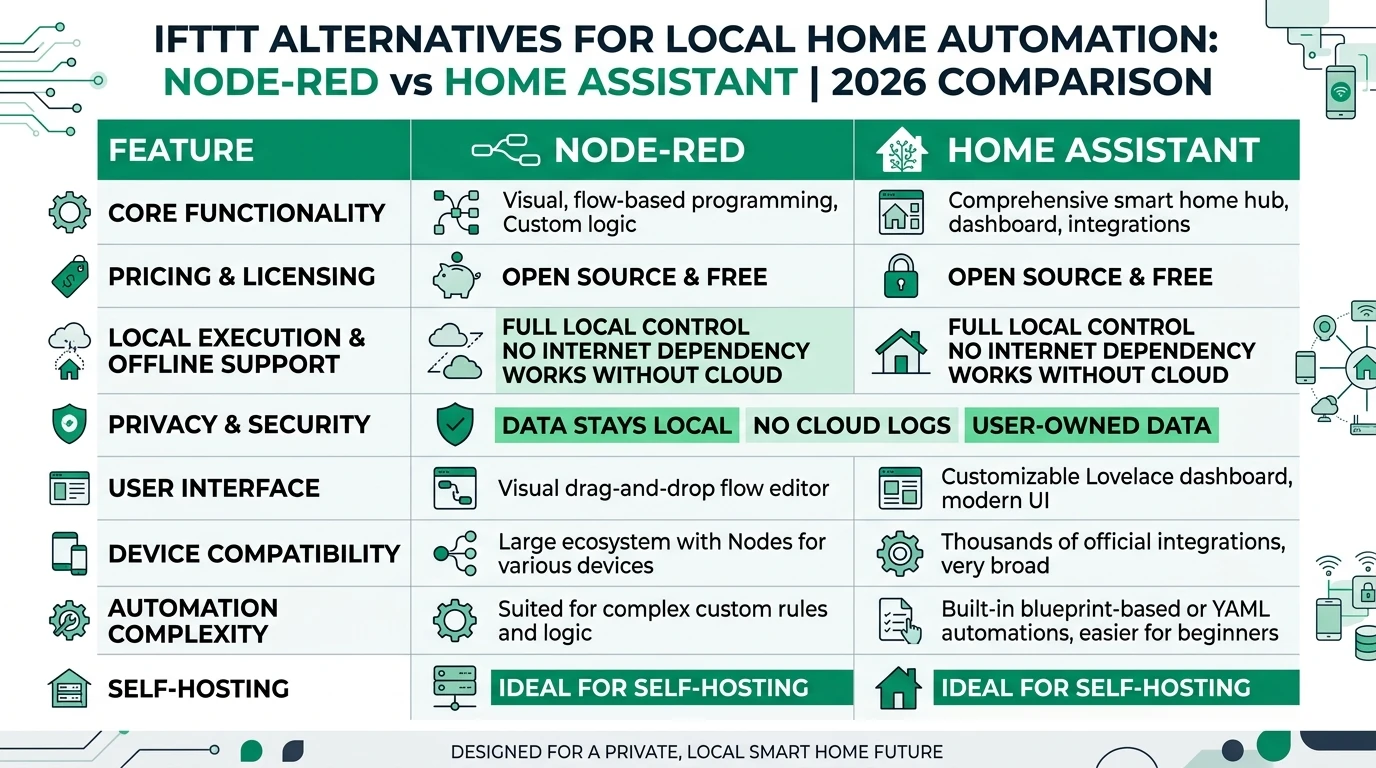
| Criterion | IFTTT (Baseline) | Home Assistant | Node-RED |
|---|---|---|---|
| Privacy/Local | Cloud-only, data shared | Fully local, open-source | Fully local, open-source |
| Offline Reliability | Fails without internet | Works offline (1,300-2,000+ integrations) | Works offline (MQTT/Zigbee support) |
| Integrations | Limited (cloud IoT) | 2,000+ devices | 1,000+ nodes (flows via npm) |
| TCO (1st Year) | $2.49/mo Pro (~$30) | Free software; $75/yr Cloud optional; Raspberry Pi ~$50 | Free; Raspberry Pi ~$50 |
Setup Complexity and Support
Setting up a local automation system with Home Assistant or Node-RED requires a certain level of technical expertise. Unlike IFTTT, which offers a simple, no-code interface, these platforms demand familiarity with concepts like YAML configuration and Docker. However, the investment in time and effort is rewarded with a more secure and reliable automation setup.
Home Assistant’s setup process can be challenging for beginners, as it involves command-line installation and configuration through YAML files. The initial setup on a Raspberry Pi typically takes 1-2 hours, but the extensive community support available through forums and Discord channels can help ease the learning curve. Once configured, Home Assistant offers a robust platform with over 1,300 integrations available out-of-the-box.
Node-RED, on the other hand, offers a more intuitive setup experience with its browser-based user interface and drag-and-drop flow editor. The setup process is relatively straightforward, taking around 30 minutes to complete. Node-RED’s use of npm for node installation allows for easy expansion of its capabilities, making it a versatile choice for users looking to create custom automation flows.
Checklist
- Assess your technical skills before choosing a platform
- Consider the time investment for setup and maintenance
- Explore community resources for support
- Evaluate the need for custom automation flows
- Plan for hardware and electricity costs
Security and Privacy Implications
Security and privacy are paramount when it comes to home automation. IFTTT’s cloud-based model poses inherent risks, such as data breaches and unauthorized access to your personal information. In contrast, Home Assistant and Node-RED prioritize local control, ensuring that your data remains secure and private.
Home Assistant processes all data on-premises, eliminating the need for external servers unless you opt for the optional cloud service. Its open-source nature means that the code is regularly audited by the community, ensuring that vulnerabilities are quickly identified and addressed. Node-RED also benefits from its open-source status, with secure Node.js flows and support for TLS/MQTT security protocols.
While local control offers significant privacy advantages, it also places the responsibility for security updates on the user. Regularly updating your software and hardware is crucial to protect against vulnerabilities, such as those found in unpatched Zigbee devices. By staying informed about security advisories and best practices, you can maintain a secure and private home automation setup.
FAQ
Frequently Asked Questions
Why should I consider alternatives to IFTTT for home automation?
IFTTT relies on cloud services, which can lead to privacy concerns and disruptions during internet outages. Alternatives like Home Assistant and Node-RED offer local control and offline reliability.
What are the main benefits of using Home Assistant?
Home Assistant provides extensive integrations, local data processing, and offline functionality, making it a robust choice for privacy-focused users.
How does Node-RED compare to Home Assistant?
Node-RED excels in creating custom automation flows with its visual editor, while Home Assistant offers a comprehensive platform with a wide range of integrations.
What are the costs associated with setting up a local automation system?
The primary costs include hardware (e.g., Raspberry Pi), electricity, and maintenance time. Both Home Assistant and Node-RED are free to use.
Is technical knowledge required to set up Home Assistant or Node-RED?
Yes, both platforms require some technical expertise for setup and configuration, but extensive community resources are available to assist users.
Primary Sources Table
| Index | Title/Description | Direct URL |
|---|---|---|
| 1 | The 8 Best IFTTT Alternatives in 2026 (Adaptive.ai; covers Home Assistant, n8n) | https://adaptive.ai/blog/best-ifttt-alternatives |
| 2 | IFTTT Alternatives 2026: Top Competitors Compared (Checkthat.ai; Home Assistant spotlight) | https://checkthat.ai/brands/ifttt/alternatives |
| 3 | Top 10 IFTTT Alternatives & Competitors in 2026 - G2 (Zapier focus, alternatives list) | https://www.g2.com/products/ifttt/competitors/alternatives |
| 4 | TOP 8 IFTTT Alternatives - Latenode Blog (Pricing, features for various tools) | https://latenode.com/blog/platform-comparisons-alternatives/automation-platform-comparisons/top-8-ifttt-alternatives |
| 5 | Best 15 IFTTT Alternatives in 2026 - Software Advice (Features/integrations comparisons) | https://www.softwareadvice.com/bi/ifttt-profile/alternatives/ |
Conclusion
In the quest for a reliable and private home automation solution, Home Assistant and Node-RED emerge as strong contenders against IFTTT. Their local-first approach ensures data privacy and offline functionality, making them ideal for users who prioritize security and control. While the setup may require technical expertise, the benefits of a self-hosted system far outweigh the initial challenges.
Explore related guides for more insights into smart home privacy and hardware options: