Comparisons
Local Facial Recognition: Frigate CompreFace vs Double Take
Explore the privacy-focused comparison of local facial recognition setups using Frigate with CompreFace versus Double Take for home automation.
Quick answer:
Executive Summary
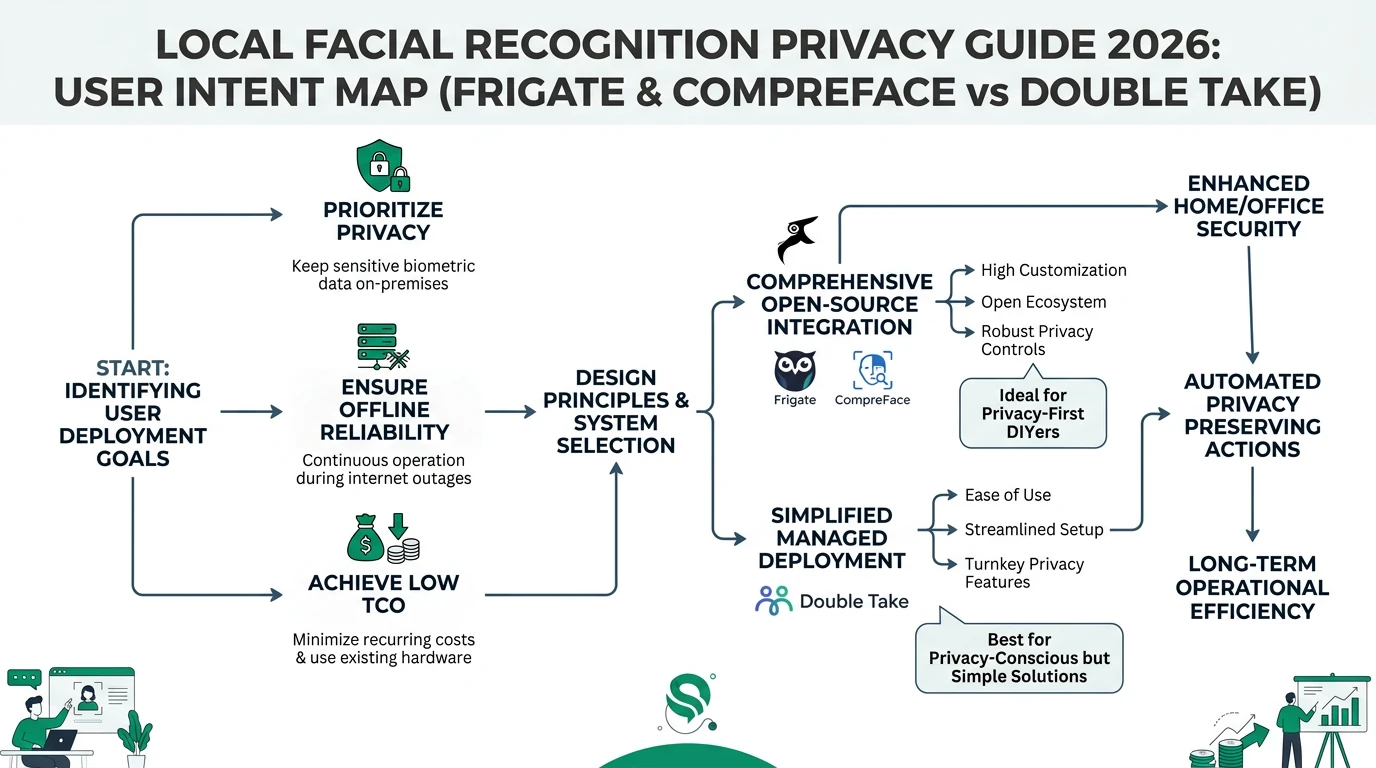
In the evolving landscape of home automation, privacy and reliability are paramount, especially when it comes to facial recognition technology. This guide provides a detailed comparison between two popular local facial recognition setups: Frigate paired with CompreFace and Double Take. Both systems offer unique advantages tailored to privacy-conscious users seeking offline reliability and low total cost of ownership (TCO). CompreFace, when integrated with Frigate, delivers a straightforward, privacy-first solution with robust local control and minimal setup complexity. On the other hand, Double Take offers enhanced flexibility through its multi-detector capabilities, albeit with a slightly higher setup burden and potential for cloud failover.
Bottom line: For users prioritizing privacy and simplicity, CompreFace with Frigate is the recommended choice. However, those seeking advanced features and multi-detector support may find Double Take more suitable.
Privacy and Local Control
Privacy is a critical concern for users deploying facial recognition systems in their homes. Both CompreFace and Double Take offer solutions that prioritize local data processing, ensuring that sensitive information remains within the user’s control. CompreFace, when used with Frigate, operates entirely offline, leveraging local APIs to process facial recognition data without any cloud dependency1. This setup is ideal for users who are particularly concerned about data leaks and privacy breaches.
Double Take, while also supporting local processing, introduces an additional layer of flexibility by aggregating data from multiple detectors, including CompreFace. This allows for a more comprehensive approach to facial recognition but introduces the potential for cloud failover if not carefully configured2. Users must ensure that all settings are optimized to maintain local control, avoiding any unintended data transmission to external servers.
The choice between these systems often hinges on the user’s comfort level with potential privacy trade-offs. CompreFace’s isolated API and lack of external model dependencies make it a robust choice for those who prioritize absolute local control. In contrast, Double Take’s aggregation capabilities may appeal to users who require a more versatile system, provided they are diligent in managing privacy settings.
Offline Reliability
Offline reliability is another crucial factor for users seeking to implement facial recognition technology in their homes. Both CompreFace and Double Take can function without internet connectivity, ensuring that the system remains operational even in the event of network outages. CompreFace, in particular, excels in this area, offering a fully offline experience when paired with Frigate23. This makes it an attractive option for users who live in areas with unreliable internet service or who prefer to minimize their dependence on cloud-based solutions.
Double Take also supports offline operation, provided that it is configured to use only local detectors. This setup can be particularly beneficial for users who wish to leverage the strengths of multiple facial recognition systems while maintaining offline reliability2. However, the added complexity of managing multiple detectors may increase the likelihood of configuration errors, which could impact the system’s overall reliability.
For users who prioritize offline reliability above all else, CompreFace with Frigate offers a straightforward, dependable solution. Those who require the flexibility of a multi-detector setup should carefully consider the potential trade-offs in terms of complexity and reliability.
Total Cost of Ownership (TCO)
When evaluating facial recognition systems, the total cost of ownership (TCO) is an important consideration. Both CompreFace and Double Take are open-source solutions, meaning there are no licensing fees associated with their use. However, the TCO can vary significantly depending on the hardware and configuration choices made by the user.
CompreFace, when deployed on existing hardware alongside Frigate, offers a cost-effective solution with minimal additional expenses. The primary costs are associated with the hardware itself, such as an Intel NUC and Coral TPU, which can be a one-time investment of approximately $2002. The ongoing costs, such as electricity, are relatively low, estimated at around $10 per year2.
Double Take, while also leveraging existing hardware, may incur additional costs due to its multi-detector capabilities. The need for an extra container can increase power consumption slightly, adding approximately $5 per year to the TCO2. Additionally, users may need to invest more time in configuring and maintaining the system, which could translate to higher indirect costs.
Ultimately, the choice between these systems should consider both the direct and indirect costs associated with their deployment. CompreFace offers a lower TCO for users seeking a straightforward, maintenance-free solution, while Double Take provides additional features at a slightly higher cost.
Deployment Checklist
- Ensure all components are configured for local processing.
- Verify hardware compatibility with Frigate and CompreFace.
- Optimize settings to minimize false positives.
- Regularly update software to maintain security and functionality.
- Consider power consumption and hardware costs in TCO calculations.
Accuracy and Performance
Accuracy is a key metric for evaluating facial recognition systems, as it directly impacts the effectiveness of the technology in real-world scenarios. CompreFace, when paired with Frigate, offers high accuracy levels, with confidence thresholds that can be tuned to achieve over 98% accuracy3. This makes it a reliable choice for users who require precise facial recognition capabilities.
Double Take, which aggregates data from multiple detectors, can match the accuracy of CompreFace when configured correctly12. However, the added complexity of managing multiple detectors may introduce variability in performance, particularly if the system is not optimized for the specific use case.
Users should consider the accuracy requirements of their specific application when choosing between these systems. CompreFace’s straightforward configuration and high accuracy make it a strong contender for most users, while Double Take’s flexibility may appeal to those with more complex needs.
Setup Complexity and Support
The complexity of setting up a facial recognition system can be a significant barrier for users, particularly those without extensive technical expertise. CompreFace, when used with Frigate, offers a relatively straightforward setup process, with Docker installation and API key configuration taking approximately 8-15 minutes4. Users will need to provide 5-10 training images per person to achieve optimal accuracy, and tuning the detection probability threshold can further enhance performance3.
Double Take, while offering additional features, requires a more complex setup process. Users must configure an extra container and manage multi-detector YAML configurations, which can take 20-25 minutes4. The added complexity of setting up Home Assistant automations may also increase the overall setup burden.
Support for both systems is primarily community-driven, with active discussions on GitHub and Home Assistant forums12. While this provides a wealth of information and troubleshooting tips, users should be prepared for a potentially higher support burden compared to commercial solutions with dedicated support teams.
Security and Privacy Implications
Security and privacy are paramount when deploying facial recognition technology in a home environment. Both CompreFace and Double Take offer robust security features, with 100% local control ensuring that no data leaves the premises25. This is a significant advantage over cloud-based solutions, which may expose sensitive data to external threats.
CompreFace’s isolated API and lack of external model dependencies further enhance its security profile, reducing the risk of data leaks or unauthorized access1. However, users must ensure that the system is properly configured and trained to avoid false positives, which could compromise security.
Double Take, while offering additional flexibility, introduces potential security risks if not configured correctly. The abstraction layer and potential for cloud failover require careful management to maintain local control and prevent data leaks2. Users should regularly review their configuration settings and update software to mitigate these risks.
Primary Sources Table
Conclusion
In conclusion, the choice between CompreFace with Frigate and Double Take depends largely on the user’s specific needs and priorities. CompreFace offers a straightforward, privacy-focused solution with robust offline reliability and low TCO, making it ideal for users who prioritize simplicity and security. Double Take, with its multi-detector capabilities, provides additional flexibility and advanced features, albeit with a higher setup burden and potential privacy trade-offs.
For further insights into local facial recognition and home automation, explore our related guides on Apple HomeKit Secure Video vs Local NVR for Privacy, Best Hardware for Local AI Smart Home 2026, and Best Local Storage Security Cameras Without Subscription 2026.
Frequently Asked Questions
What is the primary advantage of using CompreFace with Frigate?
CompreFace with Frigate offers complete local control and offline reliability, ensuring that no data leaves the premises, which is ideal for privacy-conscious users.
How does Double Take enhance facial recognition capabilities?
Double Take aggregates data from multiple detectors, providing enhanced flexibility and the ability to leverage the strengths of different facial recognition systems.
What are the potential privacy risks associated with Double Take?
If not configured correctly, Double Take’s cloud failover capabilities could inadvertently transmit data to external servers, compromising privacy.
What is the estimated total cost of ownership for these systems?
CompreFace with Frigate has an estimated TCO of ~$50 over three years, while Double Take’s TCO is slightly higher at ~$100 due to additional configuration and maintenance requirements.
Can these systems operate without an internet connection?
Yes, both CompreFace and Double Take can function offline, ensuring reliability even in the event of network outages.
Footnotes
-
https://community.home-assistant.io/t/facial-recognition-room-presence-using-double-take-frigate/290943?page=5 ↩ ↩2 ↩3 ↩4 ↩5
-
https://github.com/jakowenko/double-take/issues/343 ↩ ↩2 ↩3 ↩4 ↩5 ↩6 ↩7 ↩8 ↩9 ↩10 ↩11
-
https://github.com/exadel-inc/CompreFace/discussions/1011 ↩ ↩2 ↩3 ↩4
-
https://www.devopsschool.com/blog/top-10-facial-recognition-software-tools-in-2025-features-pros-cons-comparison/ ↩ ↩2
-
https://slashdot.org/software/comparison/CompreFace-vs-Face-SDK/ ↩
-
https://www.techradar.com/pro/will-2026-be-the-year-facial-recognition-becomes-boring-and-why-does-it-matter ↩