Comparisons
Local-Only Smart Home for High-Security Offices 2026
Explore the best local-only smart home systems for high-security home offices, focusing on privacy, offline functionality, and network isolation.
Quick answer: What are the best local-only smart home systems for high-security home offices in 2026?
For high-security home offices in 2026, local-only smart home systems offer unparalleled privacy and control. Key options include Home Assistant for tech-savvy users and SimpliSafe for those seeking ease of use. Prioritize systems with local processing, offline operation, and network isolation to ensure data sovereignty and compliance with data residency requirements.
Executive Summary
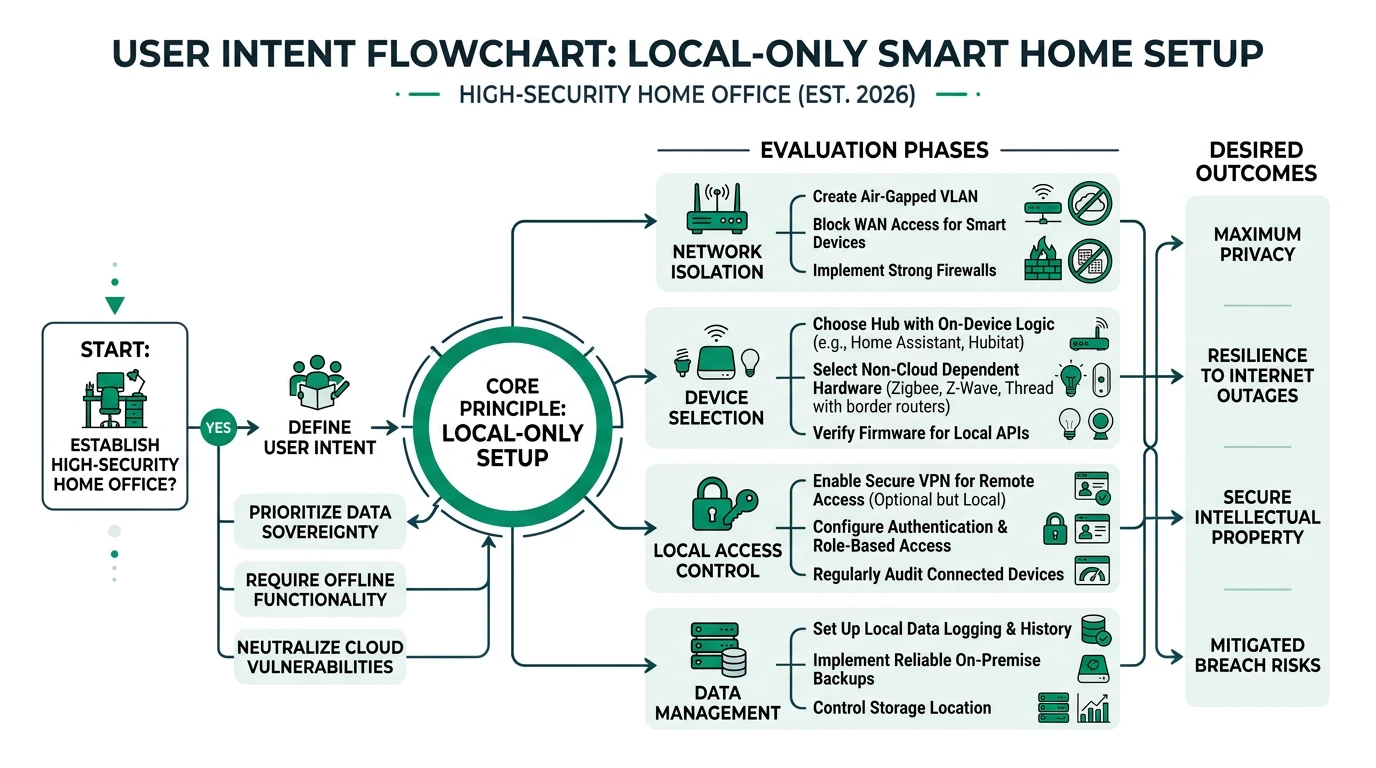
In 2026, the demand for local-only smart home setups in high-security home offices is driven by the need for data sovereignty, offline functionality, and network isolation. Professionals working with sensitive information require systems that operate independently of cloud infrastructure, ensuring that data remains within the confines of their home network. This guide explores the best options available, focusing on systems that process data locally, function during internet outages, and offer robust network isolation features.
The bottom line is that while local-only systems may require more initial setup and technical know-how, they provide unmatched privacy and control, making them the ideal choice for high-security environments.
Understanding Local-Only Smart Home Systems
Local-only smart home systems are designed to operate independently of cloud services, prioritizing data sovereignty and privacy. These systems process all data locally, ensuring that sensitive information never leaves the premises. This is particularly crucial for high-security home offices where data breaches could have severe consequences. By eliminating cloud dependencies, these systems also maintain functionality during internet outages, a critical feature for uninterrupted security monitoring.
For instance, Home Assistant, a leading platform for local-only setups, runs on dedicated hardware and supports a wide range of integrations through open standards like MQTT, Zigbee, and Z-Wave1. This flexibility allows users to create complex automation scenarios without relying on external servers. Similarly, local storage camera systems like the aosu SolarCam D1 Classic and eufy video doorbells provide reliable monitoring with local storage options, ensuring continuous operation even when the internet is down23.
However, not all systems marketed as “local” truly operate independently of the cloud. It’s essential to verify that the system can function without internet access and that all data processing occurs on-premises. This often requires consulting vendor documentation or conducting tests to ensure compliance with local-only requirements.
Key Criteria for Selecting Local-Only Systems
When selecting a local-only smart home system, several critical criteria must be considered to ensure it meets the needs of a high-security home office. Local processing is paramount, as it ensures that all video and sensor data are handled on-site, reducing the risk of data breaches associated with cloud storage. Systems like Home Assistant excel in this area, offering robust local processing capabilities1.
Offline operation is another critical factor. A reliable system should continue to function during internet outages, maintaining security monitoring and automation tasks. This is where systems with local storage, such as the aosu SolarCam D1 Classic, shine, as they can record and store footage without relying on an internet connection2.
Network isolation is also essential for high-security environments. The ability to segregate the security system from the primary home network prevents unauthorized access and ensures that sensitive data remains protected. Professional installations often emphasize the importance of a strong Wi-Fi and wiring infrastructure to support this level of isolation4.
Finally, consider the integration with open standards and the complexity of installation. Systems that support non-proprietary protocols offer greater flexibility and future-proofing, while those with DIY installation capabilities can reduce costs and increase user control.
| System | Local Processing | Offline | Setup | Best For |
|---|---|---|---|---|
| Home Assistant | Yes | Yes | Complex | Tech-savvy |
| SimpliSafe | Yes | Yes | Easy | DIY users |
| Ring Alarm | Partial | Partial | Easy | Budget |
| Feature | Home Assistant | SimpliSafe | Ring |
|---|---|---|---|
| Cloud Optional | Yes | Yes | No |
| Network Isolation | Yes | Yes | Limited |
| Open Standards | Yes | No | No |
Privacy score comparison
| Product | Cloud required | Local storage | Mandatory account | Offline control | Score / 10 |
|---|---|---|---|---|---|
| Home Assistant | No | Yes | No | Yes | 9.5 |
| SimpliSafe | Optional | Yes | Optional | Yes | 8.0 |
| Ring Alarm | Partial | Limited | Yes | Partial | 6.5 |
Product Ecosystem: Options and Limitations
The product ecosystem for local-only smart home systems in 2026 offers a range of options, each with its strengths and limitations. Home Assistant is a standout choice for those with technical proficiency, offering unparalleled control and customization through its local-first architecture1. It supports a wide array of devices and protocols, making it a versatile option for complex automation needs.
Local storage camera systems, such as those offered by aosu and eufy, provide reliable monitoring solutions with features like solar power and infrared night vision23. These systems are ideal for users who prioritize offline operation and energy independence. However, they may require additional investment in storage solutions if the built-in capacity is insufficient.
Conversely, systems like Ring and SimpliSafe offer more user-friendly options with DIY installation and optional professional monitoring35. While these systems provide convenience and affordability, they often rely on cloud connectivity for advanced features, which may not align with strict local-only requirements.
It’s crucial to evaluate each system’s capabilities and limitations in the context of your specific security needs. For instance, while Ring offers a cost-effective solution with optional monitoring, its reliance on cloud services for certain functionalities may not be suitable for environments with stringent data sovereignty requirements3.
Checklist
- Verify local processing and offline operation
- Ensure network isolation for security devices
- Check data residency and compliance requirements
- Evaluate integration with open standards (MQTT, Zigbee, Z-Wave)
- Assess setup complexity and support options
Security and Privacy Implications
Security and privacy are at the forefront of considerations for local-only smart home systems. By processing data locally, these systems significantly reduce the risk of data breaches associated with cloud storage. This is particularly important for high-security home offices where sensitive information must remain protected from external threats.
Data sovereignty is a key benefit of local-only setups. Systems like Home Assistant ensure that all data, including security footage and automation logic, remains within the home network, eliminating the need for external data transmission1. This approach not only enhances privacy but also ensures compliance with data residency requirements.
Network isolation further enhances security by preventing unauthorized access to the security system. Professional installations often include dedicated network segments for security devices, ensuring that they operate independently of the primary home network4. This separation is crucial for maintaining the integrity of sensitive data.
However, it’s important to consider the potential privacy implications of advanced features like facial recognition. While systems like ADT offer convenient features such as Trusted Neighbor access, they also introduce privacy considerations that must be weighed against organizational data handling policies5.
Setup Complexity and Support Considerations
The complexity of setting up a local-only smart home system can vary significantly depending on the chosen platform and the user’s technical proficiency. Systems like Home Assistant require a higher level of technical expertise, as they involve configuring local network settings, MQTT protocols, and automation logic1. This makes them suitable for users comfortable with command-line interfaces and network troubleshooting.
In contrast, commercial systems like Ring and SimpliSafe offer more straightforward installation processes with intuitive mobile apps for configuration36. These systems are designed for DIY installation, making them accessible to users with limited technical knowledge. However, they may not offer the same level of customization and control as more complex platforms.
Professional installation is an option for those who prefer a hands-off approach. Installers typically assess the home layout, design sensor and camera placement, and handle the full installation process4. This approach ensures optimal system performance and can be particularly beneficial in complex environments with specific security needs.
Support is another critical consideration. While commercial systems provide vendor support and documentation, platforms like Home Assistant rely on community forums and self-directed troubleshooting1. For home offices where downtime is costly, the availability of reliable support can be a deciding factor.
Price Model and Hidden Costs
The cost of implementing a local-only smart home system can vary widely based on the chosen platform and additional features. Equipment costs for average-sized homes typically range from $200 to $800, depending on system sophistication5. For example, the eufy Video Doorbell is priced at $129.99, offering a cost-effective solution for local storage and monitoring3.
Professional monitoring is an optional expense, with subscriptions ranging from $10 to $60 per month5. Ring offers a low-cost option at $20 per month or $200 per year, providing a significant cost advantage for self-monitored setups3. However, it’s important to consider potential hidden costs, such as network infrastructure upgrades, replacement batteries for wireless sensors, and ongoing maintenance.
Long-term cost analysis should also account for the total cost of ownership, including installation labor, network infrastructure, and multi-year subscription commitments. While initial equipment costs may be low, additional expenses can accumulate over time, impacting the overall affordability of the system.
FAQ
Frequently Asked Questions
What is a local-only smart home system?
A local-only smart home system operates independently of cloud services, processing all data locally to ensure privacy and offline functionality.
Why is local processing important for high-security home offices?
Local processing ensures that sensitive data remains within the home network, reducing the risk of data breaches associated with cloud storage.
Can local-only systems function during internet outages?
Yes, systems with local storage and processing capabilities can continue to operate during internet outages, maintaining security monitoring and automation tasks.
What are the benefits of network isolation in smart home systems?
Network isolation prevents unauthorized access to the security system, ensuring that sensitive data remains protected from external threats.
How do I choose the right local-only system for my home office?
Consider factors such as local processing capabilities, offline operation, network isolation, and your technical proficiency to select a system that meets your specific security needs.
Primary Sources Table
| Source | URL | Publication Date | Relevance | Data Quality |
|---|---|---|---|---|
| EPS Online | https://eps-online.com/2026/02/06/home-security-installation-houston/ | February 6, 2026 | Houston-specific installation practices, local weather considerations, professional setup process | High for regional context; limited technical specifications |
| AOSU Life | https://www.aosulife.com/blogs/smart-home/best-home-security-systems-in-2025-smart-and-budget-friendly | 2025-2026 | Local storage camera systems, solar-powered options, product bundles and pricing | Medium; marketing-oriented content |
| Security.org | https://www.security.org/smart-home/ | 2025 Guide (current as of 2026) | Ring Alarm specifications, professional monitoring costs, smart platform integrations, comparative features | High for commercial DIY systems; limited local-only analysis |
| SafeHome.org | https://www.safehome.org/security-systems/ | 2025 Guide (current as of 2026) | Equipment cost ranges, connectivity options, professional monitoring pricing, ADT and SimpliSafe positioning | High for cost and feature comparison; limited technical depth |
| Consumer Reports | https://www.consumerreports.org/home-garden/home-security-systems/best-diy-home-security-systems-of-the-year-a7270683122/ | 2025 (current as of 2026) | DIY system satisfaction metrics, professional monitoring options, vendor support quality | High for consumer satisfaction data; limited technical specifications |
| YouTube (TechTRX) | https://www.youtube.com/watch?v=t_IIP90ixKE | 2026 | Home Assistant local-only architecture, MQTT integrations, automation logic, offline-first design | High for local-only implementation; technical audience |
Conclusion
In conclusion, local-only smart home systems offer a robust solution for high-security home offices, prioritizing privacy and control over convenience. By focusing on local processing, offline functionality, and network isolation, these systems ensure that sensitive data remains protected and accessible even during internet outages. While they may require more technical expertise and initial setup, the benefits of data sovereignty and compliance with data residency requirements make them an ideal choice for professionals handling sensitive information.
Explore more on related topics:
- Apple HomeKit Secure Video vs Local NVR for Privacy
- Best Local Storage Security Cameras Without Subscription 2026
- Best Open Source Smart Home Software for Privacy Advocates