Comparisons
Local Voice Assistant Without Amazon or Google 2026
Explore local voice assistants for smart homes in 2026, focusing on privacy, offline reliability, and low TCO without Amazon or Google.
Quick answer:
Executive Summary
In 2026, the landscape of smart home voice assistants is evolving, with a growing emphasis on privacy and offline functionality. Users are increasingly seeking alternatives to Amazon and Google, driven by concerns over data privacy and cloud dependency. This guide explores local voice assistants that operate entirely offline, offering robust privacy, reliable local control, and low total cost of ownership (TCO). We evaluate options like Home Assistant Voice PE, OpenHAB with Willow, and Homebridge, focusing on their ability to deliver a seamless smart home experience without compromising user data.
The bottom line: For those prioritizing privacy and offline reliability, Home Assistant Voice PE emerges as a leading choice, offering comprehensive local processing and integration capabilities.
Privacy and Local Processing
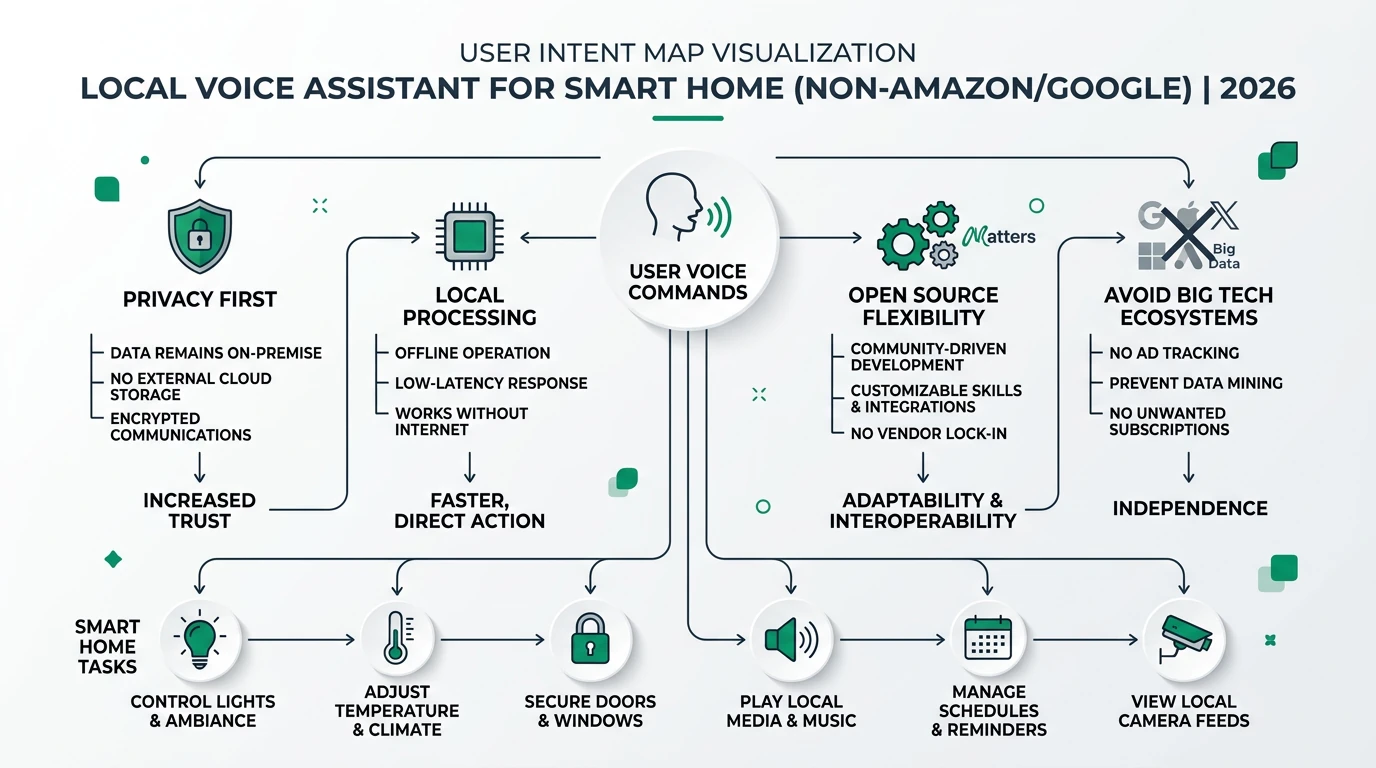
Privacy is a paramount concern for users seeking local voice assistants. In 2026, the demand for solutions that ensure data never leaves the device is more significant than ever. Home Assistant Voice PE stands out by processing all voice commands locally, ensuring that no audio data is sent to the cloud. This approach not only enhances privacy but also reduces the risk of data breaches associated with cloud storage. Similarly, OpenHAB, when paired with Willow hardware, offers a robust local processing solution, leveraging open-source code that users can audit for security assurance.
Local processing also means that users can enjoy uninterrupted service even when internet connectivity is lost. This is crucial for maintaining the functionality of smart home devices, such as lights and intercom systems, during outages. Homebridge, while primarily a bridge for legacy devices, also operates on a local network, ensuring that user data remains within the confines of the home. This local-first approach is a significant departure from traditional cloud-based assistants, offering peace of mind to privacy-conscious users.
However, the shift to local processing does come with challenges. Users must be prepared to engage with more technical setups and configurations. Unlike plug-and-play solutions from big tech companies, these local systems require a degree of DIY involvement. Yet, for those willing to invest the time, the payoff in terms of privacy and control is substantial. The community-driven nature of these projects also means that users can benefit from continuous improvements and updates, driven by a collective commitment to privacy and open-source principles.
Offline Reliability and Local Control
Offline reliability is a critical factor for users who want their smart home systems to function seamlessly without internet dependency. In 2026, local voice assistants like Home Assistant Voice PE and OpenHAB are designed to operate independently of cloud services, ensuring that core functions remain accessible even during network outages. This is achieved through local wake-word detection and speech-to-text (STT) processing, allowing users to control their smart home devices without relying on external servers.
Home Assistant Voice PE, for example, integrates local language models (LLMs) that process voice commands directly on the device. This not only enhances privacy but also ensures that users can control their smart home environment, from adjusting lights to playing music, without any delay caused by internet latency. OpenHAB, with its local LLM integration, offers similar capabilities, allowing users to execute commands swiftly and efficiently.
The reliability of these systems is further bolstered by their compatibility with open-source hardware and software. By utilizing platforms like ESPHome, users can customize their smart home setup to meet specific needs, ensuring that devices communicate effectively within the local network. This level of customization is not typically available with commercial voice assistants, which often lock users into proprietary ecosystems.
Despite these advantages, users should be aware of the potential complexities involved in setting up and maintaining these systems. The DIY nature of local voice assistants means that users may need to troubleshoot issues independently, relying on community forums and resources for support. However, the benefits of offline reliability and local control often outweigh these challenges, providing users with a more secure and dependable smart home experience.
Total Cost of Ownership (TCO)
The total cost of ownership (TCO) is a crucial consideration for users evaluating local voice assistants. In 2026, the focus is on achieving a balance between affordability and functionality. Home Assistant Voice PE, for instance, offers a competitive TCO by providing a comprehensive local processing solution at a reasonable price point. With hardware costs ranging from $100 to $150 per unit, users can set up a robust smart home system without exceeding their budget.
OpenHAB, when paired with Willow hardware, presents an even more cost-effective option. At just $50 per unit, users can achieve Echo-like functionality without the associated privacy concerns. This affordability extends to the overall setup, with additional costs for components like Raspberry Pi and power supplies remaining minimal. Homebridge, while free to use, requires investment in compatible hardware, such as a Raspberry Pi, to function effectively.
It’s important to note that while the initial costs of these systems are competitive, users should also consider potential hidden costs. These may include electricity usage, setup time, and ongoing maintenance. However, the absence of subscription fees, which are common with cloud-based assistants, significantly reduces the long-term financial burden. By investing in local voice assistants, users can achieve a high level of functionality and privacy without incurring the recurring costs associated with traditional smart home solutions.
TCO Considerations
- Initial hardware costs
- Electricity usage
- Setup and maintenance time
- Absence of subscription fees
- Potential expansion costs
Product Ecosystem and Compatibility
The product ecosystem and compatibility are vital factors for users seeking to integrate local voice assistants into their smart homes. In 2026, the emphasis is on interoperability and support for a wide range of devices. Home Assistant Voice PE excels in this regard, offering compatibility with Matter, a standard that facilitates cross-brand control without the need for proprietary hubs. This ensures that users can seamlessly integrate devices from different manufacturers into their smart home setup.
OpenHAB, with its plugin-based architecture, supports over 1,000 devices, providing users with extensive flexibility in configuring their smart home environment. This level of compatibility is particularly beneficial for users with diverse device ecosystems, allowing them to maintain a cohesive and functional smart home system. Homebridge, while primarily focused on bridging legacy devices, also offers a high degree of compatibility, making it an attractive option for users with older smart home equipment.
However, users should be prepared for the potential challenges associated with device compatibility. The DIY nature of these systems means that users may need to invest time in configuring and troubleshooting device integrations. Additionally, while Matter compatibility enhances cross-brand support, users may still encounter limitations with specific devices that require additional configuration or hardware, such as Z-Wave or Zigbee sticks.
Security and Privacy Implications
Security and privacy are at the forefront of considerations for users adopting local voice assistants. In 2026, the focus is on ensuring that user data remains secure and private, with all processing occurring locally. Home Assistant Voice PE, for example, processes audio and language models on-device, ensuring that no data is transmitted to external servers. This approach significantly reduces the risk of data breaches and unauthorized access.
OpenHAB, with its local LLM integration, offers similar security benefits, allowing users to control their smart home environment without relying on cloud services. The open-source nature of these platforms also provides users with the opportunity to audit the code, ensuring that there are no hidden vulnerabilities. Homebridge, operating on a local network, further enhances security by keeping user data within the confines of the home.
While these systems offer robust security and privacy features, users should be aware of the potential risks associated with DIY setups. Misconfigurations, such as exposed ports, can create vulnerabilities that may be exploited by malicious actors. To mitigate these risks, users are encouraged to follow best practices for securing their smart home networks, such as using strong passwords and regularly updating software.
Setup Complexity and Support Burden
The setup complexity and support burden are important considerations for users evaluating local voice assistants. In 2026, these systems require a higher level of technical knowledge compared to traditional cloud-based assistants. Home Assistant Voice PE, for example, involves hardware assembly and flashing ESPHome firmware, which can take several hours to complete. Similarly, OpenHAB requires users to configure local LLMs and integrate devices, which may be challenging for those without technical expertise.
Homebridge, while offering a more straightforward setup process, still requires users to configure plugins and manage device integrations. The DIY nature of these systems means that users must be prepared to troubleshoot issues independently, relying on community forums and resources for support. This can be a significant burden for users who are not comfortable with technical configurations.
Despite these challenges, the benefits of local voice assistants often outweigh the initial setup complexity. Once configured, these systems offer reliable offline functionality and robust privacy features, providing users with a secure and dependable smart home experience. For those willing to invest the time and effort, the payoff in terms of control and customization is substantial.
FAQ
Frequently Asked Questions
What are the main benefits of local voice assistants?
Local voice assistants offer enhanced privacy, offline reliability, and reduced dependency on cloud services, ensuring user data remains secure.
How do local voice assistants ensure privacy?
By processing all data locally, these assistants prevent user data from being sent to external servers, reducing the risk of data breaches.
Are local voice assistants compatible with all smart home devices?
While they support a wide range of devices, compatibility may vary, and users may need to configure specific integrations manually.
What are the cost implications of using local voice assistants?
While initial setup costs are competitive, users should consider potential hidden costs, such as electricity usage and maintenance time.
What support options are available for local voice assistants?
Support is primarily community-driven, with users relying on forums and resources for troubleshooting and configuration assistance.
Primary Sources Table
| Index | Title/Description | Direct URL |
|---|---|---|
| [1] | Top 5 Home Assistant Alternatives to Consider in 2025 | https://reolink.com/blog/home-assistant-alternative/ |
| [2] | Revisiting local LLM-powered Voice Assistants in 2026? - DIY | https://community.openhab.org/t/revisiting-local-llm-powered-voice-assistants-in-2026/168251 |
| [3] | Best Voice Assistants for Smart Homes in 2026: Alexa, Google, or Apple | https://spartanconcepts.ai/best-voice-assistants-for-smart-homes-in-2026-alexa-google-or-apple/ |
| [4] | My TOP 5 Smart Home Devices 2026 Edition - YouTube (transcript excerpts) | https://www.youtube.com/watch?v=tWvwKGTVGGg |
Conclusion
In conclusion, local voice assistants offer a compelling alternative to traditional cloud-based solutions, prioritizing privacy, offline reliability, and cost-effectiveness. For users seeking to maintain control over their smart home environment without compromising data security, options like Home Assistant Voice PE and OpenHAB provide robust solutions. While the setup and maintenance of these systems may require technical expertise, the benefits in terms of privacy and functionality are significant.
For further insights into smart home privacy and security, explore our guides on Apple HomeKit Secure Video vs. Local NVR for Privacy, Best Local Storage Security Cameras Without Subscription 2026, and Best Open-Source Smart Home Software for Privacy Advocates.