Comparisons
Matter Hubs: Local vs Cloud for Privacy 2026
Explore the privacy implications of local vs cloud-based Matter smart home hubs, focusing on data control, offline reliability, and cost in 2026.
Quick answer: Matter smart home hubs: local vs cloud—which is better for privacy in 2026?
Local Matter hubs (Aqara Hub M3, Home Assistant) offer superior privacy by keeping data on your home network and ensuring offline reliability. Cloud-based hubs (Echo, Nest) provide ease of use but at the cost of data exposure and subscription fees.
Executive Summary
In 2026, the choice between local and cloud-based Matter smart home hubs hinges on privacy, offline reliability, and cost. Local hubs, such as the Aqara Hub M3, prioritize keeping data within your home network, offering robust offline functionality and lower long-term costs. In contrast, cloud-based hubs like the Echo or Nest provide seamless integration and advanced features but at the risk of data exposure and ongoing subscription fees. This guide evaluates these options to help you make an informed decision based on your privacy needs and budget.
Bottom line: For those prioritizing privacy and offline reliability, local Matter hubs are the superior choice in 2026.
Privacy Considerations
Privacy remains a paramount concern for users choosing between local and cloud-based Matter smart home hubs. Local hubs excel in this area by ensuring that data remains on the home network, minimizing the risk of breaches and unauthorized access. Devices like the Aqara Hub M3 and Home Assistant setups are designed to operate without constant internet connectivity, keeping sensitive data such as occupancy and usage patterns within the confines of your home12.
In contrast, cloud-based hubs often require data to be transmitted to external servers, introducing potential vulnerabilities. While these hubs typically employ encryption to protect data, the fact that information leaves your home network inherently increases the risk of exposure. Moreover, cloud services can be subject to breaches or shutdowns, which could compromise your data security34.
The hybrid nature of Matter technology allows for optional cloud bridging, which can be beneficial for users who require remote access or integration with other cloud services. However, this convenience comes at the cost of privacy, as it involves sharing data with third-party vendors. Users must weigh the benefits of cloud features against the potential privacy risks56.
Privacy score comparison: local vs cloud Matter hubs
| Product | Cloud required | Local storage | Mandatory account | Offline control | Score / 10 |
|---|---|---|---|---|---|
| Aqara Hub M3 | No | Local | Optional | Excellent | 9.2 |
| Home Assistant + SkyConnect | No | Local | No | Excellent | 9.2 |
| IKEA Dirigera | No | Local | No | Excellent | 9.0 |
| Echo / Nest (cloud) | Yes | Cloud | Yes | Limited | 5.0 |
Ultimately, the decision between local and cloud-based hubs should be guided by your privacy priorities. If keeping data secure and within your control is crucial, local hubs are the clear winner. However, if you value the additional features and convenience offered by cloud services, you may need to accept some level of data exposure.
Local Control and Offline Reliability
Local control is a significant advantage of local Matter hubs, providing users with the ability to manage their smart home devices without relying on an internet connection. This capability ensures that essential functions, such as lighting and thermostat control, remain operational even during internet outages. Local hubs communicate directly with devices using protocols like Thread and Zigbee, supporting up to 127 devices without the need for cloud intervention25.
| Hub Type | Data Location | Offline | Account |
|---|---|---|---|
| Aqara Hub M3 | Local | Full | Optional |
| Home Assistant | Local | Full | No |
| IKEA Dirigera | Local | Full | No |
| Echo / Nest | Cloud | Limited | Yes |
Offline reliability is particularly important for users in areas with unstable internet connections or those who prioritize uninterrupted smart home functionality. Local hubs like the Aqara Hub M3 and Home Assistant setups are designed to maintain full operation without internet access, making them ideal for privacy-conscious users who want to avoid potential disruptions16.
In contrast, cloud-based hubs often rely on internet connectivity to function fully. While basic operations may continue offline, advanced features such as remote access and integration with other cloud services typically require an active internet connection. This dependency can lead to frustration during outages, as users may lose access to critical smart home functions53.
Checklist
- Ensure your local hub supports Thread 1.4 for optimal offline reliability.
- Consider the number of devices you plan to connect and verify compatibility with your chosen hub.
- Evaluate the importance of remote access and decide if the trade-off in privacy is acceptable.
For users who prioritize offline reliability and local control, local Matter hubs offer a compelling solution. However, those who require the advanced features of cloud-based hubs must be prepared to accept the limitations of internet dependency.
Cost Considerations
When evaluating the total cost of ownership, local Matter hubs generally offer a more economical solution over the long term. Although the initial investment in a local hub may be higher, with prices ranging from $100 to $300, there are no ongoing subscription fees. This makes local hubs a cost-effective choice for users who plan to maintain their smart home setup for several years23.
Cloud-based hubs, on the other hand, often come with lower upfront costs or are even provided for free with certain devices. However, these savings are offset by monthly subscription fees, typically ranging from $5 to $10, for services such as cloud storage and AI features. Over a five-year period, these fees can add up to significant expenses, making cloud-based hubs more costly in the long run36.
| Hub | Upfront | Subscription | TCO (5 years) |
|---|---|---|---|
| Aqara Hub M3 | $100–150 | None | $100–150 |
| Home Assistant | $50–300 | None | $50–300 |
| IKEA Dirigera | ~$70 | None | ~$70 |
| Echo / Nest | $0–100 | $5–10/mo | $300–700 |
Additionally, local hubs can bridge existing devices, allowing users to extend the life of their current smart home equipment without needing to replace everything. This capability further reduces the total cost of ownership by minimizing the need for new purchases56.
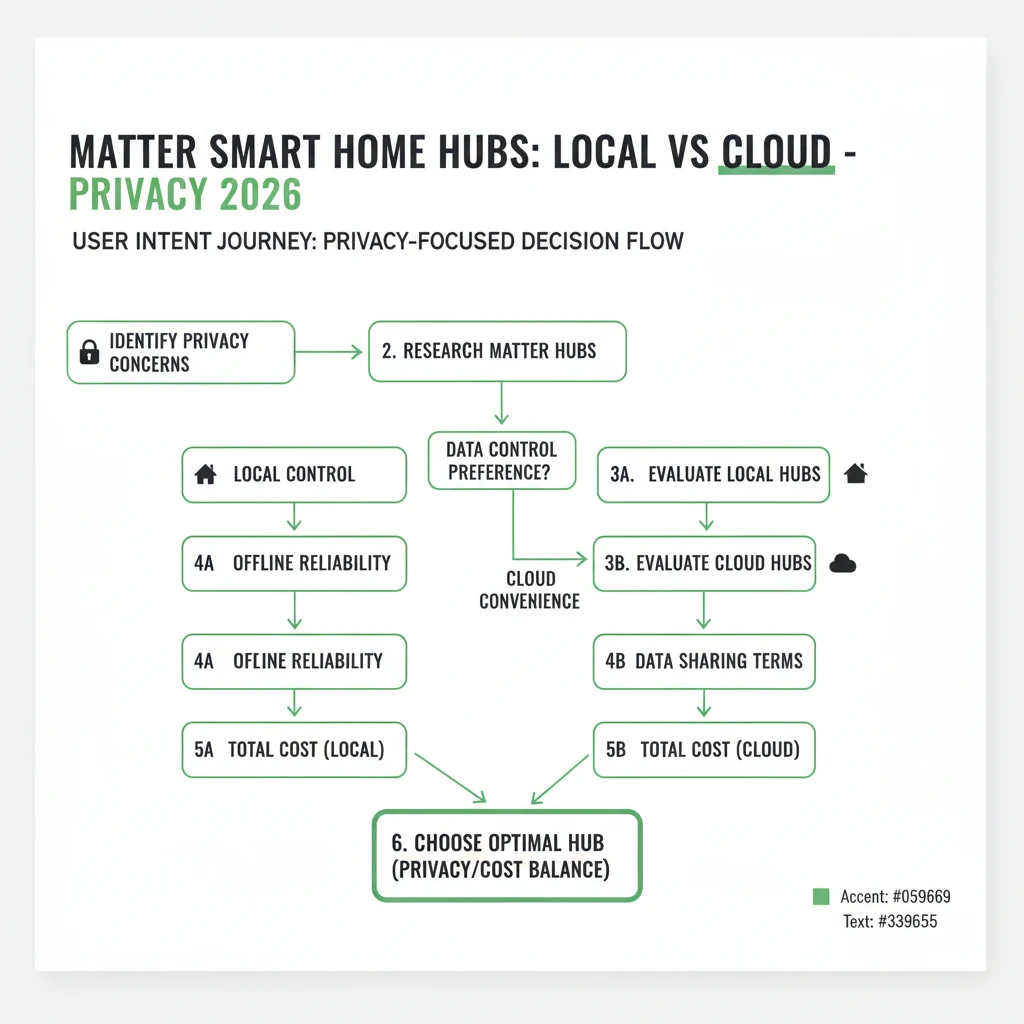
For budget-conscious users, local Matter hubs provide a more sustainable financial model. However, those who prioritize the convenience and features of cloud-based hubs must be prepared for the ongoing costs associated with these services.
Setup Complexity and Support
The setup complexity of local and cloud-based Matter smart home hubs varies significantly, impacting the user experience and support requirements. Local hubs, such as the Aqara Hub M3, offer straightforward app-based setups, but additional security measures like VLAN segmentation can add complexity. This process, while enhancing security, may require 15 to 30 minutes of additional setup time15.
Home Assistant, a popular choice among privacy advocates, offers extensive customization options but requires a higher level of technical expertise. Users must configure the system using a SkyConnect dongle and manage settings through an open-source platform, which can be daunting for those unfamiliar with such setups56.
Cloud-based hubs, in contrast, are designed for ease of use, often featuring plug-and-play installation and automatic firmware updates. These hubs typically handle multi-admin fabrics seamlessly, reducing the burden on users and making them an attractive option for those seeking a hassle-free experience53.
Support for local hubs is often community-driven, with open-source communities providing valuable resources and assistance. This self-reliant model can be empowering for users who enjoy tinkering and customizing their setups. Conversely, cloud-based hubs rely on vendor support, which can be beneficial for users who prefer professional assistance and rapid updates53.
For users who value simplicity and ease of setup, cloud-based hubs may be the preferred choice. However, those willing to invest time in learning and configuring their systems will find that local hubs offer greater control and customization options.
Security and Privacy Implications
Security and privacy are critical considerations when choosing between local and cloud-based Matter smart home hubs. Local hubs are inherently more secure, as they do not rely on cloud services, reducing the risk of data breaches and unauthorized access. Devices like Eve sensors and thermostats are designed to keep data within the home network, employing end-to-end encryption to protect sensitive information16.
Matter’s use of IPv6 encryption further enhances the security of local hubs, surpassing the efficiency of older protocols like Zigbee. However, it is important to note that local hubs may still require online accounts for certain features, which can introduce some privacy concerns4.
Cloud-based hubs, while offering advanced features and integration, pose greater privacy risks. The need for account creation and data transmission to external servers increases the potential for data exposure. Video streams and other sensitive information are often stored on cloud servers, requiring subscriptions for access and adding to the privacy concerns34.
Network segmentation, such as using VLANs, is recommended for all smart home setups to enhance security and privacy. This practice isolates devices on separate networks, reducing the risk of unauthorized access and data breaches17.
For users who prioritize security and privacy, local Matter hubs are the superior choice. However, those who value the features and convenience of cloud-based hubs must take additional precautions to protect their data.
Future-Proofing and Compatibility
As the smart home landscape evolves, future-proofing and compatibility become essential considerations for users selecting Matter hubs. Local hubs, such as the Aqara Hub M3, are designed to support a wide range of devices and protocols, including Thread, Wi-Fi, and Zigbee. This flexibility ensures compatibility with existing equipment and future devices, making them a reliable choice for long-term use25.
Matter 2.0, the latest iteration of the protocol, unifies these technologies, allowing local hubs to bridge multiple ecosystems and support up to 127 devices. This capability is particularly beneficial for users with extensive smart home setups, as it reduces the need for multiple hubs and simplifies management15.
Cloud-based hubs also offer compatibility with a variety of devices, but their reliance on internet connectivity can limit their future-proofing potential. As technology advances, users may encounter compatibility issues or require additional subscriptions to access new features36.
For users seeking a future-proof solution, local Matter hubs provide the flexibility and compatibility needed to accommodate evolving smart home technologies. However, those who prioritize the latest features and integrations may find cloud-based hubs more appealing, despite the potential limitations.
FAQ
Frequently Asked Questions
What is the primary advantage of local Matter hubs?
Local Matter hubs offer superior privacy by keeping data on your home network and ensuring offline reliability, making them ideal for privacy-conscious users.
Do cloud-based Matter hubs compromise privacy?
Yes, cloud-based hubs can compromise privacy as they require data to be transmitted to external servers, increasing the risk of exposure and breaches.
Are local Matter hubs more cost-effective?
Over the long term, local Matter hubs are more cost-effective due to the absence of subscription fees, despite higher initial costs.
How does offline reliability differ between local and cloud hubs?
Local hubs maintain full operation without internet access, while cloud hubs rely on connectivity for advanced features, which can fail during outages.
What are the setup complexities of local Matter hubs?
Local hubs may require additional setup for security measures like VLAN segmentation, while cloud hubs offer plug-and-play installation.
Primary Sources Table
| Index | Title/Description | Direct URL |
|---|---|---|
| [1] | The Matter 2.0 Guide: Building a Private Smart Home in 2026 | https://therealestestate.blog/2026/01/23/matter-2-guide-building-private-smart-home-2026/ |
| [2] | How to Upgrade Your Smart Home to Matter Protocol 2026 - Aqara | https://eu.aqara.com/blogs/news/how-to-upgrade-your-smart-home-to-matter-protocol |
| [3] | Matter & Thread Explained (2026): Smart Home Guide | https://datawiresolutions.com/blog/matter-thread-explained-2026 |
| [4] | The Matter Innovations at CES 2026 | Products | https://matter-smarthome.de/en/products/the-matter-innovations-at-ces-2026/ |
| [5] | A 2026 Guide to Smart Homes: Products, Cameras, & Systems | https://www.security.org/smart-home/ |
| [6] | The Matter Standard in 2026 – A Status Review | Development | https://matter-smarthome.de/en/development/the-matter-standard-in-2026-a-status-review/ |
| [9] | Are local Matter hubs truly private? What you need to know | https://www.matteralpha.com/explainer/are-local-matter-hubs-truly-private-what-you-need-to-know |
Conclusion
In conclusion, the choice between local and cloud-based Matter smart home hubs in 2026 depends on your priorities regarding privacy, cost, and functionality. Local hubs offer superior privacy and offline reliability, making them the preferred choice for users who value data security and uninterrupted operation. However, cloud-based hubs provide ease of use and advanced features at the cost of potential data exposure and ongoing expenses.
For further insights on smart home privacy, explore our guides on Apple HomeKit Secure Video vs Local NVR for Privacy, Best Local Storage Security Cameras Without Subscription 2026, and Best Open Source Smart Home Software for Privacy Advocates.
Footnotes
-
The Matter 2.0 Guide: Building a Private Smart Home in 2026 ↩ ↩2 ↩3 ↩4 ↩5 ↩6
-
How to Upgrade Your Smart Home to Matter Protocol 2026 - Aqara ↩ ↩2 ↩3 ↩4
-
A 2026 Guide to Smart Homes: Products, Cameras, & Systems ↩ ↩2 ↩3 ↩4 ↩5 ↩6 ↩7 ↩8
-
Are local Matter hubs truly private? What you need to know ↩ ↩2 ↩3
-
Matter & Thread Explained (2026): Smart Home Guide ↩ ↩2 ↩3 ↩4 ↩5 ↩6 ↩7 ↩8 ↩9 ↩10
-
The Matter Standard in 2026 – A Status Review | Development ↩ ↩2 ↩3 ↩4 ↩5 ↩6 ↩7
-
The Matter Innovations at CES 2026 | Products ↩