Smart Home Privacy
n8n vs Home Assistant vs Node-RED Privacy 2026
Compare n8n, Home Assistant automations, and Node-RED for local-first privacy in 2026: data flows, self-hosting trade-offs, MQTT glue, and when to combine stacks safely.
Quick answer: n8n, Home Assistant automations, or Node-RED for private workflows?
Use Home Assistant’s built-in automations for device-native logic that stays on your HA host. Add Node-RED when you want visual flow wiring beside HA. Use self-hosted n8n when you orchestrate APIs and services beyond HA—but audit every node for outbound calls.
Source: Home Assistant documentation
Executive Summary
In the evolving landscape of automation tools, understanding the privacy implications of n8n, Home Assistant, and Node-RED is crucial for users prioritizing data security and local control. Official references: n8n docs, Home Assistant, Node-RED. Cross-read IFTTT alternatives and Proxmox vs Docker vs bare metal for HA before you mix orchestration layers.
Bottom line: Choose the tool that aligns with your privacy priorities and technical requirements for optimal local workflow management.
| Layer | Primary privacy lever | Typical pitfall |
|---|---|---|
| Home Assistant automations | YAML/UI; runs on HA core | Accidentally calling cloud rest actions |
| Node-RED | Flows on LAN; MQTT/HTTP to HA | Installing nodes that phone home |
| n8n | Self-hosted workflows | Credential sprawl + external webhooks |
Understanding Privacy in Automation Tools
Privacy is a critical consideration when selecting an automation tool. n8n, Home Assistant, and Node-RED each offer different approaches to managing user data and ensuring local control. Understanding these differences can help you choose the right tool for your needs.
n8n is designed with flexibility in mind, allowing users to create custom workflows that can be hosted locally or in the cloud. This flexibility means that users can choose to keep their data entirely within their own infrastructure, enhancing privacy. However, the level of privacy you achieve with n8n largely depends on your hosting choices and configurations.
Home Assistant, on the other hand, is built specifically for smart home environments. It offers deep integration with a wide range of devices, providing users with extensive control over their smart home ecosystem. Home Assistant is open-source and can be run locally, ensuring that your data remains within your home network. This local control is a significant advantage for users concerned about data privacy in smart home setups.
Node-RED is known for its ease of use and powerful local control capabilities. It allows users to create complex automation workflows without needing extensive programming knowledge. Node-RED can be run entirely on local hardware, ensuring that your data does not leave your premises. This makes it an excellent choice for users who prioritize local data processing and privacy.
n8n: Flexible Automation with Privacy Options
n8n offers a unique blend of flexibility and privacy, making it a popular choice for users who need customizable automation solutions. Its open-source nature allows users to host their workflows on their own servers, providing complete control over data privacy.
One of the key privacy features of n8n is its ability to operate in a self-hosted environment. By running n8n on your own infrastructure, you can ensure that all data processing occurs locally, without relying on third-party cloud services. This setup is ideal for users who need to comply with strict data protection regulations or who simply prefer to keep their data private.
n8n also supports a wide range of integrations, allowing users to connect with various services and applications. While this flexibility is a significant advantage, it also means that users need to be mindful of the data flows between these integrations. Proper configuration and monitoring are essential to maintain privacy when using n8n.
For users who prefer a cloud-based solution, n8n offers a hosted version. While this option provides convenience and ease of use, it may not offer the same level of privacy as a self-hosted setup. Users should carefully consider their privacy needs and evaluate the trade-offs between convenience and data control when choosing between self-hosted and cloud-based n8n.
Home Assistant: Privacy in Smart Home Automation
Home Assistant is a powerful tool for managing smart home devices, offering extensive privacy features for users who prioritize local control. Its open-source nature and ability to run entirely on local hardware make it a top choice for privacy-conscious users.
One of the standout features of Home Assistant is its ability to integrate with a wide range of smart home devices while keeping all data processing local. This local control ensures that your data remains within your home network, reducing the risk of exposure to third-party services. For users concerned about the privacy implications of cloud-based smart home solutions, Home Assistant offers a compelling alternative.
Home Assistant’s community-driven development model also contributes to its privacy strengths. The platform is continuously updated and improved by a global community of developers, ensuring that privacy and security remain top priorities. Users can benefit from regular updates and enhancements that address potential security vulnerabilities.
However, the complexity of Home Assistant can be a barrier for some users. Setting up and configuring the platform requires a certain level of technical expertise, which may not be suitable for all users. Those who are willing to invest the time to learn and configure Home Assistant will find it a powerful tool for maintaining privacy in their smart home environment.
Node-RED: Robust Local Control for Privacy
Node-RED is renowned for its robust local control capabilities, making it an excellent choice for users who prioritize privacy in their automation workflows. Its visual programming interface allows users to create complex automations without extensive coding knowledge, making it accessible to a wide range of users.
One of the key advantages of Node-RED is its ability to run entirely on local hardware. By processing data locally, Node-RED ensures that your information remains within your control, reducing the risk of exposure to external services. This local-first approach is particularly appealing to users who need to comply with strict data protection regulations or who simply prefer to keep their data private.
Node-RED’s flexibility extends to its integration capabilities, allowing users to connect with a wide range of devices and services. While this flexibility is a significant advantage, it also requires users to be mindful of the data flows between these integrations. Proper configuration and monitoring are essential to maintain privacy when using Node-RED.
For users who require additional security features, Node-RED can be configured to use secure communication protocols, such as HTTPS and MQTT with TLS. These features enhance the platform’s privacy capabilities, ensuring that data is transmitted securely between devices and services.
Privacy Score Table
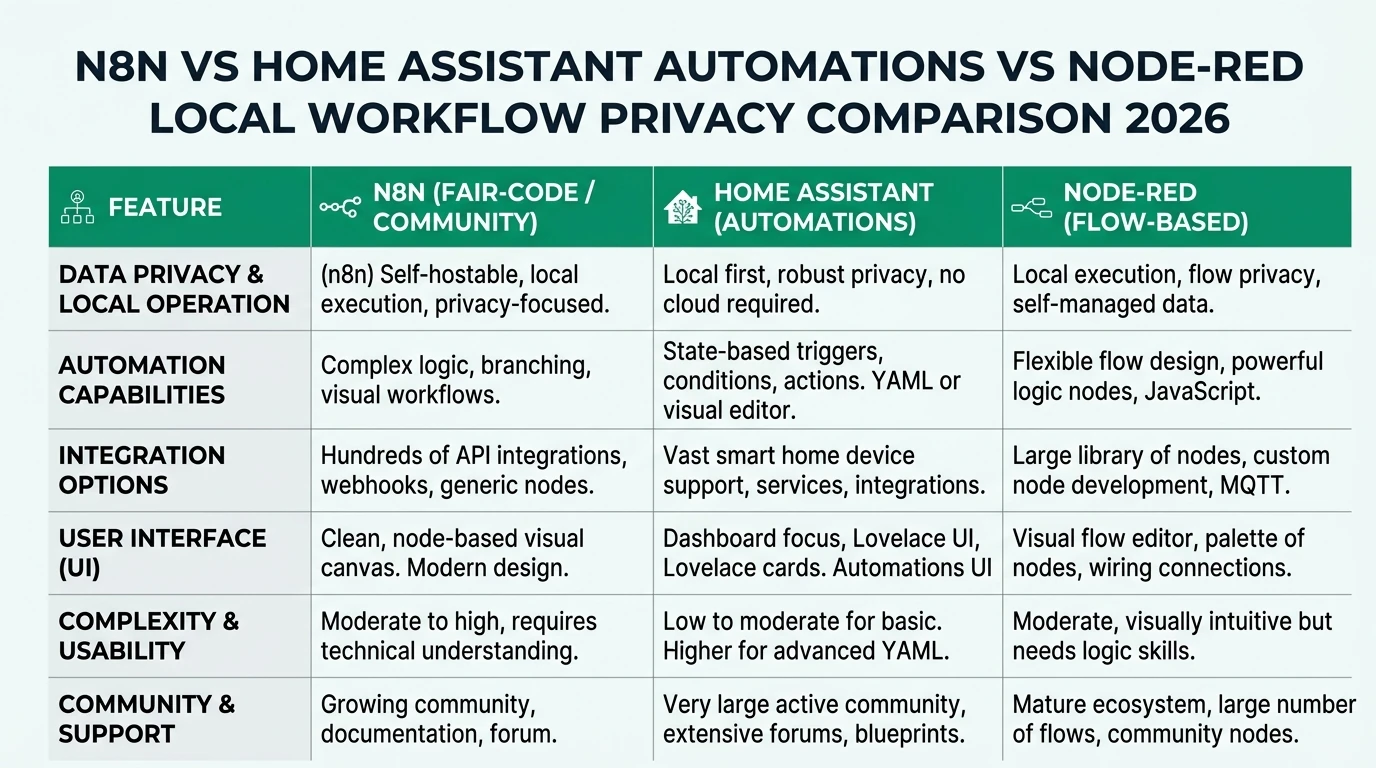
To help you compare the privacy features of n8n, Home Assistant, and Node-RED, we’ve created a Privacy Score Table. This table provides a quick overview of each platform’s strengths and weaknesses in terms of privacy and local control.
The Privacy Score Table highlights the key privacy features of each platform, allowing you to make an informed decision based on your specific needs. Consider factors such as local control, integration capabilities, and ease of use when evaluating each tool’s privacy strengths.
Checklist for Choosing the Right Automation Tool
When selecting an automation tool, it’s essential to consider your specific privacy needs and technical requirements. Use this checklist to guide your decision-making process:
Checklist
- Evaluate your privacy priorities and data protection needs.
- Consider the level of technical expertise required for setup and configuration.
- Assess the integration capabilities of each platform with your existing devices and services.
- Determine whether you prefer a self-hosted or cloud-based solution.
- Review the community support and development activity for each platform.
By following this checklist, you can ensure that you choose the right automation tool for your privacy and local control needs.
| If you need… | Start here |
|---|---|
| Device-first rules (lights, climate, presence) | Home Assistant automations |
| Complex cross-service logic on LAN | Node-RED add-on + MQTT to HA |
| API-heavy glue (CRM, webhooks, SaaS) with audit trail | Self-hosted n8n on isolated VLAN |
Frequently Asked Questions
Frequently Asked Questions
What is the primary focus of n8n?
n8n focuses on providing flexible and customizable automation solutions that can be hosted locally or in the cloud, allowing users to control their data privacy.
How does Home Assistant ensure privacy?
Home Assistant ensures privacy by allowing users to run the platform entirely on local hardware, keeping all data processing within the home network.
Can Node-RED be used for smart home automation?
Yes, Node-RED can be used for smart home automation, offering robust local control and integration capabilities with various devices and services.
Is technical expertise required to use these platforms?
Some technical expertise is required, especially for Home Assistant, which can be complex to set up. Node-RED and n8n offer more user-friendly interfaces.
Which platform offers the best local control?
Node-RED is known for its robust local control capabilities, making it an excellent choice for users who prioritize privacy and data protection.
Primary Sources Table
| Source | Description |
|---|---|
| [1] | n8n documentation — hosting and security |
| [2] | Home Assistant automation docs |
| [3] | Node-RED documentation |
Conclusion
In conclusion, n8n, Home Assistant, and Node-RED each offer unique privacy features and local control capabilities. Your choice should be guided by your specific privacy needs, technical expertise, and the level of integration required with your existing devices and services. By carefully evaluating each platform’s strengths and weaknesses, you can select the tool that best aligns with your privacy priorities.