Smart Home Privacy
ONVIF vs RTSP vs Proprietary APIs for NVR Privacy
ONVIF vs RTSP vs proprietary camera APIs in 2026 for Frigate and local NVR: interoperability, vendor lock-in, TLS, and which stack keeps video off the cloud.
Quick answer: What camera protocol should I standardize on for a private NVR?
Prefer ONVIF-conformant cameras when you want discovery, profiles, and multi-vendor swaps. Use raw RTSP when you trust fixed URLs and want the smallest surface. Avoid proprietary APIs unless you accept vendor apps and cloud tie-ins.
Source: ONVIF specifications
Executive Summary
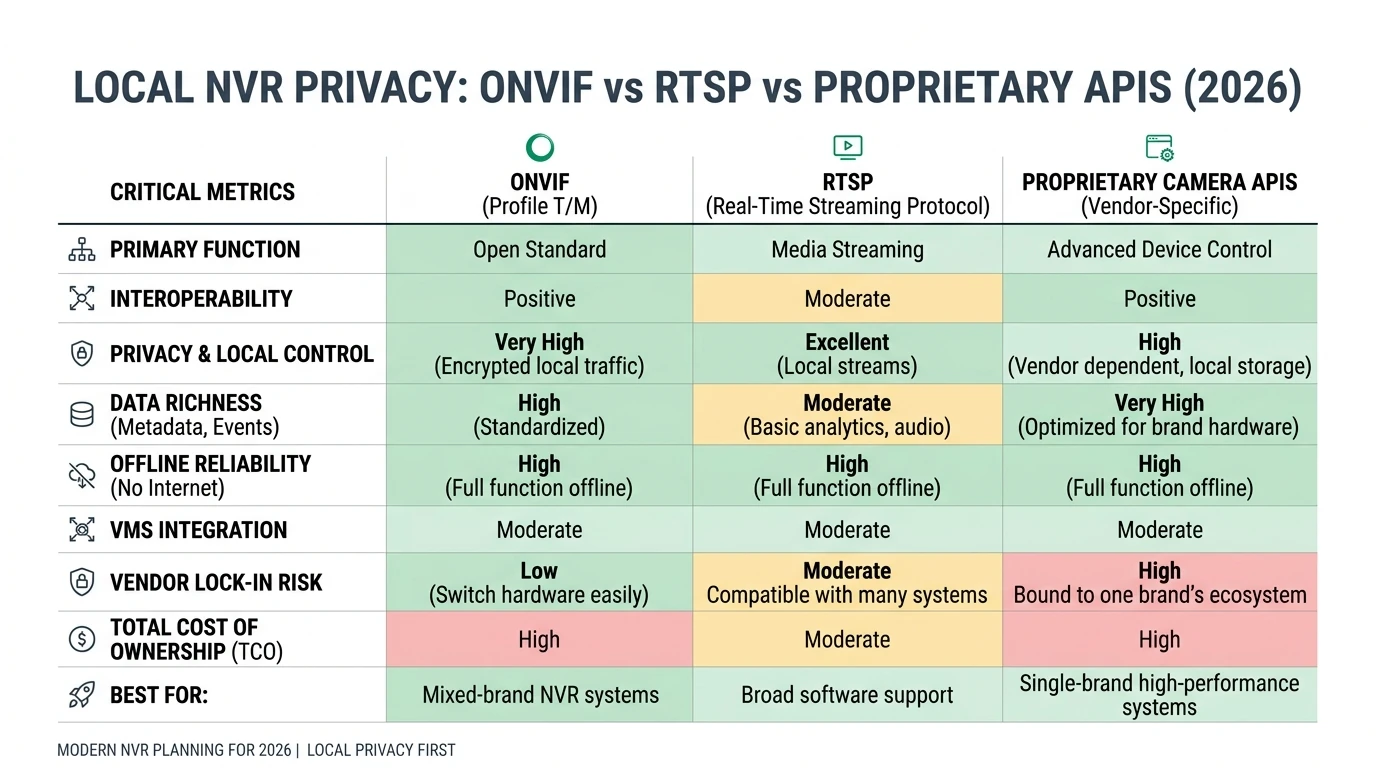
As we move into 2026, choosing the right protocol for local NVR setups is crucial for ensuring privacy, local control, and cost efficiency. ONVIF, RTSP, and proprietary camera APIs each offer unique benefits and challenges. This guide provides a comprehensive comparison to help you make an informed decision based on your specific needs. Read the ONVIF overview and pair with our Frigate vs Ring vs Arlo, Scrypted vs Frigate vs Blue Iris, and PoE cameras with local AI stacks.
ONVIF stands out for its robust privacy features and interoperability, making it a preferred choice for those seeking a future-proof solution. RTSP is favored for its simplicity and offline reliability, ideal for straightforward streaming needs. Proprietary APIs, while offering unique features, often come with privacy concerns and potential vendor lock-in.
Bottom line: For most users, ONVIF provides the best balance of privacy, control, and cost-effectiveness for local NVR setups in 2026.
| Layer | What it is | Typical privacy trade-off |
|---|---|---|
| RTSP | Video transport | No discovery; you must firewall URLs |
| ONVIF | Profiles + services on top of RTSP | Interop; still depends on vendor firmware |
| Proprietary SDK | Brand app features | Highest lock-in / cloud risk |
Understanding ONVIF, RTSP, and Proprietary APIs
When setting up a local NVR system, understanding the differences between ONVIF, RTSP, and proprietary APIs is essential. ONVIF, an open industry standard, facilitates interoperability among IP-based security products. It supports a wide range of features, including auto-discovery, PTZ control, and metadata handling, making it a versatile choice for comprehensive surveillance needs1.
RTSP, on the other hand, is a protocol designed for streaming media. It is widely supported and offers a straightforward way to transmit video streams from cameras to NVRs. Its simplicity and direct IP-based operation make it highly reliable for offline use, although it lacks the advanced management features found in ONVIF2.
Proprietary APIs are vendor-specific interfaces that often provide unique features tailored to specific camera brands. While they can offer advanced functionalities and optimizations, they also pose risks of vendor lock-in and potential privacy concerns due to cloud dependencies and telemetry3.
In 2026, the choice between these options should consider not only current needs but also future-proofing against evolving technologies like edge AI and H.265 video compression4.
Privacy Considerations for Local NVR Setups
Privacy is a paramount concern for local NVR setups, especially when avoiding cloud dependencies. ONVIF excels in this area, particularly with Profile T, which supports HTTPS for secure communications and local metadata handling. This ensures that sensitive data remains within your local network, minimizing exposure to external threats5.
RTSP, while inherently secure due to its direct streaming nature, requires additional measures such as VLANs to ensure privacy, as it does not include built-in authentication by default. This simplicity, however, reduces the attack surface, making it a reliable choice for privacy-conscious users6.
Proprietary APIs often involve cloud-based features, which can introduce privacy risks. Many vendors collect telemetry data, and some systems may have backdoors or vulnerabilities if not regularly updated. It’s crucial to evaluate the privacy policies and security practices of the vendor when considering proprietary solutions7.
In summary, ONVIF offers the most comprehensive privacy features, while RTSP provides a straightforward, secure streaming option. Proprietary APIs require careful scrutiny to ensure they meet your privacy standards.
Local Control and Offline Reliability
Local control is a critical factor for users who want to manage their NVR systems without relying on external networks. ONVIF provides excellent local control capabilities through its profiles, allowing for seamless integration and management of various camera functions. This includes auto-discovery, PTZ control, and metadata management, all of which enhance user control over their surveillance systems8.
RTSP offers basic control, primarily focusing on streaming capabilities. Its strength lies in its offline reliability, as it operates independently of network discovery processes. This makes it an ideal choice for environments where network stability is a concern9.
Proprietary APIs can offer robust local control features, but these are often tied to specific vendor ecosystems. While they may provide advanced functionalities, such as custom analytics, they can also limit flexibility and increase dependency on the vendor10.
For users prioritizing local control and offline reliability, ONVIF and RTSP provide strong options, with ONVIF offering more comprehensive management features.
Total Cost of Ownership (TCO) Analysis
When evaluating the total cost of ownership for local NVR setups, it’s important to consider both initial and ongoing costs. ONVIF, as an open standard, offers significant cost advantages due to its interoperability. With over 30,000 conformant products, it allows for flexible hardware choices and reduces the need for vendor-specific purchases, potentially saving 20-50% on hardware costs11.
RTSP, being a universally supported protocol, incurs no licensing fees and is compatible with a wide range of devices, further minimizing costs. Its simplicity also reduces setup and maintenance expenses, making it a cost-effective choice for straightforward streaming needs12.
Proprietary APIs, while often offering low upfront costs, can lead to higher long-term expenses due to vendor lock-in and upgrade fees. These hidden costs can accumulate, especially if hardware replacements or SDK fees are required13.
In conclusion, ONVIF and RTSP provide the most cost-effective solutions for local NVR setups, with ONVIF offering greater flexibility and RTSP excelling in simplicity.
Future-Proofing Your NVR Setup for 2026
As technology evolves, future-proofing your NVR setup becomes increasingly important. ONVIF’s commitment to supporting emerging technologies, such as H.265 video compression and edge AI capabilities, makes it a strong contender for long-term viability. Its backward compatibility ensures that existing investments remain relevant as new features are introduced14.
RTSP continues to be a foundational protocol for IP cameras, with ongoing support and updates ensuring its relevance in 2026 and beyond. Its simplicity and reliability make it a dependable choice for future-proofing basic streaming needs15.
Proprietary APIs may offer cutting-edge features, but their reliance on specific vendor ecosystems can limit adaptability to new technologies. It’s essential to assess the vendor’s track record for updates and support when considering proprietary solutions16.
For those seeking a future-proof NVR setup, ONVIF provides the most comprehensive support for emerging technologies, while RTSP offers a reliable foundation for streaming.
Checklist
- Evaluate current and future needs for privacy and control
- Consider interoperability and vendor lock-in risks
- Assess total cost of ownership, including hidden costs
- Ensure compatibility with emerging technologies like H.265
- Review vendor support and update policies
FAQ
Frequently Asked Questions
What is the main advantage of using ONVIF for local NVR setups?
ONVIF offers robust privacy features, interoperability, and support for emerging technologies, making it a versatile and future-proof choice for local NVR setups.
How does RTSP ensure offline reliability?
RTSP operates independently of network discovery processes, providing direct IP-based streaming that enhances offline reliability.
What are the privacy risks associated with proprietary APIs?
Proprietary APIs often involve cloud-based features and telemetry data collection, posing potential privacy risks if not properly managed.
How does ONVIF support future-proofing for 2026?
ONVIF supports emerging technologies like H.265 and edge AI, ensuring compatibility with future advancements while maintaining backward compatibility.
What are the hidden costs of proprietary APIs?
Proprietary APIs can lead to higher long-term expenses due to vendor lock-in, upgrade fees, and potential hardware replacements.
Primary Sources Table
| Index | Title/Source | Direct URL |
|---|---|---|
| 1 | ONVIF vs RTSP: An In-Depth Tutorial - SecuriThings | SecuriThings |
| 2 | RTSP vs ONVIF: Unraveling the Intricacies of IP Camera Tech - BAS-IP | BAS-IP |
| 3 | ONVIF vs. RTSP: What’s the Difference? - VXG Inc. | VXG |
| 4 | ONVIF Cameras: How to Choose the Right IP Camera | CCTV Camera World |
| 5 | ONVIF IP Cameras: A Comprehensive Guide - eufy US | eufy |
| 6 | ONVIF & RTSP Explained: How Coram’s Universal NVR Works… | Coram |
| 7 | The Real-Time Streaming Protocol (RTSP)… for 2026 - Baudcom | Baudcom |
| 8 | RTSP vs ONVIF: What’s the Difference? - Infiniti Electro-Optics | Infiniti |
| 9 | ONVIF vs RTSP: Key Differences… - SmartVision | SmartVision |
Conclusion
In the evolving landscape of local NVR setups, choosing the right protocol is crucial for ensuring privacy, control, and cost-effectiveness. ONVIF stands out as the most balanced option, offering robust privacy features and interoperability. RTSP provides simplicity and reliability, while proprietary APIs require careful consideration due to potential privacy risks and higher costs.
| NVR stack | Best protocol emphasis |
|---|---|
| Frigate | RTSP/RTMP + ONVIF discovery optional |
| Blue Iris | ONVIF + RTSP |
| Proprietary NVR | Often pushes vendor API first |
For further insights, explore our related guides on Apple HomeKit Secure Video vs Local NVR for Privacy, Aqara vs Shelly vs Tuya Privacy 2026, Best Hardware for Local AI Smart Home 2026, and how to block cameras from the internet.
Footnotes
-
ONVIF vs RTSP: An In-Depth Tutorial - SecuriThings ↩
-
RTSP vs ONVIF: Unraveling the Intricacies of IP Camera Tech - BAS-IP ↩
-
ONVIF vs. RTSP: What’s the Difference? - VXG Inc. ↩
-
ONVIF Cameras: How to Choose the Right IP Camera ↩
-
ONVIF IP Cameras: A Comprehensive Guide - eufy US ↩
-
ONVIF & RTSP Explained: How Coram’s Universal NVR Works… ↩
-
The Real-Time Streaming Protocol (RTSP)… for 2026 - Baudcom ↩
-
RTSP vs ONVIF: What’s the Difference? - Infiniti Electro-Optics ↩
-
ONVIF vs RTSP: Key Differences… - SmartVision ↩
-
ONVIF Cameras: How to Choose the Right IP Camera ↩
-
ONVIF & RTSP Explained: How Coram’s Universal NVR Works… ↩
-
RTSP vs ONVIF: Unraveling the Intricacies of IP Camera Tech - BAS-IP ↩
-
ONVIF vs. RTSP: What’s the Difference? - VXG Inc. ↩
-
ONVIF IP Cameras: A Comprehensive Guide - eufy US ↩
-
The Real-Time Streaming Protocol (RTSP)… for 2026 - Baudcom ↩
-
ONVIF Cameras: How to Choose the Right IP Camera ↩