Buying Guides
PoE Security Camera Systems with Local AI Face Recognition
Explore the benefits and considerations of PoE security camera systems with local AI face recognition, focusing on privacy, reliability, and cost-effectiveness.
Quick answer: What are the best PoE security camera systems with local AI face recognition?
PoE security camera systems with local AI face recognition offer enhanced privacy by processing data on-device, ensuring offline reliability, and reducing total cost of ownership by eliminating cloud dependencies. Top options include Defender Sentinel, Amcrest, Reolink, and GW Security.
Executive Summary
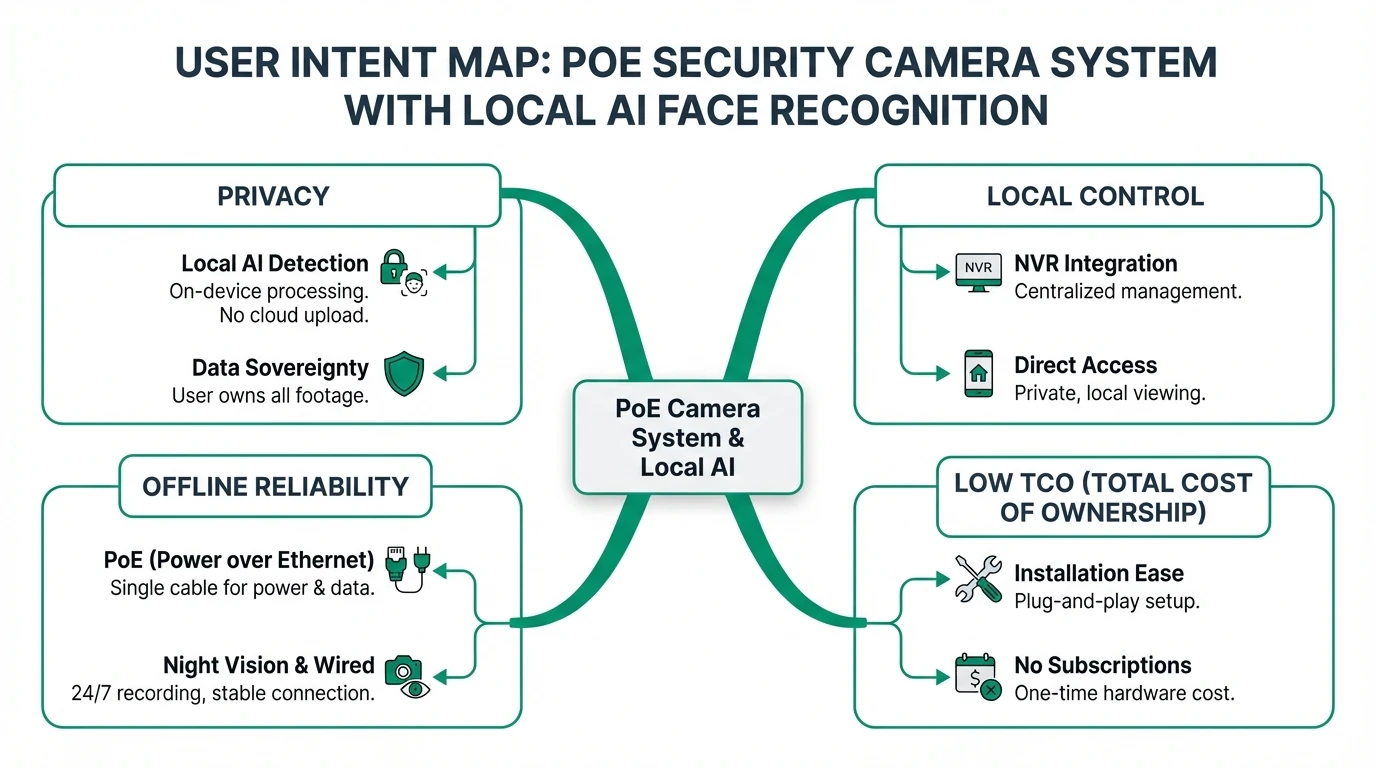
In the realm of modern surveillance, PoE security camera systems with local AI face recognition stand out for their emphasis on privacy, offline reliability, and cost-effectiveness. These systems process data locally, avoiding the pitfalls of cloud-based solutions that often compromise user privacy. By leveraging Power over Ethernet (PoE) technology, they ensure stable, interference-free operation, crucial for environments where reliability is paramount. Furthermore, the reduction in false alerts through advanced AI capabilities, coupled with simplified installation processes, makes these systems an attractive option for both residential and commercial users. The bottom line is that PoE security camera systems with local AI face recognition provide a robust, privacy-focused solution that minimizes ongoing costs and maximizes operational efficiency.
Privacy and Local Control
Privacy is a primary concern for users of security camera systems, particularly when it comes to sensitive data like facial recognition. PoE security camera systems with local AI face recognition address this concern by processing data on-device, eliminating the need for cloud-based data transmission. This approach not only enhances privacy but also ensures that sensitive information remains within the user’s control. Systems like the Defender Sentinel and GW Security utilize NVRs with built-in AI chipsets, enabling face recognition and other advanced features directly on the device12. This local processing capability is crucial for users who prioritize data security and wish to avoid potential breaches associated with cloud storage.
Local control is further enhanced by the use of NVRs that operate independently of the internet. This feature is particularly beneficial in scenarios where internet connectivity is unreliable or where users prefer to keep their surveillance systems isolated from external networks. The ability to manage and monitor the system through a dedicated app, with support for multiple users, adds another layer of convenience and control. Systems supporting ONVIF and P2P protocols ensure compatibility with a wide range of devices, allowing for seamless integration into existing security infrastructures34.
The emphasis on privacy and local control is not without its challenges. Users must be vigilant about securing their networks to prevent unauthorized access, especially when remote monitoring features are enabled. While these systems offer robust privacy protections, they also require careful management to ensure that all security features are properly configured and maintained. This includes regular firmware updates and the implementation of strong access controls to safeguard against potential vulnerabilities.
Privacy score comparison for PoE AI camera systems
| Product | Cloud required | Local storage | Mandatory account | Offline control | Score / 10 |
|---|---|---|---|---|---|
| Defender Sentinel | No | NVR | No | Excellent | 9.2 |
| Amcrest PoE | No | NVR | No | Excellent | 9.0 |
| Reolink PoE | No | NVR | No | Excellent | 9.0 |
| GW Security | No | NVR | No | Excellent | 8.8 |
Offline Reliability
The reliability of a security camera system is paramount, especially in environments where uninterrupted surveillance is critical. PoE technology plays a significant role in ensuring offline reliability by providing a stable power and data connection through a single Ethernet cable. This eliminates the need for separate power sources and reduces the risk of interference from wireless networks. Systems adhering to the IEEE 802.3af/at standards, such as those offered by Amcrest and Reolink, deliver consistent performance even in challenging conditions56.
Offline reliability is further bolstered by the ability of these systems to operate independently of internet connectivity. This feature is particularly advantageous in remote locations or areas with unreliable internet service. By storing data locally on NVRs, users can ensure continuous recording and access to footage without relying on external servers. This not only enhances reliability but also provides peace of mind knowing that critical data is always available when needed.
However, achieving offline reliability requires careful consideration of system components and installation practices. Users must ensure that all connections are secure and that the system is properly configured to handle power outages or other disruptions. Regular maintenance and testing are essential to verify that all components are functioning as expected and that the system can withstand potential challenges. By prioritizing offline reliability, users can create a robust surveillance solution that remains operational under a wide range of conditions.
| Brand | PoE Standard | Local AI | Offline Recording |
|---|---|---|---|
| Defender Sentinel | IEEE 802.3af/at | Yes | Yes |
| Amcrest | IEEE 802.3af/at | Yes | Yes |
| Reolink | IEEE 802.3af/at | Yes | Yes |
| GW Security | IEEE 802.3af/at | Yes | Yes |
Checklist
- Ensure all PoE connections are secure and compliant with IEEE 802.3af/at standards.
- Verify that the NVR is configured for local storage and offline operation.
- Regularly test system components to ensure functionality during power outages.
- Implement a backup power solution to maintain system operation during extended outages.
- Conduct routine maintenance to identify and address potential vulnerabilities.
Total Cost of Ownership
When evaluating PoE security camera systems with local AI face recognition, the total cost of ownership (TCO) is a critical factor. These systems offer significant cost advantages by minimizing the need for ongoing subscriptions and reducing installation complexity. The initial investment typically includes the cost of cameras, NVRs, and necessary cabling, with prices varying based on the number of channels and additional features. For example, a basic setup with an 8-channel NVR and four cameras can range from $500 to $1000, depending on the brand and specifications12.
One of the key benefits of these systems is the elimination of subscription fees, which are often required for cloud-based solutions. By processing and storing data locally, users can avoid recurring costs and retain full control over their surveillance data. Additionally, the use of H.265+ video compression technology significantly reduces bandwidth and storage requirements, further lowering operational costs. This technology can save up to 70% in bandwidth and storage compared to older compression standards4.
Despite these advantages, users should be aware of potential hidden costs associated with system expansion and maintenance. Adding additional cameras or upgrading storage capacity may require the purchase of PoE switches or larger hard drives. Professional installation services, while optional, can also add to the overall cost. By carefully planning and budgeting for these expenses, users can optimize their investment and ensure a cost-effective surveillance solution over the long term.
| Setup | Est. Cost | Subscription | TCO Year 1 |
|---|---|---|---|
| 4-cam + 8ch NVR | $500–1000 | None | $500–1000 |
| 8-cam + 16ch NVR | $800–1500 | None | $800–1500 |
| Expansion (4 more cams) | $200–400 | None | Add-on |
Product Ecosystem and Compatibility
The ecosystem of PoE security camera systems with local AI face recognition is diverse, offering a range of options to suit different needs and preferences. Key players in the market, such as Defender, Amcrest, and Reolink, provide comprehensive solutions that include NVRs, cameras, and supporting software156. These systems are designed to work seamlessly together, ensuring compatibility and ease of use.
Compatibility is a crucial consideration when selecting a security camera system, as it determines the ability to integrate with existing infrastructure and expand as needed. Systems that support ONVIF and RTSP protocols offer greater flexibility, allowing users to mix and match components from different manufacturers. This is particularly beneficial for users who wish to upgrade or expand their systems over time without being locked into a single brand34.
The choice of cameras within these ecosystems also plays a significant role in determining system capabilities. Options range from fixed turret cameras to advanced PTZ models with motorized zoom and 360-degree coverage. Features such as built-in microphones, weatherproofing, and night vision capabilities further enhance the functionality and versatility of these systems. By carefully evaluating the available options and selecting components that align with their specific needs, users can create a tailored surveillance solution that meets their requirements.
Security and Privacy Implications
Security and privacy are paramount when it comes to surveillance systems, and PoE security camera systems with local AI face recognition are designed to address these concerns. By processing data locally, these systems minimize the risk of unauthorized access and data breaches associated with cloud-based solutions. This approach not only enhances privacy but also ensures compliance with data protection regulations342.
However, the use of app-based remote access introduces potential security risks that must be carefully managed. Users should implement strong authentication measures and regularly update their systems to protect against vulnerabilities. The inclusion of two-way audio features, while convenient, also raises privacy concerns, as it involves the transmission of audio data. Users must be aware of these implications and take appropriate steps to secure their systems1.
Despite these challenges, the benefits of local AI processing and offline operation make these systems an attractive option for privacy-conscious users. By prioritizing security and privacy in their design and implementation, these systems provide a robust solution that meets the needs of modern surveillance while safeguarding sensitive data.
Frequently Asked Questions
What is PoE and how does it benefit security camera systems?
PoE, or Power over Ethernet, allows both power and data to be transmitted over a single Ethernet cable, simplifying installation and reducing the need for separate power sources.
How does local AI face recognition enhance privacy?
Local AI face recognition processes data on-device, eliminating the need for cloud-based data transmission and reducing the risk of unauthorized access.
What are the key features to look for in a PoE security camera system?
Key features include local AI processing, offline operation, high-resolution cameras, night vision capabilities, and compatibility with ONVIF and RTSP protocols.
Are there any hidden costs associated with PoE security camera systems?
Potential hidden costs include the need for PoE switches, additional storage capacity, and optional professional installation services.
How can I ensure the security of my PoE security camera system?
Implement strong authentication measures, regularly update system firmware, and secure all network connections to protect against vulnerabilities.
Primary Sources Table
| Index | Title/Description | Direct URL |
|---|---|---|
| 1 | AI Powered Sentinel 4K PTZ Wired 8 Channel PoE NVR | Defender Cameras |
| 2 | POE IP Security Cameras (Amcrest) | Amcrest |
| 3 | Face Recognition CCTV Kits (Domar) | Domar |
| 4 | Best PoE Security Camera System (Backstreet Surveillance) | Backstreet Surveillance |
| 5 | 4K Turret PoE Camera with Face Recognition (CCTV Camera World) | CCTV Camera World |
| 6 | PoE IP Cameras & NVRs (Reolink) | Reolink |
| 7 | 8 Channel NVR with Face Recognition (GW Security) | GW Security |
| 8 | 4K IP Camera AI System (CCTV Camera Pros) | CCTV Camera Pros |
Conclusion
In conclusion, PoE security camera systems with local AI face recognition offer a compelling solution for users seeking privacy-focused, reliable, and cost-effective surveillance options. By processing data locally and operating independently of the internet, these systems provide enhanced security and control over sensitive information. While there are challenges associated with managing and securing these systems, the benefits they offer make them an attractive choice for both residential and commercial applications. For those interested in further exploring privacy-focused surveillance solutions, consider reading our guides on Apple HomeKit Secure Video vs. Local NVR for Privacy, Best Local Storage Security Cameras Without Subscription 2026, and Best Open Source Smart Home Software for Privacy Advocates.