Comparisons
Privacy-Focused Smart Home Hubs for Home Assistant
Explore privacy-focused smart home hubs that integrate with Home Assistant, emphasizing local data processing and offline functionality.
Quick answer: What are the best privacy-focused smart home hubs compatible with Home Assistant?
Home Assistant Green and Yellow are top choices, offering local data processing, extensive device integration, and offline functionality.
Executive Summary
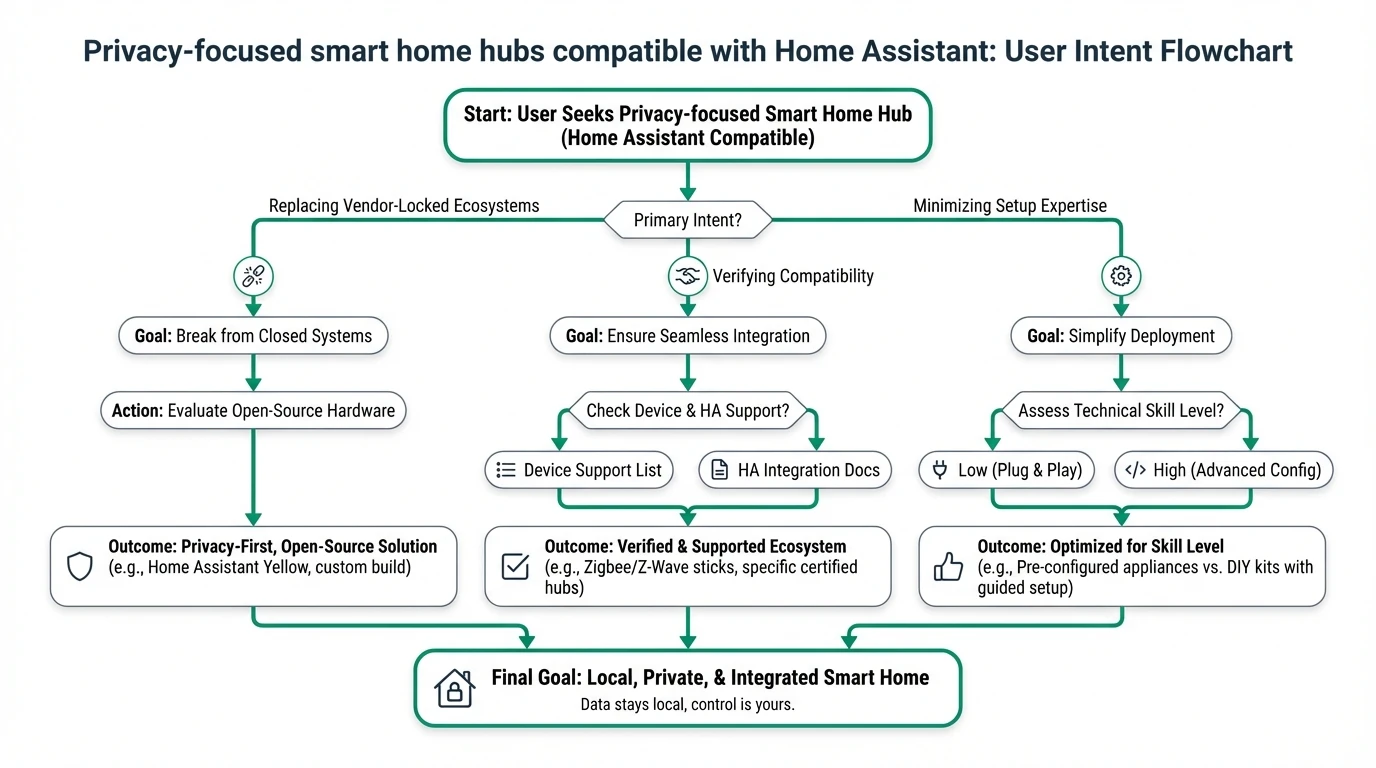
In the evolving landscape of smart home technology, privacy remains a paramount concern for users seeking to maintain control over their personal data. This guide delves into privacy-focused smart home hubs that seamlessly integrate with Home Assistant (HA), emphasizing local data processing, offline functionality, and cost-effectiveness. The primary focus is on replacing vendor-locked ecosystems with open-source alternatives that offer verifiable security claims and compatibility with standards like Zigbee and Thread.
Bottom line: Home Assistant Green emerges as the optimal choice for most privacy-conscious users, offering a robust local-first design and extensive device compatibility.
Privacy and Local Data Processing
Privacy is a critical factor when selecting a smart home hub, especially for users concerned about data sovereignty. Home Assistant (HA) hubs, particularly the Green and Yellow models, prioritize local data processing, ensuring that user data remains within the confines of their home network. This approach eliminates the need for cloud-based data storage, significantly reducing the risk of data breaches and unauthorized access1.
The open-source nature of HA hubs allows for transparency and community-driven audits, providing users with confidence in the security of their systems. Unlike proprietary systems that often rely on cloud services, HA hubs store and process data locally, offering users full control over their information. This local-first design is complemented by advanced encryption standards, further enhancing data security2.
Moreover, HA hubs support a wide range of integrations, allowing users to connect various devices without compromising privacy. The extensive compatibility with standards like Zigbee and Thread ensures that users can build a comprehensive smart home ecosystem while maintaining local control. This flexibility is crucial for users transitioning from vendor-locked systems to more open and secure alternatives3.
Privacy score comparison for Home Assistant hubs
| Product | Cloud required | Local storage | Mandatory account | Offline control | Score / 10 |
|---|---|---|---|---|---|
| Home Assistant Green | No | User managed | No | Excellent | 9.2 |
| Home Assistant Yellow | No | User managed | No | Excellent | 9.2 |
| Raspberry Pi + HA | No | User managed | No | Excellent | 9.0 |
The emphasis on privacy extends to the setup process, where HA hubs offer a straightforward installation experience. Users can quickly configure their systems without the need for extensive technical expertise, making it accessible to a broader audience. This ease of use, combined with robust privacy features, positions HA hubs as a leading choice for privacy-focused smart home enthusiasts.
Local Control and Offline Functionality
Local control is a defining feature of privacy-focused smart home hubs, enabling users to operate their devices without relying on an internet connection. Home Assistant hubs excel in this regard, offering direct device communication that ensures reliability even in the absence of internet access. This offline capability is particularly valuable in scenarios where network outages occur, allowing users to maintain control over their smart home environment4.
The integration of Zigbee and Thread standards further enhances local control, providing a reliable communication protocol for connected devices. These standards facilitate seamless interaction between devices, ensuring that users can manage their smart home systems efficiently. The optional Connect ZBT-2 add-on enhances this capability by extending the range and reliability of Zigbee/Thread communications5.
Home Assistant’s extensive library of over 1,000 integrations supports a diverse range of devices, allowing users to customize their smart home setup to meet specific needs. This flexibility is crucial for users seeking to replace vendor-locked ecosystems with open-source alternatives that offer greater control and privacy. The ability to operate offline without sacrificing functionality makes HA hubs an attractive option for privacy-conscious users6.
| Hub Model | Offline Support | Zigbee/Thread | Integrations |
|---|---|---|---|
| Home Assistant Green | Full | Via ZBT-2 add-on | 1,000+ |
| Home Assistant Yellow | Full | Built-in | 1,000+ |
| Raspberry Pi + HA | Full | Via USB dongle | 1,000+ |
Checklist
- Ensure local data processing is enabled.
- Verify compatibility with Zigbee/Thread devices.
- Test offline functionality to confirm reliability.
- Regularly update firmware for security enhancements.
The commitment to local control is further reinforced by the community-driven nature of Home Assistant. Regular updates and enhancements ensure that users benefit from the latest security features and integrations, maintaining the reliability and functionality of their systems. This active community support is a testament to the robustness of HA hubs as a privacy-focused solution.
Total Cost of Ownership
When evaluating smart home hubs, the total cost of ownership (TCO) is a crucial consideration. Home Assistant Green offers a cost-effective solution with an upfront price of approximately HK$900 (~$115 USD), making it accessible to a wide range of users. This price includes essential components such as a Gigabit Ethernet cable and a universal power supply, ensuring that users have everything they need to get started7.
The optional Connect ZBT-2 add-on, priced at around $30, provides enhanced Zigbee/Thread support, expanding the hub’s capabilities without significantly increasing costs. Unlike many proprietary systems, HA hubs do not require subscriptions for core functionality, further reducing the TCO. The optional Nabu Casa cloud service, available for approximately $6.50 per month, offers additional features such as voice control integration with Alexa and Google Assistant, but it is not necessary for core operations8.
| Setup Option | Upfront Cost | Optional Add-ons | Monthly Sub |
|---|---|---|---|
| HA Green | ~$115 | ZBT-2 add-on ~$30 | None |
| HA Yellow | ~$150 | None | None |
| Raspberry Pi + HA | $50–80 | USB dongles $20–50 | None |
Hidden costs are minimal, with potential expenses limited to optional USB accessories for Z-Wave or Bluetooth support. The energy consumption of HA hubs is also low, contributing to their cost-effectiveness over time. This affordability, combined with robust privacy and local control features, makes HA hubs an appealing choice for users seeking a reliable and secure smart home solution9.
Security and Privacy Implications
Security is a paramount concern for users of smart home hubs, and Home Assistant hubs are designed with this in mind. The local-first design ensures that all data is stored and processed within the user’s home network, minimizing the risk of data breaches and unauthorized access. This approach is complemented by advanced encryption standards, providing an additional layer of security for user data10.
The open-source nature of HA hubs allows for transparency and community-driven audits, enabling users to verify the security of their systems. This transparency is crucial for users seeking assurance that their data is protected from external threats. Regular updates and enhancements from the active Home Assistant community ensure that users benefit from the latest security features and integrations11.
While HA hubs offer robust security features, users must remain vigilant in implementing best practices to protect their systems. This includes regularly updating firmware, isolating smart home devices on a separate network, and verifying the security of third-party integrations. By following these guidelines, users can maximize the security and privacy of their smart home environments12.
Frequently Asked Questions
What makes Home Assistant hubs privacy-focused?
Home Assistant hubs prioritize local data processing, ensuring that user data remains within the home network. This approach eliminates the need for cloud-based storage, reducing the risk of data breaches.
Can Home Assistant hubs operate offline?
Yes, Home Assistant hubs offer offline functionality, allowing users to control their devices without an internet connection. This capability ensures reliability even during network outages.
What is the total cost of ownership for Home Assistant Green?
The upfront cost of Home Assistant Green is approximately HK$900 (~$115 USD), with optional add-ons like the Connect ZBT-2 priced at around $30. There are no mandatory subscriptions for core functionality.
How does Home Assistant ensure data security?
Home Assistant hubs use advanced encryption standards and local data processing to protect user data. The open-source nature allows for community audits and regular updates to enhance security.
Are there any hidden costs associated with Home Assistant hubs?
Hidden costs are minimal, with potential expenses limited to optional USB accessories for additional device support. Energy consumption is low, contributing to cost-effectiveness over time.
Primary Sources Table
Conclusion
In conclusion, Home Assistant hubs offer a compelling solution for users seeking privacy-focused smart home systems. With a local-first design, extensive device compatibility, and cost-effective pricing, HA hubs provide a robust and secure platform for smart home automation. Users can confidently transition from vendor-locked ecosystems to open-source alternatives, enjoying the benefits of local data processing and offline functionality.
For further exploration of privacy-focused smart home solutions, consider reading our guides on Apple HomeKit Secure Video vs. Local NVR for Privacy, Best Local Storage Security Cameras Without Subscription 2026, and Best Open-Source Smart Home Software for Privacy Advocates.
Footnotes
-
Home Assistant Green - Smart home hub. Retrieved from https://www.home-assistant.io/green/ ↩
-
Home Assistant Green vs Yellow: Which Smart Home Hub… Retrieved from https://www.linko.com.hk/blogs/general/home-assistant-green-vs-yellow-which-smart-home-hub-is-right-for-you ↩
-
Call for Collaboration: Home Assistant Safety, Security & Privacy. Retrieved from https://community.home-assistant.io/t/call-for-collaboration-home-assistant-safety-security-privacy/964086 ↩
-
Home Assistant - Open Source Home Automation. Retrieved from https://www.home-assistant.io ↩
-
Home Assistant Official and Compatible Devices. Retrieved from https://www.seeedstudio.com/blog/home-assistant/ ↩
-
Are local Matter hubs truly private? What you need to know. Retrieved from https://www.matteralpha.com/explainer/are-local-matter-hubs-truly-private-what-you-need-to-know ↩
-
Why Home Assistant Is the Ultimate Smart Home Hub. Retrieved from https://homeautomationsmarthome.com/home-assistant-smart-home-hub/ ↩
-
Best Practices for a Private Smart Home - Configuration. Retrieved from https://community.home-assistant.io/t/best-practices-for-a-private-smart-home/778141 ↩
-
Aqara Smart Hubs for Home Automation. Retrieved from https://www.aqara.com/us/product/hub/ ↩
-
Home Assistant Green - Smart home hub. Retrieved from https://www.home-assistant.io/green/ ↩
-
Home Assistant Green vs Yellow: Which Smart Home Hub… Retrieved from https://www.linko.com.hk/blogs/general/home-assistant-green-vs-yellow-which-smart-home-hub-is-right-for-you ↩
-
Call for Collaboration: Home Assistant Safety, Security & Privacy. Retrieved from https://community.home-assistant.io/t/call-for-collaboration-home-assistant-safety-security-privacy/964086 ↩