Smart Home Privacy
Scrypted vs Frigate vs Blue Iris: NVR Privacy 2026
Compare Scrypted, Frigate, and Blue Iris for local NVR privacy in 2026. Understand their privacy features and implications.
Quick answer: Which local NVR is best for privacy in 2026?
Frigate is the open-source, Docker-native detector/NVR most Home Assistant users pair with Coral TPUs. Scrypted adds a plugin platform (including Frigate and HomeKit bridges) with low overhead. Blue Iris is Windows-first, closed-source, and camera-dense—strong controls, but a different trust and update model than self-hosted Linux stacks.
Source: Frigate documentation
Executive Summary
In the realm of local Network Video Recorders (NVRs), privacy is a paramount concern. Scrypted, Frigate, and Blue Iris each offer unique strengths and weaknesses in this area. Official references: the Frigate project documentation, Scrypted’s documentation hub, and Blue Iris product pages. Cross-read our existing camera stack guides—Frigate vs Ring vs Arlo, top NVR without cloud, and Apple HomeKit Secure Video vs local NVR—before you standardize on one NVR layer. Scrypted is noted for efficient resource usage; Frigate stands out for open-source adaptability with Docker; Blue Iris is feature-rich on Windows but demands license and hardware discipline.
Bottom line: Choose the NVR system that aligns with your privacy priorities and technical environment, balancing features, resource demands, and setup complexity.
Understanding Local NVR Privacy
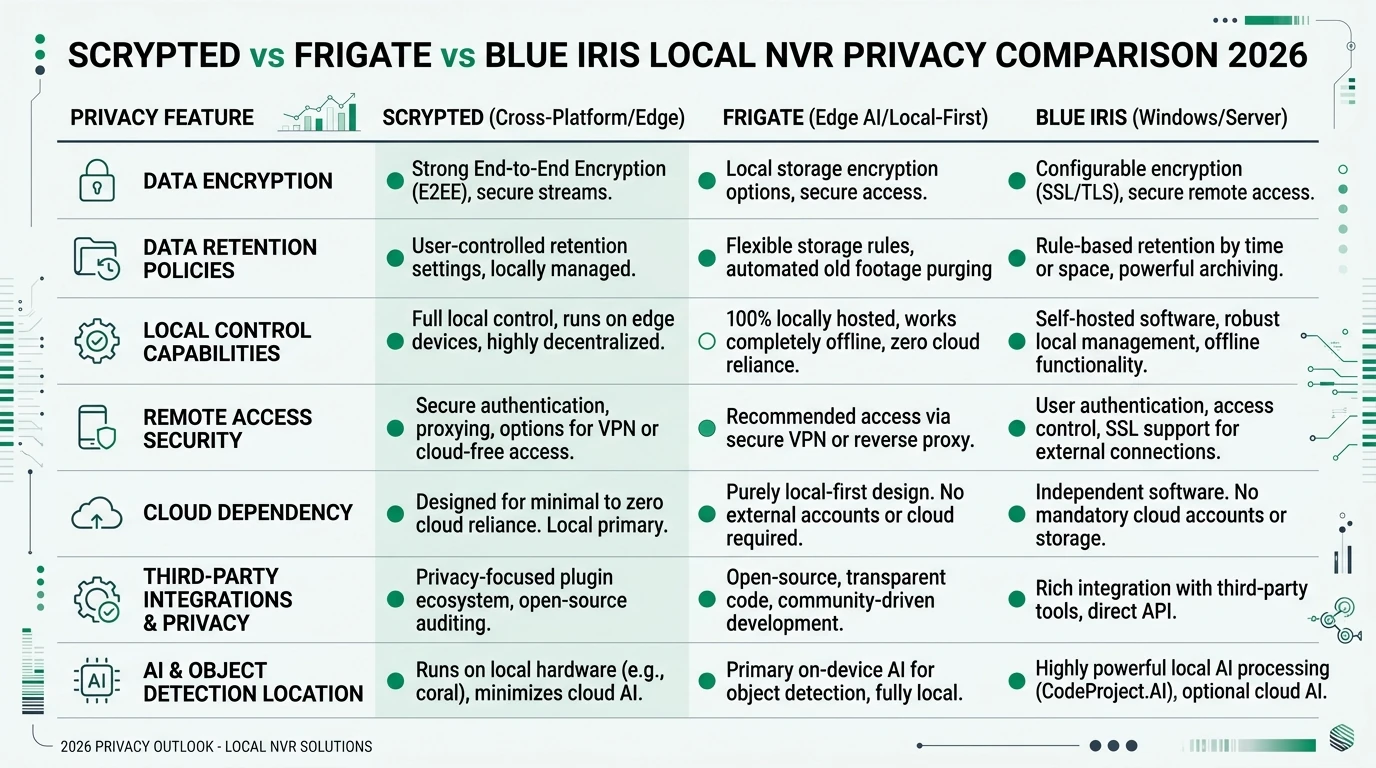
Local NVR systems like Scrypted, Frigate, and Blue Iris are designed to manage video surveillance without relying on cloud services, which can enhance privacy by keeping data within your control. However, the degree of privacy protection varies significantly among these systems. Scrypted, for instance, is praised for its efficient use of resources, which can be crucial for maintaining privacy without compromising performance. This efficiency means less data is processed externally, reducing potential exposure.
Frigate, on the other hand, is known for its flexibility and adaptability. It can be deployed on various platforms using Docker, allowing users to tailor their setup to specific privacy needs. This adaptability can be a double-edged sword, as it requires a certain level of technical expertise to ensure optimal privacy settings. Users must be diligent in configuring Frigate to prevent unintentional data leaks.
Blue Iris offers a comprehensive suite of features, but its reliance on specific hardware can be a limitation. This requirement might lead to increased costs and complexity, but it also means that users can have more control over the hardware environment, potentially enhancing privacy. However, the need for specific configurations can be a barrier for those less technically inclined.
| Your priority | First look | Why |
|---|---|---|
| Home Assistant + Coral object detection | Frigate + local AI hardware | Native HA integration; community scale |
| HomeKit bridging + lean plugins | Scrypted | One pane for cameras + automations |
| Many Windows cameras + enterprise-style UI | Blue Iris | Mature VMS; you accept Windows patching |
Privacy Features and Implications
When evaluating privacy features, it’s essential to consider how each system handles data encryption, retention, and user control. Scrypted is often highlighted for its minimal CPU usage, which indirectly supports privacy by reducing the need for external processing. This local processing minimizes the risk of data exposure, as less information is transmitted outside the local network.
Frigate’s strength lies in its open-source nature, allowing users to inspect and modify the code to suit their privacy needs. This transparency can be a significant advantage for users who prioritize control over their data. However, it also means that users must be proactive in managing updates and security patches to maintain privacy.
Blue Iris, with its robust feature set, provides extensive options for data management and retention. Users can configure how long data is stored and who has access to it, offering a high degree of control. However, the complexity of these features can be overwhelming for some users, potentially leading to misconfigurations that could compromise privacy.
Resource Efficiency and Privacy
Resource efficiency is a critical factor in maintaining privacy, as systems that require less external processing are inherently more secure. Scrypted is particularly noted for its low CPU usage, which not only conserves energy but also limits the amount of data processed outside the local environment. This efficiency is achieved through optimized software design, making it an attractive option for users with limited hardware resources.
Frigate’s use of Docker allows it to run efficiently across various platforms, but this flexibility requires careful management to ensure privacy is not compromised. Users must be vigilant in configuring Docker containers to prevent unauthorized access and data leaks. This setup can be more resource-intensive initially, but it offers long-term benefits in terms of adaptability and control.
Blue Iris, while comprehensive, can be resource-heavy, particularly on Windows systems. This demand can lead to increased costs and complexity, but it also provides users with more control over their hardware environment. By carefully selecting compatible hardware, users can optimize Blue Iris for both performance and privacy, balancing resource demands with security needs.
Setup Complexity and User Control
The complexity of setting up an NVR system can significantly impact its privacy capabilities. Scrypted is often praised for its straightforward setup process, which allows users to quickly configure privacy settings without extensive technical knowledge. This ease of use makes it accessible to a broader audience, though it may lack some advanced features found in more complex systems.
Frigate’s use of Docker provides a flexible setup process, but it requires a certain level of technical expertise to ensure privacy is maintained. Users must be comfortable with Docker configurations and network settings to fully leverage Frigate’s capabilities. This complexity can be a barrier for some, but it also offers the potential for highly customized privacy solutions.
Blue Iris, with its extensive feature set, demands specific hardware configurations, which can complicate the setup process. However, this complexity also allows for greater control over privacy settings, as users can tailor the system to their specific needs. The trade-off is that users must be willing to invest time and effort into understanding and configuring the system to achieve optimal privacy.
Checklist
- Evaluate your technical expertise before choosing an NVR system.
- Consider the hardware requirements of each system.
- Assess the privacy features and how they align with your needs.
- Determine the level of control you require over your data.
- Ensure you have the resources to manage updates and security patches.
Privacy Score Comparison
To provide a clearer picture of how Scrypted, Frigate, and Blue Iris compare in terms of privacy, we can evaluate them based on key criteria such as data encryption, user control, and resource efficiency. Each system has its strengths and weaknesses, and understanding these can help you make an informed decision.
| Feature | Scrypted | Frigate | Blue Iris |
|---|---|---|---|
| Data Encryption | High | Medium | High |
| User Control | Medium | High | High |
| Resource Efficiency | High | Medium | Low |
| Setup Complexity | Low | Medium | High |
| Adaptability | Medium | High | Low |
This table highlights the differences in privacy features across the three systems. Scrypted excels in resource efficiency and data encryption, making it a strong choice for users prioritizing these aspects. Frigate offers high user control and adaptability, ideal for those comfortable with technical configurations. Blue Iris provides robust data encryption and user control but requires specific hardware and a more complex setup process.
FAQ
Frequently Asked Questions
What is the primary advantage of using Scrypted for privacy?
Scrypted’s primary advantage is its efficient use of resources, which minimizes external data processing and enhances privacy.
How does Frigate ensure user control over privacy?
Frigate’s open-source nature allows users to inspect and modify the code, providing significant control over privacy settings.
Why might Blue Iris be considered complex for some users?
Blue Iris requires specific hardware configurations and has a comprehensive feature set, which can be overwhelming for users without technical expertise.
Can Frigate be used on any platform?
Yes, Frigate’s use of Docker allows it to be deployed on various platforms, offering flexibility in setup and configuration.
What should I consider when choosing an NVR system for privacy?
Consider your technical expertise, hardware resources, and the level of control you require over data encryption and retention.
Primary Sources Table
| Source | Description |
|---|---|
| [1] | Frigate documentation — architecture, detectors, hardware acceleration |
| [2] | Scrypted documentation — plugins, HomeKit, performance |
| [3] | NIST Cybersecurity for IoT — general connected-system framing |
Conclusion
In conclusion, choosing the right local NVR system for privacy involves balancing various factors, including resource efficiency, user control, and setup complexity. Scrypted, Frigate, and Blue Iris each offer unique advantages and challenges, making it essential to align your choice with your specific privacy needs and technical capabilities.
For further insights into smart home privacy, consider reading our related guides on Apple HomeKit Secure Video vs. Local NVR for Privacy, Aqara vs. Shelly vs. Tuya Privacy 2026, Best Hardware for Local AI Smart Home 2026, and PoE cameras with local AI.