Buying Guides
Self-Hosted Smart Doorbell with Local Video Storage
Explore self-hosted smart doorbells with local video storage for enhanced privacy, offline reliability, and cost efficiency.
Quick answer:
The best self-hosted smart doorbell depends on your specific needs. For maximum privacy and local control, consider the Reolink PoE model with NVR support. For battery-powered convenience, the TP-Link Tapo D225 offers excellent offline reliability and storage capacity.
Executive Summary
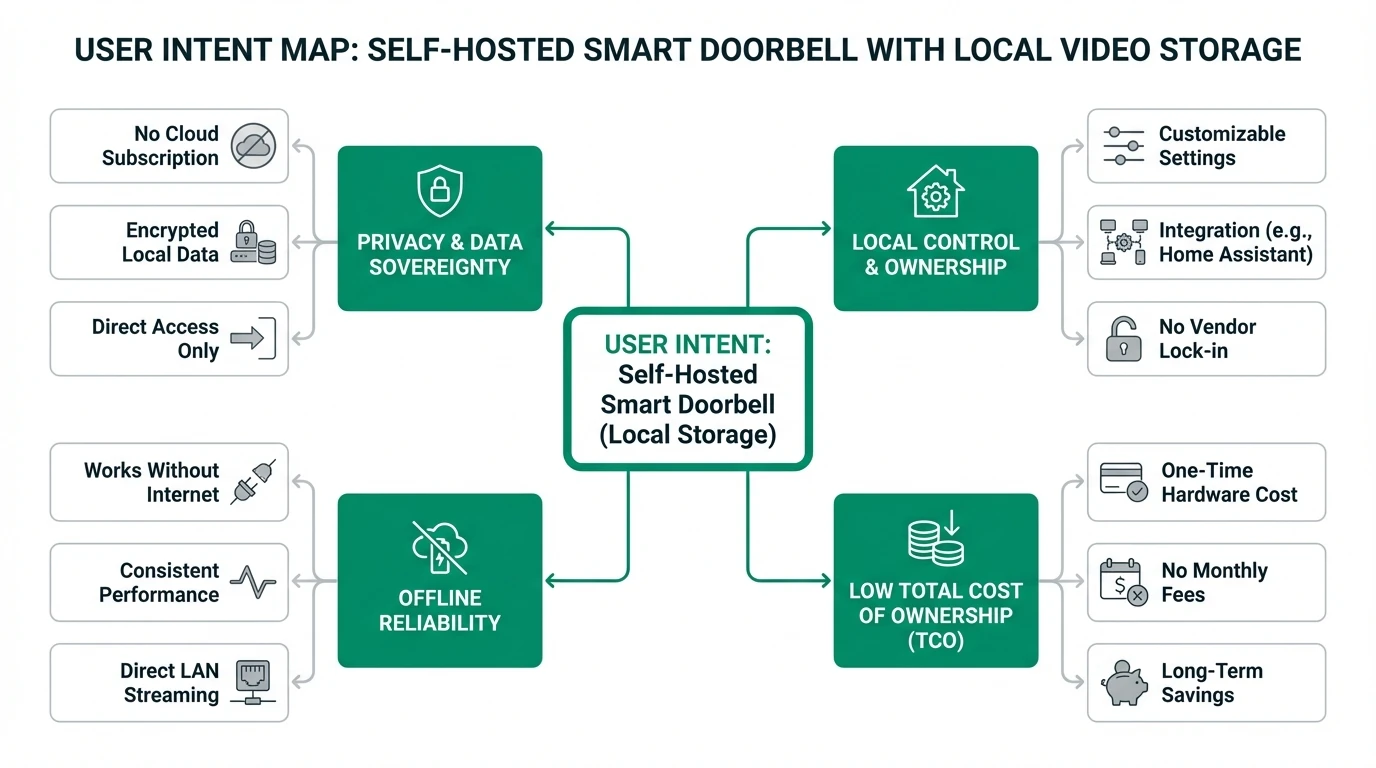
In an era where privacy concerns are paramount, self-hosted smart doorbells with local video storage offer a compelling solution for homeowners. These devices prioritize user control over footage, ensuring that sensitive data remains within the confines of your home. Unlike cloud-dependent systems, they provide offline reliability, recording even during internet outages, and eliminate recurring subscription fees, reducing the total cost of ownership. This guide evaluates top contenders in the market, focusing on privacy, local control, offline reliability, and cost efficiency.
Bottom line: For those seeking a secure, cost-effective, and reliable smart doorbell solution, self-hosted options with local storage are the way to go. They provide peace of mind by keeping your data private and accessible without ongoing costs.
Privacy and Local Control
Privacy is a critical concern for users of smart doorbells, especially when it comes to video footage. Self-hosted systems with local storage ensure that your data remains private, with no mandatory cloud storage that could expose your footage to third-party access. According to Reolink’s guide on doorbell cameras with local storage, devices like the Reolink and Eufy doorbells offer on-device storage options, such as microSD cards or NVRs, allowing users to manage and delete footage as needed12. SafeHome.org provides additional guidance on subscription-free options.
Local control is another significant advantage of self-hosted smart doorbells. These systems allow users to access and manage their footage without relying on external servers or subscriptions. For instance, the Reolink Home Hub supports up to 16TB of storage, providing ample space for video recordings without the need for cloud services3. This level of control is crucial for users who want to avoid vendor lock-in and maintain autonomy over their security systems.
Encryption options further enhance the privacy of self-hosted smart doorbells. While not all devices offer end-to-end encryption, some, like the Aqara G4, integrate with HomeKit Secure Video for added security3. This ensures that even if footage is intercepted, it remains protected from unauthorized access. However, users should be aware of the potential risks associated with physical theft or vandalism of on-site storage devices1.
In summary, self-hosted smart doorbells with local storage provide unparalleled privacy and control over video footage. By eliminating the need for cloud storage, users can ensure that their data remains secure and accessible only to them. This makes these devices an ideal choice for privacy-conscious individuals seeking a reliable home security solution.
Privacy score comparison for self-hosted doorbells
| Product | Cloud required | Local storage | Mandatory account | Offline control | Score / 10 |
|---|---|---|---|---|---|
| Reolink PoE Doorbell | No | NVR/SD | No | Excellent | 9.2 |
| TP-Link Tapo D225 | No | microSD | No | Excellent | 9.0 |
| Eufy Doorbell | No | HomeBase | No | Good | 8.5 |
| Aqara G4 | Optional | HomeKit | Optional | Good | 8.2 |
Offline Reliability
Offline reliability is a crucial factor for smart doorbells, ensuring that they continue to function even during internet outages. This capability is particularly important for users in areas with unstable internet connections or those who prefer not to rely on cloud services. Self-hosted smart doorbells excel in this regard, as they can record and store footage locally without needing an active internet connection2.
Battery life is a key consideration for offline reliability. Devices like the TP-Link Tapo D225 boast an impressive 8-month battery life, making them ideal for users who want a low-maintenance solution4. However, it’s important to note that real-world usage can affect battery performance, and users may experience shorter battery life depending on factors such as recording frequency and environmental conditions5.
| Model | Storage Type | Max Capacity | Power |
|---|---|---|---|
| Reolink PoE | NVR / microSD | 16TB | PoE |
| TP-Link Tapo D225 | microSD | 256GB | Battery |
| Eufy | HomeBase / microSD | 16GB | Battery |
| Reolink Battery | microSD | 256GB | Battery |
For those who prefer wired solutions, Power over Ethernet (PoE) models like the Reolink PoE doorbell offer continuous power and recording capabilities1. These devices are particularly suited for users who require 24/7 surveillance and are willing to invest in the necessary cabling infrastructure. PoE models eliminate the need for battery replacements, providing a more consistent and reliable power source.
In conclusion, self-hosted smart doorbells with local storage offer robust offline reliability, ensuring that your home remains secure even when the internet is down. Whether you choose a battery-powered or wired solution, these devices provide peace of mind by maintaining continuous surveillance without relying on external services.
Total Cost of Ownership
The total cost of ownership (TCO) is a significant consideration for users evaluating smart doorbell options. Self-hosted systems with local storage offer a cost-effective alternative to cloud-based solutions, eliminating the need for ongoing subscription fees. This can result in substantial savings over time, as users are not required to pay monthly or annual fees for cloud storage12.
Upfront costs for self-hosted smart doorbells typically range from $100 to $250, depending on the model and features43. For example, the Reolink Battery doorbell is priced around $150, while the Eufy doorbell is available for approximately $13042. Additional costs may include storage expansions, such as microSD cards or NVRs, which can range from $20 for a 256GB microSD card to $300 or more for a high-capacity NVR13.
Hidden costs, such as battery replacements and wiring for PoE models, should also be considered. Battery replacements may be necessary every 6 to 12 months, costing around $30 each5. For PoE models, users may need to invest in Ethernet cabling or PoE injectors, which can add to the overall cost1.
| Model | Upfront | Storage Add-on | Subscription |
|---|---|---|---|
| Reolink PoE | ~$150 | NVR $200+ | None |
| TP-Link Tapo D225 | ~$100 | microSD $20 | None |
| Eufy | ~$130 | HomeBase incl. | None |
Despite these additional expenses, self-hosted smart doorbells with local storage offer a favorable TCO compared to cloud-based alternatives. By avoiding subscription fees, users can save $60 to $180 per year, making these devices a financially sound investment for long-term home security12.
Checklist
- Evaluate upfront costs and potential expansions.
- Consider battery replacement and wiring expenses.
- Calculate long-term savings from avoiding subscription fees.
Expandability and Integration
Expandability is a key feature of self-hosted smart doorbells, allowing users to tailor their systems to meet their specific needs. Many devices offer expandable storage options, such as microSD cards or NVRs, providing flexibility in how footage is stored and managed. For instance, the Reolink Home Hub supports up to 16TB of storage, accommodating extensive video archives without the need for cloud services3.
Integration with existing home setups is another important consideration for users. Self-hosted smart doorbells often support standard protocols like ONVIF, enabling compatibility with a wide range of NVRs and other security devices3. This allows users to create a cohesive home security system that integrates seamlessly with their existing infrastructure.
However, users should be aware of potential ecosystem lock-in when selecting a smart doorbell. Some devices, like the Eufy doorbell, require specific hubs or bases to achieve maximum storage capacity2. While these ecosystems can offer enhanced functionality and ease of use, they may limit users’ ability to mix and match devices from different manufacturers.
In summary, self-hosted smart doorbells with local storage offer significant expandability and integration options, allowing users to customize their home security systems. By choosing devices that support standard protocols and offer flexible storage solutions, users can create a robust and adaptable security setup that meets their unique needs.
Setup Complexity and Support Burden
Setting up a self-hosted smart doorbell can vary in complexity depending on the model and features. Battery-powered models, such as the Reolink and TP-Link Tapo D225, offer a straightforward installation process, typically taking 15 to 30 minutes via a mobile app14. These devices are ideal for users seeking a quick and easy setup without the need for extensive wiring or technical expertise.
In contrast, PoE and NVR-based systems may require more involved installation, including running Ethernet cables and configuring network settings1. While this can be more time-consuming, it provides a more reliable and consistent power source, making it suitable for users who prioritize 24/7 surveillance.
Support burden is another consideration for users of self-hosted smart doorbells. Without the backing of a subscription service, users must rely on self-help resources and community forums for troubleshooting and support1. Firmware updates are typically managed through mobile apps, ensuring that devices remain up-to-date with the latest features and security patches3.
Despite the potential challenges, self-hosted smart doorbells offer a self-reliant solution that empowers users to manage their home security systems independently. By choosing a device that aligns with their technical expertise and support preferences, users can enjoy the benefits of a secure and reliable smart doorbell without the constraints of a subscription service.
Security and Privacy Implications
Security and privacy are paramount when selecting a smart doorbell, and self-hosted systems with local storage offer significant advantages in these areas. By keeping video footage on-site, users can ensure that their data remains private and secure, free from the risks associated with cloud storage2. This is particularly important for users who prioritize privacy and want to maintain control over their video recordings.
Local storage also provides protection against data loss during internet outages, ensuring that footage is continuously recorded and accessible even when the internet is down2. This offline capability is a key advantage of self-hosted systems, as it prevents gaps in surveillance coverage that can occur with cloud-dependent devices.
However, users should be aware of potential risks associated with physical storage, such as theft or vandalism1. To mitigate these risks, users can implement additional security measures, such as securing storage devices in tamper-proof enclosures or using encrypted storage solutions3. While most devices automatically overwrite the oldest footage to manage storage capacity, users should regularly back up important recordings to prevent data loss2.
In conclusion, self-hosted smart doorbells with local storage offer robust security and privacy benefits, making them an ideal choice for users seeking a reliable and private home security solution. By understanding the potential risks and implementing appropriate safeguards, users can enjoy the peace of mind that comes with complete control over their video footage.
FAQ
Frequently Asked Questions
What is the best self-hosted smart doorbell for privacy?
The Reolink PoE model is highly recommended for privacy due to its local storage capabilities and encryption options.
How does local storage improve offline reliability?
Local storage ensures that footage is recorded and accessible even during internet outages, providing continuous surveillance.
Are there any hidden costs with self-hosted smart doorbells?
Potential hidden costs include battery replacements, wiring for PoE models, and storage expansions like microSD cards or NVRs.
Can self-hosted smart doorbells integrate with existing home security systems?
Yes, many self-hosted smart doorbells support standard protocols like ONVIF, allowing integration with a wide range of security devices.
What are the risks associated with local storage?
Risks include physical theft or vandalism of storage devices and potential data loss if footage is not regularly backed up.
Primary Sources Table
| Index | Title/Description | Direct URL |
|---|---|---|
| [1] | Doorbell Cameras with Local Storage: A Comprehensive Guide (Reolink) | https://reolink.com/blog/doorbell-cameras-with-local-storage/ |
| [2] | Best smart video doorbells that store locally (not in the cloud) (Android Central) | https://www.androidcentral.com/best-smart-video-doorbells-store-locally-not-cloud |
| [3] | A Guide to Subscription-Free Smart Doorbell Cameras (SafeHome.org) | https://www.safehome.org/doorbell-cameras/best/no-subscription/ |
| [4] | Top 3 Ring alternative video doorbells with local storage (TechRadar) | https://www.techradar.com/home/home-security/i-test-smart-home-tech-for-a-living-and-these-are-the-top-3-ring-alternative-video-doorbells-i-recommend-with-local-storage-for-your-videos |
| [5] | Best Video Doorbell Cameras Without a Subscription (Consumer Reports) | https://www.consumerreports.org/home-garden/home-security-cameras/best-video-doorbell-cameras-without-a-subscription-a1134473783/ |
Conclusion
In the quest for a secure and cost-effective home security solution, self-hosted smart doorbells with local video storage stand out as a superior choice. By prioritizing privacy, offline reliability, and total cost of ownership, these devices offer users complete control over their video footage without the constraints of cloud-based systems. Whether you opt for a battery-powered model for ease of installation or a PoE system for continuous power, self-hosted smart doorbells provide the flexibility and security needed to protect your home effectively.
Explore related guides for more insights:
- Apple HomeKit Secure Video vs Local NVR for Privacy
- Best Local Storage Security Cameras Without Subscription 2026
- Best Open Source Smart Home Software for Privacy Advocates
Footnotes
-
Doorbell Cameras with Local Storage: A Comprehensive Guide (Reolink) ↩ ↩2 ↩3 ↩4 ↩5 ↩6 ↩7 ↩8 ↩9 ↩10 ↩11
-
A Guide to Subscription-Free Smart Doorbell Cameras (SafeHome.org) ↩ ↩2 ↩3 ↩4 ↩5 ↩6 ↩7 ↩8 ↩9
-
Best Video Doorbell Cameras Without a Subscription (Consumer Reports) ↩ ↩2 ↩3 ↩4 ↩5 ↩6 ↩7 ↩8
-
Best smart video doorbells that store locally (not in the cloud) (Android Central) ↩ ↩2 ↩3 ↩4
-
Top 3 Ring alternative video doorbells with local storage (TechRadar) ↩ ↩2