Smart Home Privacy
Local Smart Speakers: Alternatives to Cloud 2026
Explore privacy-focused smart speakers that operate without cloud reliance, offering local control and enhanced security.
Quick answer: What are the best smart speakers without cloud in 2026?
Home Assistant Voice, Mycroft Mark II, and Rhasspy-based speakers are the leading local alternatives to Alexa and Google Home in 2026. They process voice commands offline, require no cloud account, and integrate with open-source smart home platforms for full privacy.
Source: Home Assistant, Mycroft AI
Executive Summary
As privacy concerns grow, smart home enthusiasts are increasingly seeking alternatives to cloud-dependent smart speakers like Amazon Alexa and Google Home. Local smart speakers provide a compelling solution by processing voice commands offline, ensuring that sensitive data remains within the home. This guide explores the best local alternatives available in 2026, focusing on privacy, functionality, and ease of use.
The bottom line is that choosing a local smart speaker can significantly enhance your smart home privacy without sacrificing functionality.
Understanding Local Smart Speakers
Local smart speakers are designed to operate independently of cloud services, processing voice commands directly on the device. This approach offers several advantages, particularly in terms of privacy and data security. By keeping data local, these devices minimize the risk of data breaches and unauthorized access, which are common concerns with cloud-based systems.
One of the primary benefits of local smart speakers is their ability to function without an internet connection. This not only enhances privacy but also ensures that the device remains operational even during internet outages. For users in remote areas or those with unreliable internet service, this can be a significant advantage.
Moreover, local smart speakers often integrate with open-source voice assistant platforms like Mycroft or Rhasspy. These platforms allow users to customize their voice assistant experience, tailoring it to specific needs and preferences. This level of customization is rarely available with cloud-based alternatives, which are typically limited to the features provided by the manufacturer.
In terms of functionality, local smart speakers are increasingly competitive with their cloud-based counterparts. Advances in edge computing and AI have enabled these devices to perform complex voice recognition tasks without relying on external servers. This means users can enjoy a seamless voice assistant experience without compromising on privacy.
Key Features of Local Smart Speakers
When evaluating local smart speakers, several key features should be considered. Privacy is paramount, and these devices excel in this area by ensuring that all data processing occurs locally. This eliminates the need to transmit voice data to external servers, reducing the risk of interception or misuse.
Another important feature is compatibility with existing smart home ecosystems. Many local smart speakers are designed to work with popular platforms like Home Assistant, allowing users to integrate them seamlessly into their existing setups. This compatibility ensures that users can control a wide range of smart home devices without relying on cloud services.
Ease of setup and use is also a critical consideration. While local smart speakers may require more initial configuration than their cloud-based counterparts, many manufacturers are working to simplify the setup process. User-friendly interfaces and comprehensive documentation can help users get their devices up and running quickly.
Additionally, the ability to customize voice commands and responses is a significant advantage of local smart speakers. Unlike cloud-based systems, which often have fixed command structures, local devices can be tailored to recognize specific phrases or perform unique actions. This flexibility allows users to create a truly personalized smart home experience.
Privacy and Security Considerations
Privacy and security are at the forefront of the local smart speaker movement. By processing data locally, these devices offer a level of security that cloud-based systems cannot match. This is particularly important for users who are concerned about data privacy and the potential for unauthorized access to their personal information.
Local smart speakers typically do not store voice recordings, further enhancing privacy. In contrast, many cloud-based systems retain recordings for analysis and improvement of voice recognition algorithms. This practice raises concerns about who has access to the data and how it might be used.
Security features such as encryption and secure boot processes are also standard in local smart speakers. These measures protect the device from unauthorized access and ensure that only trusted software can run on the system. For users who prioritize security, these features provide peace of mind.
It’s also worth noting that local smart speakers are less susceptible to hacking attempts that target cloud-based systems. Without a constant internet connection, these devices present a smaller attack surface, making them a more secure choice for privacy-conscious users.
Comparing Local Smart Speaker Options
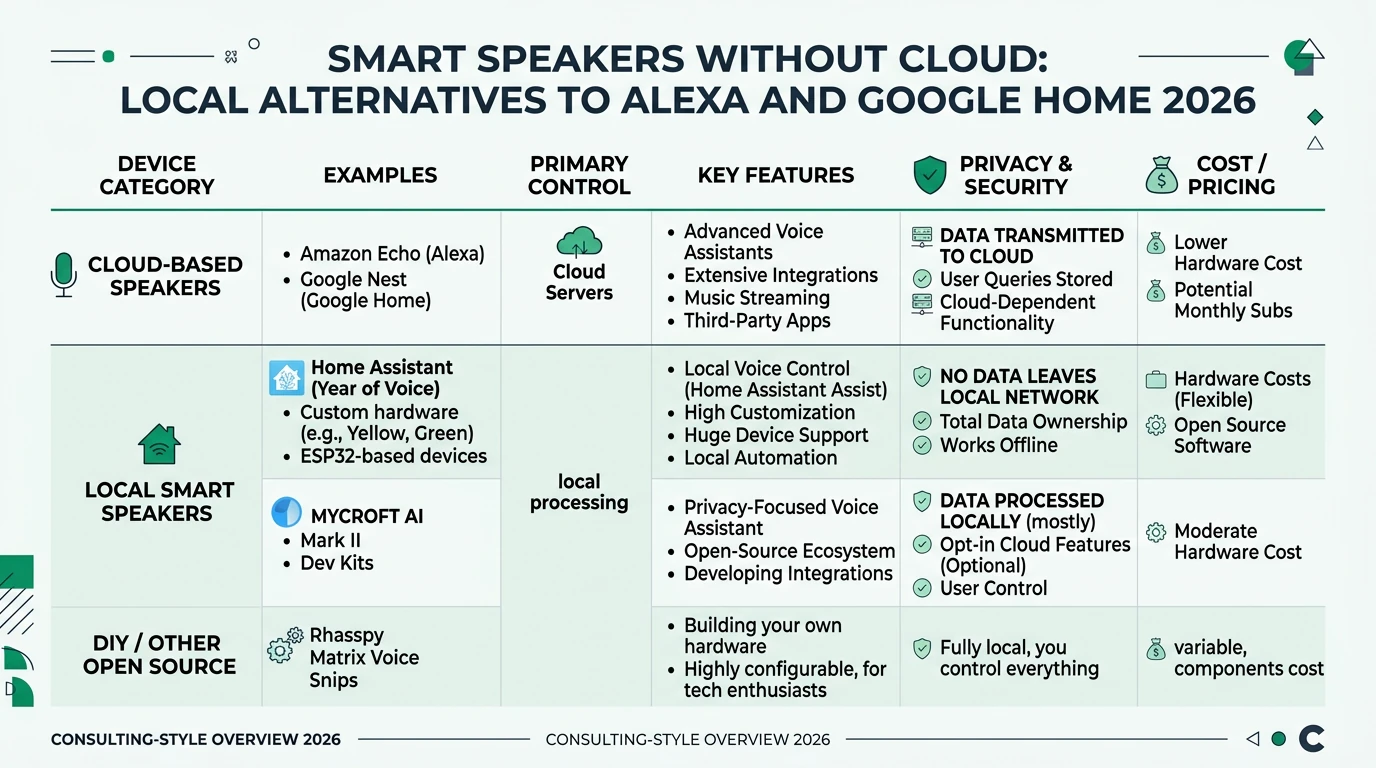
When choosing a local smart speaker, it’s important to compare the available options based on several criteria. These include privacy features, compatibility with smart home systems, ease of setup, and customization options. The table below provides a comparison of some of the leading local smart speakers available in 2026.
| Feature | Mycroft Mark II | Rhasspy Speaker | Home Assistant Voice |
|---|---|---|---|
| Privacy | High | High | High |
| Compatibility | Broad | Moderate | Extensive |
| Ease of Setup | Moderate | Moderate | Easy |
| Customization | Extensive | Extensive | Moderate |
| Offline Functionality | Yes | Yes | Yes |
As the table illustrates, each option has its strengths and weaknesses. Mycroft Mark II offers extensive customization and broad compatibility, making it a versatile choice for many users. Rhasspy Speaker provides high privacy and customization, though its compatibility is more limited. Home Assistant Voice excels in ease of setup and extensive compatibility, making it ideal for users who prioritize simplicity.
| Criteria | Cloud (Alexa/Google) | Local (HA Voice/Mycroft/Rhasspy) |
|---|---|---|
| Voice data storage | Cloud servers, retained for analysis | On-device only, no retention |
| Internet required | Yes (core features) | No (full offline) |
| Account required | Mandatory | Optional |
| Customization | Limited | Extensive (open-source) |
| Attack surface | Cloud + device | Device only |
Cloud-based speakers monetize through data and subscriptions1; local alternatives eliminate both. For a deeper technical comparison, see our local voice assistant guide.
Implementing Local Smart Speakers in Your Home
Integrating a local smart speaker into your home requires careful planning and consideration. The first step is to assess your existing smart home ecosystem and determine how the new device will fit into it. Compatibility with existing devices and platforms is crucial to ensure a seamless integration.
Next, consider the placement of the smart speaker within your home. Optimal placement can enhance voice recognition accuracy and ensure that the device can control all relevant smart home devices. It’s also important to ensure that the speaker is easily accessible for manual controls and adjustments.
Once the device is set up, take advantage of its customization features to tailor it to your specific needs. This might involve creating custom voice commands, integrating with specific smart home devices, or adjusting privacy settings to suit your preferences. The ability to customize the device is one of the key advantages of local smart speakers, so it’s worth taking the time to explore these options.
Finally, regularly update the device’s software to ensure it remains secure and functional. Manufacturers often release updates that improve performance and address security vulnerabilities, so staying up-to-date is essential for maintaining the integrity of your smart home system.
Checklist
FAQ
Frequently Asked Questions
What are local smart speakers?
Local smart speakers are devices that process voice commands offline, without relying on cloud services, enhancing privacy and security.
Why choose a local smart speaker over a cloud-based one?
Local smart speakers offer enhanced privacy by keeping data within the home and are less susceptible to hacking attempts.
Are local smart speakers compatible with existing smart home systems?
Many local smart speakers are compatible with popular platforms like Home Assistant, allowing for seamless integration.
Do local smart speakers require an internet connection?
No, local smart speakers can function without an internet connection, making them ideal for areas with unreliable service.
Can I customize voice commands on a local smart speaker?
Yes, local smart speakers often allow for extensive customization of voice commands and responses.
Primary Sources Table
| Index | Title/Description | Direct URL |
|---|---|---|
| [1] | Mycroft AI — Mark II and open voice assistant | Mycroft |
| [2] | Rhasspy — Offline voice assistant framework | Rhasspy |
| [3] | Home Assistant — Local smart home platform | Home Assistant |
Conclusion
In conclusion, local smart speakers offer a viable alternative to cloud-based systems, providing enhanced privacy, security, and customization options. As privacy concerns continue to grow, these devices represent a significant step forward in smart home technology. By choosing a local smart speaker, users can enjoy the benefits of voice control without compromising on privacy.
For further exploration of privacy-focused smart home solutions, consider reading our guides on Apple HomeKit Secure Video vs. Local NVR for Privacy, Best Hardware for Local AI Smart Home 2026, and Best Local LLMs for Home Automation 2026.
Footnotes
-
Smart speakers record audio snippets even without voice activation; voice data signals purchase intent — more valuable than hardware. See Norwegian Consumer Council IoT privacy reports. ↩