Smart Home Privacy
Sonoff Zigbee Bridge vs SLZB-06 vs ConBee for HA
Sonoff Zigbee Bridge vs SLZB-06 vs ConBee II for Home Assistant in 2026: Ethernet vs USB, firmware paths, RF power, and which coordinator keeps Zigbee traffic local.
Quick answer: Which Zigbee coordinator should I buy for Home Assistant in 2026?
Ethernet coordinators like SLZB-06 reduce USB extension issues and keep the radio away from noisy servers. ConBee II remains a proven deCONZ path. Sonoff bridges work but often need firmware attention—validate Zigbee2MQTT or ZHA compatibility before you buy.
Source: Zigbee2MQTT supported adapters
Executive Summary
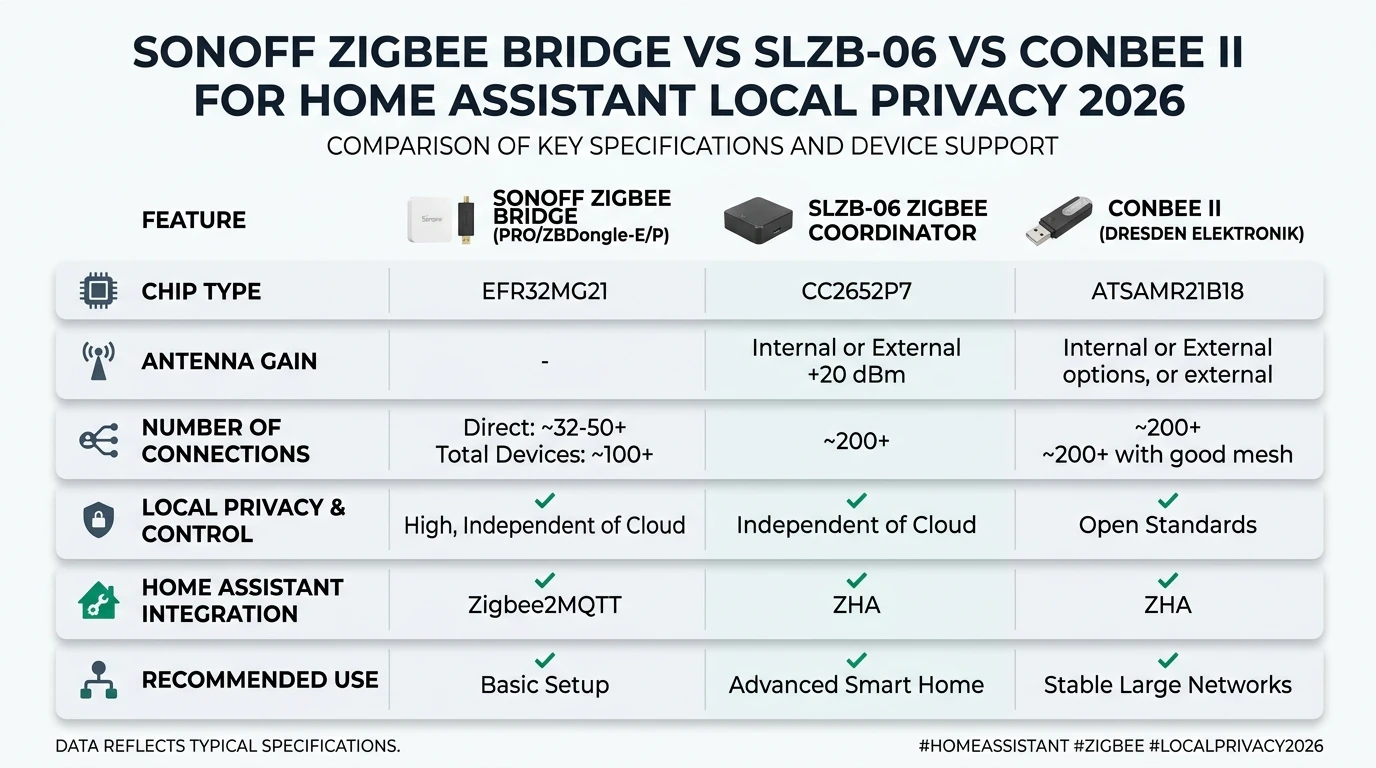
In 2026, choosing the right Zigbee coordinator for Home Assistant is crucial for maintaining local privacy and offline reliability. This guide compares the Sonoff Zigbee Bridge, SLZB-06, and ConBee II. Pair hardware choices with Zigbee2MQTT vs ZHA vs deCONZ and best Thread border routers when you mix Matter and Zigbee. The SLZB-06 often wins for placement and Ethernet; ConBee remains the deCONZ reference.
Bottom line: For a privacy-focused, reliable, and cost-effective Zigbee coordinator in 2026, the SLZB-06 is the optimal choice for Home Assistant users.
| Pick when | Coordinator |
|---|---|
| You want Ethernet + PoE options | SLZB-06 family |
| You run deCONZ / Phoscon | ConBee II / III |
| Budget bridge + tinkerer firmware | Sonoff Zigbee Bridge |
Privacy and Local Control
When it comes to privacy and local control, the SLZB-06 stands out as the most secure option. It operates entirely locally with support for ZHA and Zigbee2MQTT (Z2M), ensuring no data is sent to the cloud. This is crucial for users who prioritize privacy and want to avoid any potential data leakage. The open-source firmware support further enhances its privacy credentials, allowing users to customize and control their setup without relying on vendor-specific applications.
In contrast, the Sonoff Zigbee Bridge, while capable of local operation, often defaults to cloud-based services via eWeLink, unless custom firmware is flashed. This presents a potential privacy risk if users are not diligent about configuring their devices for local control. The ConBee II, meanwhile, offers local control through deCONZ and Z2M, but its reliance on USB connections can limit flexibility in placement and integration.
The SLZB-06’s privacy-first design is complemented by its robust local control capabilities. It supports a wide range of devices and protocols, including Zigbee, Thread, and Bluetooth, making it a versatile choice for smart home enthusiasts. This flexibility ensures that users can maintain a high level of privacy while integrating a diverse array of devices into their Home Assistant setup.
Overall, for users who prioritize privacy and local control, the SLZB-06 offers the most comprehensive solution. Its ability to operate entirely offline and its support for open-source firmware make it the ideal choice for those looking to safeguard their smart home data.
Offline Reliability and Network Capacity
Offline reliability is a critical factor for any smart home setup, particularly for those who want their systems to function seamlessly without an internet connection. The SLZB-06 excels in this area, boasting a powerful EFR32MG24 chip with a +20dBm antenna gain, ensuring strong and reliable connectivity even in large homes or complex environments. This makes it particularly suitable for networks with 20 or more devices, where maintaining a stable connection is essential.
The Sonoff Zigbee Bridge offers decent offline reliability, especially when configured with custom firmware. It supports up to 256 devices, making it a viable option for larger networks. However, its reliance on WiFi or Ethernet connections can introduce potential points of failure, particularly if the network infrastructure is not robust.
The ConBee II, while reliable for smaller setups, has been reported to experience delays and unavailability issues in networks with more than 20 devices. This can be a significant drawback for users with larger networks or those who require consistent performance from their smart home devices. Its reliance on USB connections can also limit its placement options, potentially impacting signal strength and reliability.
For users with large networks or those who require maximum offline reliability, the SLZB-06 is the clear winner. Its superior chip and antenna design ensure consistent performance, even in challenging environments, making it the best choice for maintaining a stable and reliable smart home network.
Total Cost of Ownership
When evaluating the total cost of ownership (TCO) for Zigbee coordinators, it’s important to consider not only the initial purchase price but also ongoing costs such as power consumption and maintenance. The SLZB-06, priced between $50 and $70, offers excellent value for money, particularly for larger networks. Its support for Power over Ethernet (PoE) can reduce power costs and simplify installation, further enhancing its cost-effectiveness.
The Sonoff Zigbee Bridge, with an estimated price range of $40 to $60, also offers good value, especially for users who can leverage its cloud features. However, the need to flash custom firmware for optimal privacy and local control can add to the setup complexity and time investment. Additionally, its reliance on WiFi can increase power consumption, impacting the overall TCO.
The ConBee II, while the most affordable option at $30 to $40, carries potential risks due to its end-of-life status and reported reliability issues. Users may face additional costs for replacements or troubleshooting, particularly if they encounter performance issues in larger networks. Its USB connection also necessitates additional accessories, such as USB extensions, which can add to the overall cost.
For users seeking a balance between cost and performance, the SLZB-06 offers the best TCO. Its robust performance, low maintenance requirements, and support for PoE make it a cost-effective choice for both small and large networks.
Integration with Home Assistant
Integration with Home Assistant is a key consideration for any Zigbee coordinator, as it determines how seamlessly the device can be incorporated into an existing smart home setup. The SLZB-06 offers native support for both ZHA and Zigbee2MQTT, making it an ideal choice for Home Assistant users. Its compatibility with multiple protocols, including Zigbee, Thread, and Bluetooth, ensures broad device support and flexibility.
The Sonoff Zigbee Bridge also supports integration with Home Assistant via ZHA and Z2M, but users may need to flash custom firmware to achieve optimal performance and privacy. This can add complexity to the setup process, particularly for users who are not familiar with firmware flashing.
The ConBee II, while compatible with Home Assistant through deCONZ and Z2M, requires additional software installation and configuration. Its reliance on USB connections can also complicate integration, particularly for users with limited USB ports or those using network-attached storage devices.
For users seeking seamless integration with Home Assistant, the SLZB-06 offers the most straightforward and flexible solution. Its native support for multiple protocols and ease of setup make it the best choice for users looking to expand their smart home network with minimal hassle.
Security and Privacy Implications
Security and privacy are paramount concerns for smart home users, and each of the Zigbee coordinators discussed here offers varying levels of protection. The SLZB-06 is designed with privacy in mind, operating entirely locally and supporting open-source firmware. This ensures that no data is sent to the cloud, providing peace of mind for users concerned about data privacy.
The Sonoff Zigbee Bridge, while capable of local operation, often defaults to cloud-based services, which can pose a privacy risk. Users must be proactive in configuring their devices to operate locally, potentially requiring custom firmware flashing to achieve the desired level of privacy.
The ConBee II offers local control through deCONZ and Z2M, but its reliance on USB connections can introduce potential security vulnerabilities, particularly if the device is not properly secured. Additionally, its end-of-life status may result in reduced security updates and support, increasing the risk of vulnerabilities over time.
For users prioritizing security and privacy, the SLZB-06 offers the most robust solution. Its local operation, support for open-source firmware, and strong community support make it the best choice for safeguarding smart home data.
Setup Complexity and Support Burden
The complexity of setting up a Zigbee coordinator can vary significantly between devices, impacting the overall user experience. The SLZB-06 offers the simplest setup process, with out-of-the-box support for ZHA and Z2M and a user-friendly web interface for firmware updates. Its support for PoE and WiFi also allows for flexible placement, reducing the setup burden.
The Sonoff Zigbee Bridge requires a moderate level of setup complexity, particularly if users choose to flash custom firmware for optimal privacy and performance. While community support is available, users may need to invest time in learning how to configure their devices properly.
The ConBee II presents the highest setup complexity, requiring additional software installation and configuration through deCONZ. Its reliance on USB connections can also complicate setup, particularly for users with limited USB ports or those using network-attached storage devices.
For users seeking a straightforward setup process with minimal support burden, the SLZB-06 is the best choice. Its ease of use, flexible placement options, and strong community support make it an ideal option for both novice and experienced users.
Checklist
- Evaluate privacy needs
- Consider network size
- Assess setup complexity
- Review TCO
- Check integration options
FAQ
Frequently Asked Questions
Which Zigbee coordinator is best for privacy?
The SLZB-06 is the best choice for privacy, as it operates entirely locally and supports open-source firmware, ensuring no data is sent to the cloud.
How does the SLZB-06 compare in terms of offline reliability?
The SLZB-06 offers superior offline reliability with its powerful EFR32MG24 chip and +20dBm antenna gain, making it ideal for large networks.
What are the setup complexities of the Sonoff Zigbee Bridge?
The Sonoff Zigbee Bridge requires moderate setup complexity, especially if custom firmware is needed for optimal privacy and performance.
Is the ConBee II still a viable option in 2026?
While affordable, the ConBee II faces end-of-life risks and potential reliability issues in larger networks, making it less ideal for future-proofing.
What is the total cost of ownership for these coordinators?
The SLZB-06 offers the best TCO, with low maintenance costs and support for PoE, making it cost-effective for both small and large networks.
Primary Sources Table
| Index | Title/Description | Direct URL |
|---|---|---|
| [1] | Zew Zigbee Coordinator SONOFF - Home Assistant Community | HA Community |
| [2] | Best Zigbee Coordinators for Home Assistant 2026 | SmartHomeScene |
| [3] | What’s the BEST Zigbee Coordinator for Home Assistant? SMLight … (YouTube) | YouTube |
| [4] | Replace a Conbee II · Koenkk zigbee2mqtt · Discussion #14861 | GitHub |
| [5] | Best Zigbee USB dongle - Off-Topic - Homey Community Forum | Homey |
| [6] | The Home Automation Must Buy - SLZB-06M & Zigbee2MQTT (YouTube) | YouTube |
| [7] | Ultimate Guide to Zigbee Gateways SONOFF Zigbee USB Dongles vs. Bridges | SONOFF |
| [8] | Review SMLIGHT SLZB-06 – The Best ZigBee coordinator for Home Assistant | Creating Smart Home |
Conclusion
In the evolving landscape of smart home technology, choosing the right Zigbee coordinator is essential for maintaining privacy, reliability, and cost-effectiveness. The SLZB-06 emerges as the top choice for Home Assistant users in 2026, offering unparalleled local privacy, robust offline reliability, and a favorable total cost of ownership. Its ease of integration and support for multiple protocols make it a versatile and future-proof option for any smart home setup.
Explore more about smart home privacy in our related guides on Apple HomeKit Secure Video vs Local NVR for Privacy, Aqara vs Shelly vs Tuya Privacy 2026, Best Hardware for Local AI Smart Home 2026, and smart lighting without cloud.