Comparisons
Tailscale vs WireGuard vs ZeroTier: Smart Home Access
Compare Tailscale, WireGuard, and ZeroTier for smart home remote access in 2026, focusing on privacy, cost, and setup complexity.
Quick answer:
Executive Summary
As smart homes become increasingly sophisticated, the need for secure and efficient remote access solutions grows. Tailscale, WireGuard, and ZeroTier are three prominent options, each with distinct strengths. This guide evaluates these platforms based on protocol efficiency, privacy, cost, and ease of setup, helping you make an informed decision for your smart home in 2026.
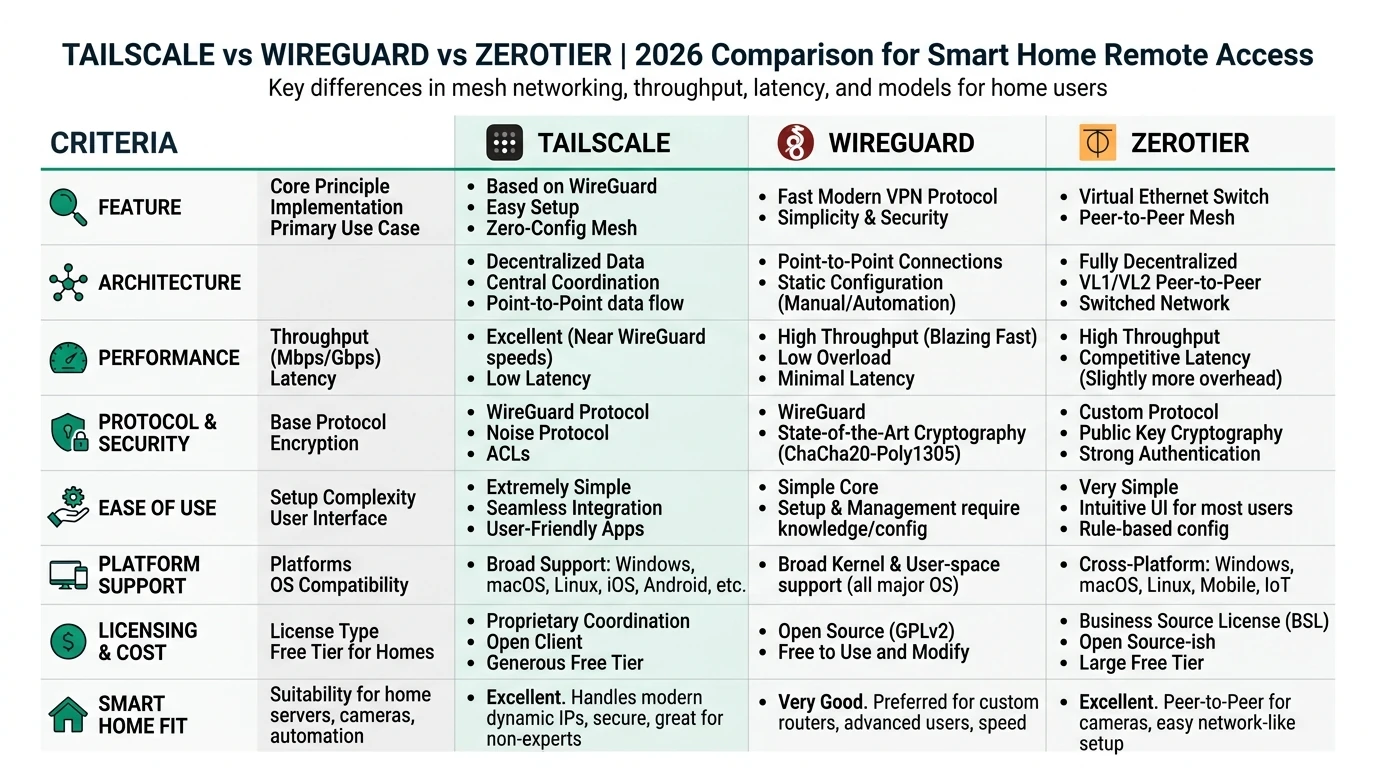
Tailscale leverages the robust WireGuard protocol, offering a user-friendly experience with automatic configuration and identity-based access. It’s ideal for those who prioritize simplicity and minimal setup time. WireGuard, known for its minimalistic design and high performance, suits environments where speed and security are paramount, albeit at the cost of increased setup complexity. ZeroTier stands out with its Layer 2 networking capabilities, making it a versatile choice for advanced networking scenarios, including multicast and bridging.
Bottom line: Choose Tailscale for ease of use, WireGuard for performance, and ZeroTier for advanced networking features.
Understanding Protocol Foundations
The foundation of each VPN solution significantly impacts its performance and suitability for smart home applications. Tailscale builds on the WireGuard protocol, known for its simplicity and speed. By integrating identity-based authentication, Tailscale simplifies the setup process, making it accessible to users without extensive networking knowledge. This approach is particularly beneficial for smart home environments where ease of use is crucial.
WireGuard, on the other hand, is a lightweight VPN protocol designed for high performance and security. Its minimal codebase reduces the attack surface, enhancing security. However, this simplicity comes at the cost of requiring manual configuration, which can be daunting for users unfamiliar with networking concepts. Despite this, WireGuard’s performance makes it an attractive option for those who prioritize speed and security.
ZeroTier employs a custom Layer 2 protocol, offering unique features like multicast and bridging. This makes it suitable for complex networking scenarios where traditional VPNs might fall short. ZeroTier’s ability to operate as a virtual network switch allows for seamless integration with various smart home devices, supporting advanced networking needs such as local network discovery and device communication.
Understanding these foundational differences is crucial when selecting a VPN solution for your smart home. Each protocol offers distinct advantages, and your choice should align with your specific needs and technical expertise.
Performance and Latency Considerations
Performance is a critical factor when choosing a VPN for smart home remote access. Tailscale, leveraging the WireGuard protocol, achieves impressive throughput rates between 2.3 and 3.0 Gbps, closely matching native WireGuard performance. This makes Tailscale an excellent choice for bandwidth-intensive applications, such as streaming security camera feeds or managing multiple smart devices simultaneously.
WireGuard, as the baseline protocol, offers maximum performance with minimal latency. Its efficiency is evident in environments where low latency is crucial, such as real-time device control and monitoring. However, achieving this performance requires careful configuration and management, which can be challenging for users without networking expertise.
ZeroTier, while offering lower throughput compared to Tailscale and WireGuard, provides unique advantages with its Layer 2 capabilities. Its throughput ranges from 800 to 1200 Mbps, which is sufficient for most smart home applications. The added latency due to userspace processing is a trade-off for the advanced networking features it offers, such as multicast and Ethernet bridging.
When evaluating these solutions, consider your specific performance needs. If high throughput and low latency are priorities, Tailscale and WireGuard are strong contenders. However, if your smart home setup requires advanced networking capabilities, ZeroTier’s trade-off in performance may be justified.
Privacy and Security Implications
Privacy and security are paramount when selecting a VPN for smart home remote access. Tailscale, built on WireGuard’s cryptographic standards, offers robust security features. Its centralized coordination model, however, means that Tailscale servers can access metadata about device connections. While this does not include the content of encrypted traffic, it may be a concern for privacy-conscious users.
WireGuard’s minimalistic design minimizes the attack surface, enhancing security. It operates without centralized coordination, eliminating third-party metadata exposure. This makes WireGuard an attractive option for users who prioritize privacy and are willing to manage the additional setup complexity.
ZeroTier’s open-source nature allows for code inspection, providing transparency in its security practices. Users can self-host ZeroTier to eliminate third-party metadata exposure, offering a high degree of privacy control. Its Layer 2 capabilities require careful configuration to prevent unintended network exposure, but they also enable advanced features like local network discovery.
For smart home users, privacy considerations should align with your comfort level regarding metadata exposure and your willingness to manage configuration complexity. Each solution offers different privacy models, and your choice should reflect your priorities and technical capabilities.
Setup Complexity and Operational Overhead
Ease of setup and ongoing management are crucial factors when choosing a VPN for smart home remote access. Tailscale excels in this area, offering a zero-touch setup process with OAuth login and automatic peer discovery. This simplicity reduces the operational overhead, making Tailscale an ideal choice for users who prefer a hassle-free experience.
WireGuard, while offering high performance, requires manual key generation and peer configuration. This complexity can be a barrier for users without networking expertise, increasing the operational burden. However, for those with the technical skills, WireGuard provides a highly secure and efficient solution.
ZeroTier strikes a balance between ease of use and advanced features. Its web interface simplifies network creation and client authorization, reducing the complexity compared to WireGuard. The option to self-host ZeroTier provides additional control, appealing to users who value privacy and are willing to manage the associated infrastructure.
When considering setup complexity, evaluate your technical expertise and the resources available for managing your smart home network. Tailscale offers the simplest setup, while ZeroTier provides a middle ground with more control and features. WireGuard, though complex, is unmatched in performance for those who can manage its setup.
Checklist
- Evaluate your technical expertise
- Consider the number of devices
- Assess privacy concerns
- Determine performance needs
- Review setup complexity
Cost Analysis and Total Ownership
Cost is a significant consideration when selecting a VPN solution for smart home remote access. Tailscale offers a free tier for up to three users with unlimited devices, making it an attractive option for small setups. However, its paid tiers, ranging from $10 to $20 per user per month, can become costly for larger deployments.
WireGuard, being open source, incurs no licensing costs. However, the hidden costs associated with its setup and maintenance can be significant, especially for dynamic environments. The need for external coordination tools and potential infrastructure costs for self-hosting should be factored into the total cost of ownership.
ZeroTier provides a free tier with unlimited devices on a single network, which is beneficial for small to medium-sized smart home setups. Its paid tier, at $29.99 per month, offers advanced features and multiple networks. The option to self-host ZeroTier can reduce costs but requires investment in infrastructure and management resources.
When evaluating costs, consider both the direct expenses and the hidden costs associated with setup and maintenance. Tailscale offers simplicity at a higher price point, while WireGuard provides cost savings for those with the technical expertise to manage its complexity. ZeroTier balances cost and features, making it a versatile option for various smart home scenarios.
| Scenario | Tailscale | WireGuard | ZeroTier |
|---|---|---|---|
| Single user, 5-10 devices | $0 (free tier) | $0 + setup time | $0 (free tier) |
| Multiple users, 20+ devices | $120-240/year | $0 + high setup burden | $360/year (paid tier) |
| Self-hosted infrastructure | N/A | $50-200/year VPS | $50-200/year VPS |
Recommended Use Cases and Decision Criteria
Choosing the right VPN solution for your smart home involves evaluating your specific needs and priorities. Tailscale is ideal for users who prioritize ease of use and minimal operational overhead. Its automatic configuration and identity-based access make it a convenient choice for those who want a hassle-free experience.
WireGuard is best suited for environments where performance and security are paramount. Its minimalistic design offers high throughput and low latency, making it ideal for bandwidth-intensive applications. However, its manual configuration requirements mean it’s best for users with advanced technical expertise.
ZeroTier offers unique advantages with its Layer 2 networking capabilities, making it suitable for complex networking scenarios. Its ability to support multicast and bridging allows for advanced smart home setups, such as local network discovery and device communication. ZeroTier’s self-hosting option provides additional privacy control, appealing to users who value both privacy and advanced features.
When deciding which solution to use, consider your need for Layer 2 features, ease of setup, and privacy concerns. Each solution offers distinct advantages, and your choice should align with your specific requirements and technical capabilities.
FAQ
Frequently Asked Questions
What is the best VPN for smart home remote access?
The best VPN depends on your specific needs. Tailscale is great for ease of use, WireGuard for performance, and ZeroTier for advanced networking features.
How does Tailscale ensure privacy?
Tailscale uses WireGuard’s cryptographic standards for secure connections but involves centralized coordination, which may expose metadata.
Can I self-host ZeroTier?
Yes, ZeroTier can be self-hosted, allowing you to eliminate third-party metadata exposure and maintain control over your network.
Is WireGuard suitable for non-technical users?
WireGuard requires manual configuration, making it less suitable for non-technical users unless they are willing to invest time in learning.
What are the hidden costs of using WireGuard?
While WireGuard is free, hidden costs include setup time, potential infrastructure for coordination, and ongoing management efforts.
Primary Sources Table
| Source | URL | Type | Relevance | Date |
|---|---|---|---|---|
| Tailscale Official Comparison | tailscale.com/compare/zerotier | Official documentation | Protocol details, performance metrics, architecture | Current |
| DevOps Helian Comparison | devopshelian.hashnode.dev | Technical blog | Feature comparison, use case analysis | Current |
| XDA Developers ZeroTier Analysis | xda-developers.com | Technology journalism | Layer 2 capabilities, homelab focus | Current |
| Onidel VPS Comparison 2025 | onidel.com/blog | Technical analysis | Performance benchmarks, CPU/memory metrics, deployment complexity | 2025 |
| YouTube: Tailscale vs ZeroTier 2026 | youtube.com | Video analysis | Current protocol comparison, use case guidance | 2026 |
| YouTube: Tailscale vs ZeroTier Best 2026 | youtube.com | Video comparison | Feature evaluation, pricing analysis | 2024 |
| Bundl Comparison 2026 | bundl.run | Comparison tool | Open source evaluation, user guidance | 2026 |
Conclusion
In the evolving landscape of smart home technology, choosing the right VPN solution is crucial for ensuring secure and efficient remote access. Tailscale, WireGuard, and ZeroTier each offer unique strengths, catering to different needs and technical capabilities. By understanding the nuances of each platform, you can make an informed decision that aligns with your smart home requirements.