Smart Home Privacy
Valetudo Firmware Privacy for Robot Vacuums 2026
Explore Valetudo firmware's privacy benefits for robot vacuums, offering local control and data security.
Quick answer:
Executive Summary
Valetudo firmware is a compelling choice for those prioritizing privacy in their smart home ecosystem. By replacing cloud connectivity with local control, Valetudo ensures that all data processing occurs within your home network, significantly reducing privacy risks associated with cloud-dependent robot vacuums. This guide explores the benefits, setup complexities, and cost considerations of using Valetudo firmware on compatible robot vacuum models.
Bottom line: Valetudo offers a robust solution for privacy-conscious users seeking local control over their robot vacuums, though it requires technical skills for installation and maintenance.
Understanding Valetudo Firmware and Its Privacy Benefits
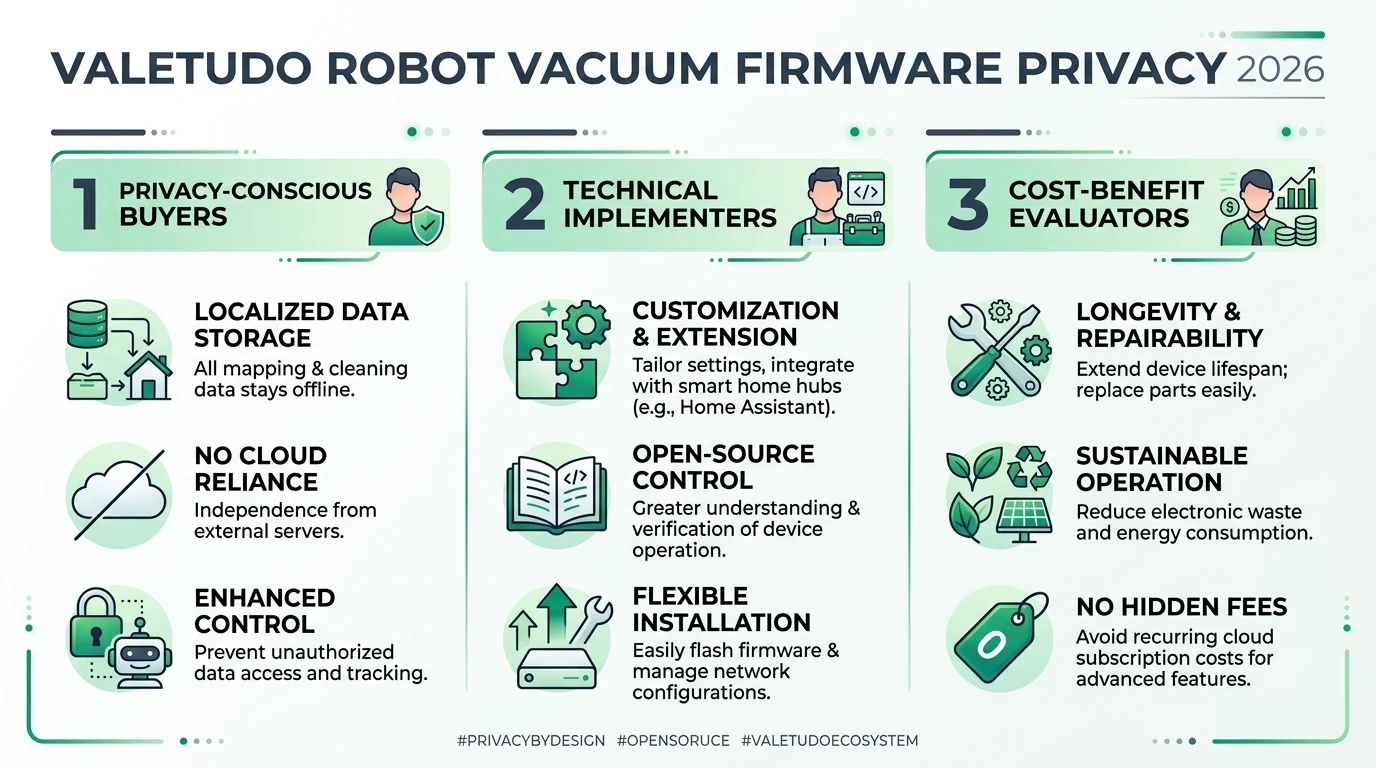
Valetudo firmware is an open-source solution designed to replace the cloud-dependent functionalities of certain robot vacuums, primarily those from Roborock and Dreame. By enabling local control, Valetudo ensures that all data processing and storage occur within your home network, eliminating the need to share data with external servers. This is particularly appealing to privacy-conscious buyers who are wary of the data collection practices associated with cloud-connected devices.
The firmware offers a web interface and supports MQTT, a lightweight messaging protocol that facilitates integration with smart home systems like Home Assistant. This means you can control your vacuum cleaner without relying on proprietary apps that often require internet access and data sharing. The ability to manage your device locally not only enhances privacy but also ensures that your vacuum continues to function even if your internet connection is disrupted.
Privacy is a significant concern with many modern smart devices, especially those equipped with cameras or microphones. While some manufacturers claim to process data on-device, the potential for data to be sent to the cloud remains a risk. Valetudo mitigates this by eliminating cloud dependencies entirely, providing peace of mind to users who prioritize data security.
However, it’s important to note that Valetudo’s privacy benefits come with certain trade-offs. The firmware requires technical expertise to install, as it involves rooting the device and potentially accessing its motherboard. This process can be daunting for users without a technical background, but for those willing to invest the time and effort, the privacy gains are substantial.
Installation Complexity and Technical Requirements
Installing Valetudo firmware is not a straightforward process and requires a certain level of technical proficiency. The installation involves rooting the robot vacuum, which may necessitate disassembling the device to access its motherboard. This step is crucial as it allows the firmware to replace the existing cloud-dependent software with Valetudo’s local control system.
The rooting process can vary depending on the model of the vacuum, and users must be prepared to follow detailed instructions carefully. Tools like the dustbuilder are essential for creating the rooted firmware images needed for installation. This manual process contrasts sharply with the plug-and-play nature of cloud-dependent vacuums, which require minimal setup.
Once installed, Valetudo provides a web-based interface for controlling the vacuum, which, while functional, may not be as polished as the proprietary apps offered by manufacturers. Users should be prepared for a learning curve as they familiarize themselves with the new interface and its capabilities.
Firmware updates also require manual intervention. Unlike cloud-connected models that receive automatic over-the-air updates, Valetudo users must manually download and install updates. This process can be time-consuming and may result in delays if the Valetudo development team has not yet released a compatible update for the latest firmware version.
Despite these challenges, the benefits of enhanced privacy and local control make Valetudo an attractive option for those willing to navigate the technical complexities. For users without the necessary skills, hiring a technician to perform the installation might be a viable alternative, though this would add to the overall cost.
Cost Considerations and Total Ownership Expenses
When evaluating Valetudo firmware, it’s essential to consider the total cost of ownership, which includes hardware expenses, setup labor, and ongoing maintenance. Valetudo-compatible models, such as those from Roborock, are often priced higher than their cloud-dependent counterparts, reflecting their advanced features and capabilities.
The initial cost of the hardware is just one aspect of the financial equation. The installation process, which involves rooting and potentially disassembling the vacuum, can be complex and time-consuming. Users without the technical skills to perform these tasks themselves may need to hire a technician, adding to the setup costs.
Ongoing maintenance is another factor to consider. Valetudo requires manual firmware updates, which can be labor-intensive and may lead to periods where the vacuum operates on outdated software. This maintenance burden is a trade-off for the enhanced privacy and local control that Valetudo provides.
In contrast, cloud-dependent solutions like those from iRobot or Ecovacs offer a more seamless user experience with automatic updates and advanced features such as self-emptying stations and mop auto-washing. However, these conveniences come at the cost of reduced privacy and potential subscription fees for premium services.
Ultimately, the decision to use Valetudo should be based on a careful assessment of your privacy priorities, technical skills, and willingness to manage the additional maintenance requirements. For those who value privacy above all else, the investment in Valetudo may be well worth the effort.
Comparing Valetudo with Cloud-Dependent Alternatives
When comparing Valetudo firmware with cloud-dependent robot vacuums, several key criteria emerge, including data privacy, local control, setup complexity, and feature completeness. Each of these factors plays a crucial role in determining which solution best meets your needs.
Data Privacy: Valetudo excels in this area by ensuring that all data processing occurs locally, with no information shared with external servers. In contrast, cloud-dependent models often transmit data to manufacturer servers, posing potential privacy risks.
Local Control: Valetudo provides full control over your vacuum via a web interface, even when offline. Cloud-dependent models, however, rely on internet connectivity and proprietary apps, which can limit functionality if your internet connection is disrupted.
Setup Complexity: Installing Valetudo is more complex than setting up a cloud-dependent vacuum, requiring technical skills to root the device and install the firmware. Cloud models are generally plug-and-play, making them more accessible to non-technical users.
Feature Completeness: While Valetudo supports essential functions, it may lack some of the advanced features found in cloud-dependent models, such as self-emptying stations and mop auto-washing. Users must weigh these feature trade-offs against their privacy priorities.
The following table provides a detailed comparison of these criteria:
| Criteria | Cloud-Dependent (iRobot, Ecovacs) | Rootable Roborock with Valetudo |
|---|---|---|
| Data Privacy | Shares data with servers | All processing local |
| Local Control | Requires internet and app | Full local network control |
| Setup Complexity | Plug-and-play | Requires rooting and setup |
| Feature Completeness | Advanced features available | Basic functions supported |
This comparison highlights the trade-offs between privacy and convenience, helping you make an informed decision based on your specific needs and priorities.
Integrating Valetudo with Smart Home Systems
Valetudo’s support for MQTT makes it an excellent choice for integrating with smart home systems like Home Assistant. This protocol allows for seamless communication between devices, enabling you to control your robot vacuum alongside other smart home components.
The integration process involves configuring your MQTT broker and setting up the necessary automations within your smart home platform. While this may require some initial setup, the flexibility and control it offers are significant advantages for users seeking a cohesive smart home experience.
Valetudo’s web interface, while less polished than proprietary apps, provides all the necessary controls to manage your vacuum’s operations. You can schedule cleaning sessions, monitor the vacuum’s status, and even receive notifications through your smart home system.
For users with existing smart home setups, Valetudo’s compatibility with MQTT offers a level of integration that cloud-dependent models may not match. This flexibility allows you to create custom automations and routines that enhance the functionality of your smart home ecosystem.
However, it’s important to note that the integration process may require technical skills, particularly if you’re new to MQTT or smart home automation. Resources and community support are available to help guide you through the setup, ensuring that you can fully leverage Valetudo’s capabilities.
Checklist
- Ensure your robot model is compatible with Valetudo
- Familiarize yourself with MQTT and smart home integration
- Prepare for manual firmware updates
- Consider hiring a technician if unsure about installation
- Evaluate privacy vs. feature trade-offs
Security and Privacy Implications of Valetudo
Valetudo’s primary advantage lies in its ability to provide local control over robot vacuums, significantly enhancing privacy by eliminating cloud dependencies. This local control ensures that all data processing and storage occur within your home network, reducing the risk of data breaches or unauthorized access.
One of the key security benefits of Valetudo is its open-source nature, which allows for code inspection and modification. This transparency enables users and developers to identify and address potential vulnerabilities, fostering a community-driven approach to security.
However, it’s important to recognize that Valetudo does not undergo the same level of formal security audits or certifications as some commercial solutions. While the open-source community actively works to maintain and improve the software, users should remain vigilant and apply security best practices.
Network isolation is another critical consideration. By configuring your router to block internet access for your robot vacuum, you can further enhance security. Valetudo’s local control ensures that the vacuum continues to function even when isolated from the internet, unlike cloud-dependent models that may lose functionality.
In summary, Valetudo offers robust privacy and security benefits for users willing to manage the technical aspects of installation and maintenance. By prioritizing local control and transparency, Valetudo provides a compelling alternative to cloud-dependent robot vacuums.
FAQ
Frequently Asked Questions
What is Valetudo firmware?
Valetudo is an open-source firmware that replaces cloud connectivity on certain robot vacuums, providing local control and enhanced privacy.
Which robot vacuums are compatible with Valetudo?
Valetudo primarily supports Roborock and Dreame models, with compatibility varying by specific model.
How does Valetudo enhance privacy?
By eliminating cloud dependencies, Valetudo ensures all data processing occurs locally, reducing the risk of data breaches.
Is Valetudo difficult to install?
Installation requires technical skills, including rooting the device and potentially accessing its motherboard.
Can Valetudo integrate with smart home systems?
Yes, Valetudo supports MQTT, enabling integration with systems like Home Assistant for enhanced smart home control.
Primary Sources Table
| Source | URL | Type | Relevance | Publication Date |
|---|---|---|---|---|
| Gigazine | Gigazine | News/Feature | Core Valetudo overview, setup complexity, capabilities | November 7, 2025 |
| Cloudland Tech | Cloudland Tech | Comparison Guide | Privacy assessment framework, camera risks, feature comparison | 2026 Audit |
| Home Assistant Community | Home Assistant Community | Forum Discussion | User perspectives on cost, supported models, feature limitations | 2026 |
| Valetudo Official | Valetudo Official | Official Site | Project history (2018 launch), licensing, mission statement | Current |
| Valetudo Capabilities | Valetudo Capabilities | Official Documentation | Detailed capability list (DoNotDisturbCapability, KeyLockCapability, etc.) | Current |
Conclusion
In conclusion, Valetudo firmware offers a robust solution for those seeking enhanced privacy and local control over their robot vacuums. While the installation process requires technical expertise, the benefits of eliminating cloud dependencies and ensuring data security are significant. For users willing to navigate the complexities of setup and maintenance, Valetudo provides a compelling alternative to cloud-dependent models.
For further exploration of privacy-focused smart home solutions, consider reading our guides on Apple HomeKit Secure Video vs. Local NVR for Privacy, Best Hardware for Local AI Smart Home 2026, and Best Local LLMs for Home Automation 2026.