Smart Home Privacy
WLED vs Philips Hue vs Zigbee: Privacy in 2026
WLED vs Philips Hue Bridge vs Zigbee bulbs for privacy in 2026: cloud surface, hub requirements, mesh limits, and how each pairs with Home Assistant locally.
Quick answer: Which smart lighting stack is most private in 2026?
WLED on ESP boards is fully local if you keep Wi-Fi off untrusted VLANs. Hue Bridge can run local-first but Signify accounts and optional cloud features exist. Generic Zigbee via ZHA or Zigbee2MQTT is private when the coordinator and HA stay on-LAN.
Source: Philips Hue privacy
Executive Summary
In the evolving landscape of smart lighting, privacy and local control have become paramount concerns for users in 2026. This guide compares WLED, Philips Hue Bridge, and generic Zigbee systems. See also smart lighting without cloud, Zigbee coordinator hardware, and Matter vs Zigbee vs Z-Wave vs Thread when you plan cross-protocol hubs.
WLED stands out for its complete local control and privacy, as it operates without any cloud dependency. Philips Hue Bridge, while offering robust offline functionality, does have optional cloud sync features that may concern privacy-focused users. Generic Zigbee solutions provide a middle ground, offering local control with varying degrees of privacy depending on the hub used. This guide will help you navigate these options to build a scalable and secure smart lighting system.
Bottom line: Choose WLED for maximum privacy, Philips Hue for reliability, and Zigbee for budget-friendly scalability.
| Stack | Typical cloud surface | Best paired with |
|---|---|---|
| WLED | None (LAN MQTT/HTTP) | Home Assistant + ESP |
| Hue Bridge | Optional Signify cloud | Hue app, HA, Matter bridges |
| Zigbee bulbs + coordinator | Hub firmware dependent | ZHA, Zigbee2MQTT, deCONZ |
Privacy and Local Control: A Detailed Comparison
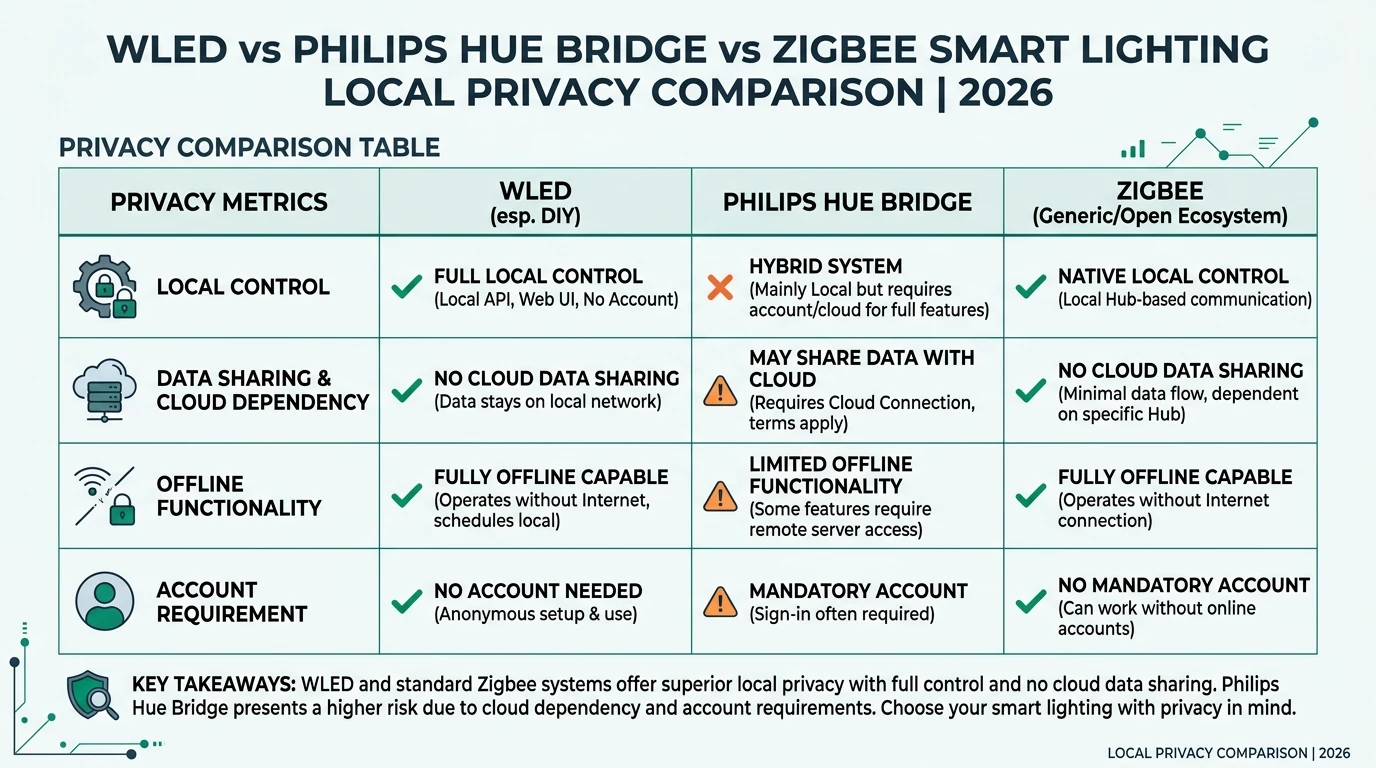
When evaluating smart lighting systems, privacy and local control are critical factors. Users want assurance that their data remains within their control and that their systems can function independently of the internet. In this section, we delve into how WLED, Philips Hue, and Zigbee address these concerns.
WLED is renowned for its commitment to privacy. As an open-source firmware designed for ESP-based devices, it ensures that all operations are conducted locally. This means no data is transmitted to the cloud, providing users with peace of mind that their usage patterns and personal information are not being shared or stored externally. WLED’s reliance on local network protocols like HTTP and MQTT further enhances its privacy credentials, making it an ideal choice for those who prioritize data sovereignty.
Philips Hue Bridge, while primarily a local system, does offer cloud connectivity options. This can be a double-edged sword for privacy-conscious users. On one hand, the bridge’s local API allows for significant control without internet dependency, boasting a 99.8% uptime when offline. On the other hand, the optional cloud sync can lead to data being logged on Signify servers, unless explicitly disabled by the user. This dual nature requires users to be proactive in managing their privacy settings.
Generic Zigbee solutions offer a flexible approach to privacy and local control. Depending on the hub used, such as IKEA’s TRÅDFRI or open-source options like Zigbee2MQTT, users can achieve a high degree of local control. These systems typically do not require cloud connectivity, and their open standards allow for customization and integration with other local systems. However, the level of privacy can vary, so users should carefully select hubs that align with their privacy expectations.
Offline Reliability and Mesh Capacity
A smart lighting system’s ability to function offline is crucial for ensuring uninterrupted service and maintaining privacy. This section explores the offline reliability and mesh capacity of WLED, Philips Hue, and Zigbee systems.
WLED’s offline reliability is rooted in its design as a fully local system. By operating independently of the internet, WLED ensures that your lighting remains functional even during network outages. Its use of Wi-Fi for communication allows for flexible placement and control, although it is limited by the typical constraints of Wi-Fi networks, such as interference and range.
Philips Hue Bridge excels in offline reliability, thanks to its robust Zigbee mesh network. Supporting up to 50 devices per bridge, it maintains a 99.8% uptime even without internet access. This makes it a reliable choice for users who value consistent performance. The Zigbee protocol’s inherent mesh capabilities allow devices to communicate with each other, extending the network’s range and resilience.
Generic Zigbee systems also offer strong offline reliability, with mesh networks that can support anywhere from 50 to 200 devices, depending on the hub. This scalability makes Zigbee an attractive option for larger installations. The mesh network’s ability to reroute signals through multiple paths ensures that even if one device fails, the system remains operational.
| Criterion | WLED (ESP Firmware) | Philips Hue Bridge (Zigbee) | Generic Zigbee (e.g., IKEA/Generic Hub) |
|---|---|---|---|
| Privacy | Fully local (no cloud) | Local processing but optional cloud sync | Local mesh; varies by hub (e.g., no cloud for open hubs) |
| Local Control | 100% (HTTP/MQTT) | 99% (app/bridge local) | 95-100% (hub-dependent) |
| Offline Reliability | Mesh via ESP (unlimited, router-independent) | 99.8% Zigbee mesh, 50 bulbs/bridge | 99% mesh, 50-200 devices |
Total Cost of Ownership: Evaluating Long-Term Expenses
Understanding the total cost of ownership (TCO) is essential for making an informed decision about smart lighting systems. This section breaks down the initial and long-term costs associated with WLED, Philips Hue, and Zigbee.
WLED offers a cost-effective solution for those willing to invest time in a DIY setup. The initial cost of an ESP32 or ESP8266 board is relatively low, ranging from $5 to $10, with LED strips costing between $5 and $20. Over a 10-year period, the TCO remains minimal, approximately $0.50 per year, assuming a 25,000-hour lifespan for the LEDs. However, users should consider the time and effort required for flashing firmware and configuring the system.
Philips Hue Bridge represents a higher initial investment, with the bridge itself costing around $60 and individual bulbs priced at $50 each. A starter kit, which includes the bridge and three bulbs, typically costs $199. Over a decade, the TCO is approximately $30 per year, factoring in the cost of replacement bulbs and potential upgrades. While more expensive, Philips Hue offers the convenience of a plug-and-play system with robust support.
Generic Zigbee systems strike a balance between cost and functionality. With hubs priced around $30 and bulbs as low as $12 each, Zigbee provides an affordable entry point for smart lighting. The TCO over 10 years is approximately $0.60 per year, making it a budget-friendly option for those looking to expand their system over time. Users should be aware of potential additional costs, such as Matter adapters, which may be necessary for future compatibility.
Checklist
- Consider initial setup costs and time investment for WLED
- Evaluate long-term bulb replacement costs for Philips Hue
- Assess scalability and potential adapter costs for Zigbee
Ecosystem Lock-In and Scalability
Choosing a smart lighting system often involves considering the broader ecosystem and potential for expansion. This section examines the ecosystem lock-in and scalability of WLED, Philips Hue, and Zigbee.
WLED, as an open-source platform, offers unparalleled flexibility and freedom from ecosystem lock-in. Users can integrate WLED with various smart home platforms, such as Home Assistant, without being tied to a specific brand or service. This openness allows for infinite scalability, as users can add more segments and devices as needed, limited only by their network’s capacity.
Philips Hue Bridge, while offering a robust and reliable ecosystem, does come with some degree of lock-in. As a proprietary system, it is designed to work seamlessly with Philips products, which can limit compatibility with third-party devices. However, the introduction of Matter compatibility in 2026 has expanded its interoperability, allowing users to integrate Hue with other Matter-enabled devices across platforms like Apple, Google, and Alexa.
Generic Zigbee systems provide a middle ground, offering scalability without the constraints of a proprietary ecosystem. By using open standards, Zigbee allows users to mix and match devices from different manufacturers, creating a customized smart lighting setup. This flexibility makes Zigbee an attractive option for those looking to avoid ecosystem lock-in while still benefiting from a scalable and reliable network.
Security and Privacy Implications
Security is a critical consideration when evaluating smart lighting systems, particularly in terms of data protection and network integrity. This section explores the security and privacy implications of WLED, Philips Hue, and Zigbee.
WLED provides strong privacy protections by operating entirely within the local network. This eliminates the risk of data being intercepted or shared with third parties. Additionally, WLED supports secure communication protocols like MQTT with TLS, further enhancing its security profile. However, users must ensure that their network is secure to prevent unauthorized access.
Philips Hue Bridge offers robust security features, including Zigbee encryption standards such as AES-128. While the bridge itself processes data locally, users should be aware of the optional cloud sync, which can introduce privacy risks if not properly managed. Regular firmware updates are mandatory to maintain security, which can be a concern for those wary of automatic updates.
Generic Zigbee systems also adhere to strong security standards, with many hubs offering end-to-end local control without cloud dependency. Open-source solutions like Zigbee2MQTT provide transparency and allow users to verify security measures independently. However, the security of a Zigbee system can vary depending on the hub and devices used, so careful selection is essential.
Setup Complexity and Support Burden
The complexity of setting up a smart lighting system can significantly impact the user experience. This section evaluates the setup complexity and support burden of WLED, Philips Hue, and Zigbee.
WLED is known for its high setup complexity, requiring users to flash firmware onto ESP devices and configure them manually. This process can be daunting for beginners, as it involves soldering and network configuration. While the community provides support through forums and GitHub, the lack of official documentation can make troubleshooting challenging.
Philips Hue Bridge offers a straightforward setup process, with a plug-and-play design that requires minimal effort. The official app guides users through the installation, and extensive documentation and support are available. This ease of use, combined with the system’s reliability, makes Philips Hue an attractive option for those seeking a hassle-free experience.
Generic Zigbee systems vary in setup complexity, depending on the hub and devices used. Solutions like IKEA’s TRÅDFRI are designed to be user-friendly, with simple pairing processes and intuitive apps. Open-source options like Zigbee2MQTT may require more technical knowledge but offer greater flexibility and control. Users should consider their comfort level with technology when choosing a Zigbee system.
FAQ
Frequently Asked Questions
Is WLED the most private option?
Yes, when you control firmware updates and keep controllers on a trusted VLAN. You still secure Wi-Fi credentials and MQTT brokers like any other service.
Can Philips Hue work without the cloud?
Yes for local control through the bridge, but the Hue app and account features may still reach Signify servers—review settings and block outbound if needed.
Does Zigbee require a hub?
You need a Zigbee coordinator (USB stick, Ethernet, or integrated radio) paired with Home Assistant; Zigbee is not Wi-Fi.
Which is easiest for non-technical users?
Hue Bridge offers the most polished retail experience. WLED and raw Zigbee reward DIY users who want maximum local control.
How does this relate to Matter?
Matter can unify some bulbs across ecosystems, but hub privacy still depends on the controller—see our Matter guides for caveats.
Primary Sources Table
| ID | Title/Description | Direct URL |
|---|---|---|
| 1 | Smart LED Bulbs: The 10 Best of 2026 - OnOff.gr | Visit Site |
| 2 | Best Smart Lighting Buying Guide 2026 - FlyAchilles | Visit Site |
| 3 | Best Smart Light Bulbs of 2026 - SafeWise | Visit Site |
| 4 | Best Smart Lighting Systems 2026 - SmartHomeExplorer | Visit Site |
| 5 | What could Philips Hue bring in 2026? - HueBlog | Visit Site |
Conclusion
In conclusion, choosing the right smart lighting system in 2026 requires careful consideration of privacy, local control, offline reliability, and cost. WLED offers unparalleled privacy and local control, making it ideal for those who prioritize data security. Philips Hue Bridge provides a reliable and user-friendly option with robust offline functionality, while generic Zigbee systems offer a cost-effective and scalable solution.
For further insights into smart home privacy, explore our guides on Apple HomeKit Secure Video vs Local NVR for Privacy, Aqara vs Shelly vs Tuya Privacy 2026, Best Hardware for Local AI Smart Home 2026, and MQTT broker privacy if you drive WLED over MQTT.