Smart Home Privacy
Zigbee vs Z-Wave for Offline Smart Home Control
Explore the differences between Zigbee and Z-Wave for offline smart home control, focusing on privacy, reliability, and cost efficiency.
Quick answer: Which protocol is better for offline smart home control: Zigbee or Z-Wave?
Both work offline. Zigbee supports more devices and faster data rates; Z-Wave offers better range and lower interference. Choose Zigbee for large device counts, Z-Wave for larger homes or stronger security focus.
Executive Summary
When choosing between Zigbee and Z-Wave for offline smart home control, consider your priorities: device capacity, range, security, and cost. Zigbee excels in supporting a large number of devices and faster data rates, making it suitable for complex automations. Z-Wave, with its superior range and security features, is ideal for larger homes and those prioritizing robust security.
Bottom line: Your choice between Zigbee and Z-Wave should align with your specific home size, security needs, and device compatibility preferences.
Understanding Zigbee and Z-Wave Protocols
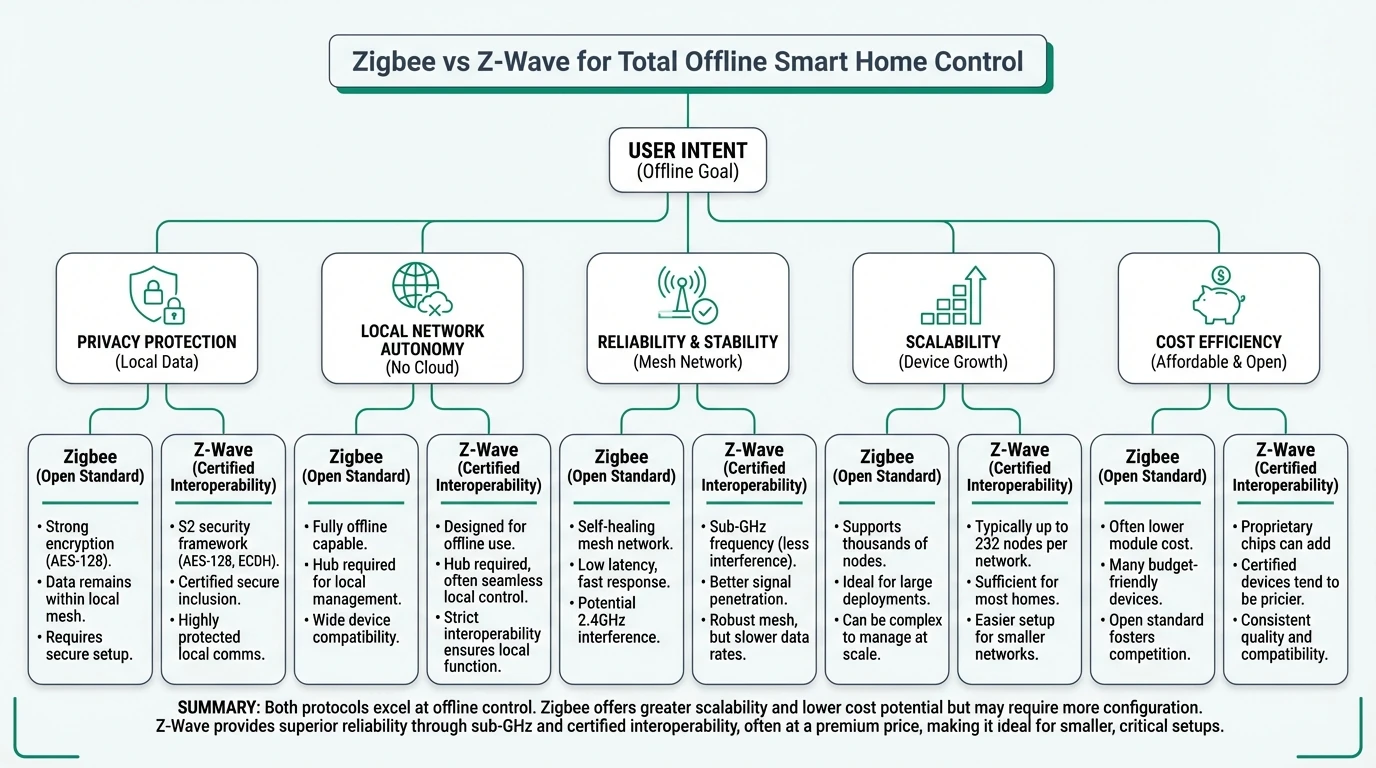
Zigbee and Z-Wave are both mesh network protocols designed for smart home devices, allowing them to communicate without internet dependency12. This local network autonomy ensures privacy and reliability, as data remains within the home network. For the full architecture picture, see the cloud-free pillar guide.
Key Differences
| Criterion | Zigbee | Z-Wave |
|---|---|---|
| Frequency | 2.4 GHz (global) | 800–900 MHz (region-specific) |
| Range | ~30 ft | ~200 ft |
| Nodes | 65,000+ | 232 |
| Data Rate | Faster | Up to 100 kbps |
| Interference | High | Low |
Zigbee operates on a globally available 2.4 GHz frequency, which can lead to interference from Wi-Fi and Bluetooth3. In contrast, Z-Wave uses less congested frequencies, offering better reliability in environments with many wireless signals13.
Privacy and Security Considerations
Both protocols provide local control, enhancing privacy by keeping data within the home. However, their security implementations differ significantly.
Security Features
- Z-Wave: Offers AES-128 encryption and additional layers against DDoS attacks34. Its proprietary nature reduces the attack surface3.
- Zigbee: Also uses AES-128 encryption but is open-source, which can present more vulnerabilities4.
Zigbee vs Z-Wave privacy and offline control
| Product | Cloud required | Local storage | Mandatory account | Offline control | Score / 10 |
|---|---|---|---|---|---|
| Zigbee (2.4 GHz mesh) | No | N/A (control protocol) | No | Excellent | 9.0 |
| Z-Wave (sub-GHz mesh) | No | N/A (control protocol) | No | Excellent | 9.2 |
While both protocols ensure offline privacy, Z-Wave’s additional security features make it a better choice for users prioritizing security.
Scalability and Device Compatibility
Zigbee supports a significantly higher number of devices, making it ideal for extensive smart home setups12. However, Z-Wave’s 232-device limit is typically sufficient for most residential applications5.
Ecosystem Overview
- Zigbee: Requires a coordinator hub and supports various specifications, though device availability is limited34.
- Z-Wave: Offers strong cross-brand compatibility due to a stringent certification process1. Compare hub options in our no-mandatory-cloud hub matrix.
Protocol selection checklist
- Consider your current and future device needs.
- Evaluate the availability of compatible devices in your region.
- Ensure your chosen protocol supports your preferred smart home platform.
Cost Efficiency and Hidden Costs
Both protocols require a hub or coordinator, but their cost structures differ.
Cost Analysis
- Zigbee: Generally lower upfront device costs4.
- Z-Wave: Higher initial costs but optimized for battery efficiency, reducing long-term expenses5.
Hidden costs include the need for repeaters in larger homes for Z-Wave, and potential maintenance for Zigbee networks due to interference14.
Setup Complexity and Support
Z-Wave’s straightforward hub integration and limited node count simplify setup and troubleshooting1. Zigbee’s higher node capacity offers flexibility but can complicate diagnostics2.
Support Considerations
- Z-Wave: Easier setup with most smart home platforms1.
- Zigbee: Requires understanding of protocol operations and may face interference challenges3.
For a seamless experience, consider the support burden and complexity of each protocol in relation to your technical expertise.
FAQ
Frequently Asked Questions
Can Zigbee and Z-Wave devices work together?
No, Zigbee and Z-Wave devices cannot directly communicate as they operate on different frequencies and protocols.
Which protocol is better for a large home?
Z-Wave is generally better for larger homes due to its superior range and lower interference susceptibility.
Are there any ongoing costs with these protocols?
Both protocols have minimal ongoing costs, primarily related to device maintenance and potential network expansions.
How do I choose the right protocol for my smart home?
Consider your home’s size, security needs, device compatibility, and budget when choosing between Zigbee and Z-Wave.
What are the main security concerns with Zigbee?
Zigbee’s open-source nature can present more vulnerabilities compared to Z-Wave’s proprietary system.
Primary Sources Table
| # | Source | URL | Content Type |
|---|---|---|---|
| 1 | Vivint | Link | Comparison guide |
| 2 | Aqara | Link | Product blog |
| 3 | XDA Developers | Link | Tech analysis |
| 4 | Gearbrain | Link | Consumer guide |
| 5 | iSmarthomesecurity | Link | Comparison article |
Conclusion
Choosing between Zigbee and Z-Wave depends on your specific needs and home environment. Zigbee offers scalability and faster data rates, while Z-Wave provides better range and security. Evaluate your priorities to make an informed decision.