Smart Home Privacy
Zigbee2MQTT vs ZHA vs deCONZ Privacy 2026
Compare Zigbee2MQTT, ZHA, and deCONZ for Home Assistant privacy in 2026. Discover the best local control solution.
Quick answer: Which Zigbee stack is best for Home Assistant privacy in 2026?
All three run locally without vendor cloud: ZHA is the lowest-friction built-in integration; Zigbee2MQTT adds MQTT flexibility and the largest device quirk database; deCONZ suits Hue/ConBee users who want Phoscon plus a blockable REST API.
Source: Home Assistant ZHA documentation
Executive Summary
In 2026, choosing the right Zigbee integration for Home Assistant is crucial for maintaining privacy and local control. Zigbee2MQTT, ZHA, and deCONZ are the leading options, each offering unique benefits. This guide compares these solutions based on privacy, local control, offline reliability, and total cost of ownership (TCO). Cross-check coordinator hardware using our Zigbee vs Z-Wave offline control and Matter vs Zigbee vs Z-Wave vs Thread primers. Official references: Home Assistant ZHA, Zigbee2MQTT documentation, and deCONZ REST API notes.
ZHA integrates seamlessly with Home Assistant, offering a straightforward setup and robust privacy features. It’s ideal for users who prioritize simplicity and local control without additional configurations. Zigbee2MQTT, while requiring more setup, provides extensive device support and flexibility, making it a favorite among power users. deCONZ, with its strong support for Philips Hue and Xiaomi devices, offers a reliable alternative for users migrating from cloud-based hubs.
Bottom line: For most users, ZHA offers the best balance of simplicity and privacy. However, if you require advanced device compatibility or are migrating from a Philips Hue setup, consider Zigbee2MQTT or deCONZ.
Privacy and Local Control: Key Considerations
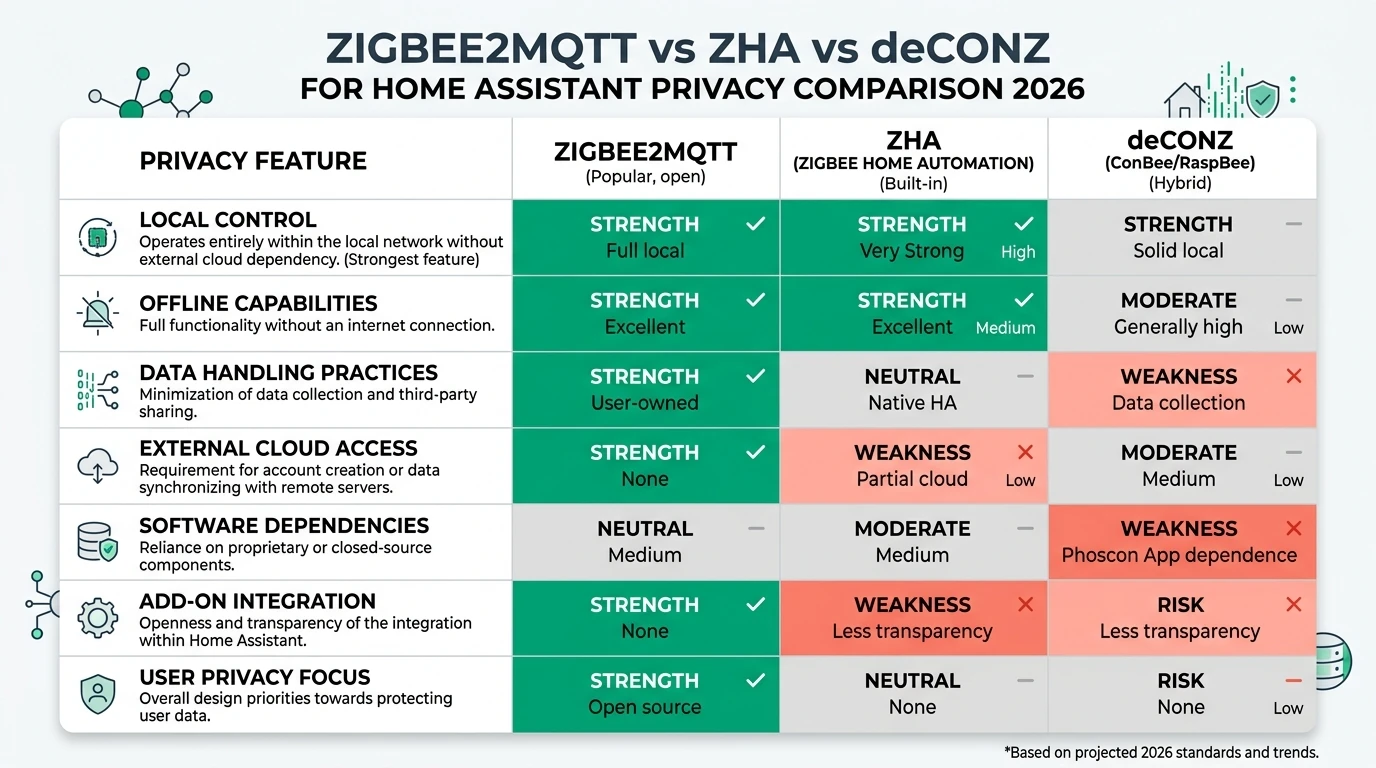
Privacy is a top concern for smart home enthusiasts, especially when integrating Zigbee devices with Home Assistant. All three solutions—Zigbee2MQTT, ZHA, and deCONZ—operate locally, eliminating the need for cloud services and ensuring that your data remains within your home network. This local-only approach aligns with the Zigbee 3.0 PRO standards, which emphasize secure and private communication.
ZHA, as a built-in integration with Home Assistant, offers the most straightforward path to achieving local control. It requires no additional software or configurations, making it an excellent choice for users who value simplicity and privacy. By directly integrating with Home Assistant entities, ZHA ensures that your data is processed locally without any external dependencies.
Zigbee2MQTT, while requiring an MQTT broker, provides a robust solution for users who need extensive device support. The MQTT broker facilitates communication between devices and Home Assistant, allowing for local control without cloud involvement. This setup, however, requires careful configuration to ensure security, as the MQTT broker can be a potential point of exposure if not properly secured.
deCONZ, with its Phoscon app, offers a user-friendly interface for managing Zigbee devices. It provides a local REST API that can be blocked from external access, ensuring that your data remains private. This makes deCONZ a reliable option for users who prioritize privacy and have a specific focus on Philips Hue or Xiaomi devices.
| Stack | Extra moving parts | Privacy sweet spot |
|---|---|---|
| ZHA | None beyond coordinator | Fewest daemons; data stays in HA |
| Zigbee2MQTT | MQTT broker + add-on | Great if you already run MQTT for sensors |
| deCONZ | deCONZ/Phoscon service | REST can be firewalled; Hue migrations stay local |
Offline Reliability: Ensuring Continuous Operation
Offline reliability is crucial for maintaining control over your smart home devices, even when your Home Assistant server is down. This section explores how Zigbee2MQTT, ZHA, and deCONZ handle offline scenarios, ensuring that your Zigbee network remains operational.
ZHA, being tightly integrated with Home Assistant, relies heavily on the server’s uptime. If Home Assistant goes down, control over your Zigbee devices is temporarily lost. However, the simplicity and direct integration often outweigh this limitation for users who prioritize ease of use and minimal setup.
Zigbee2MQTT offers a more resilient solution in offline scenarios. By decoupling the Zigbee network from Home Assistant through the MQTT broker, Zigbee2MQTT allows lights and other devices to remain controllable even if the server is down. This feature is particularly beneficial for users who require uninterrupted control over their smart home devices.
deCONZ also provides offline reliability by maintaining control over the Zigbee network independently of Home Assistant. The Phoscon app allows for direct control of devices, ensuring that your smart home remains functional even during server outages. This makes deCONZ a strong contender for users who prioritize offline reliability alongside privacy.
Total Cost of Ownership: Evaluating Long-Term Expenses
When considering Zigbee integrations for Home Assistant, it’s essential to evaluate the total cost of ownership (TCO), which includes hardware costs and any additional expenses related to setup and maintenance. This section provides a detailed analysis of the TCO for Zigbee2MQTT, ZHA, and deCONZ.
ZHA offers the lowest TCO, as it requires no additional software or hardware beyond the Zigbee coordinator. Most coordinators, such as the Sonoff ZBDongle-P, are priced between $25 and $40, making ZHA an affordable option for users seeking a cost-effective solution. With no additional software costs, ZHA is ideal for budget-conscious users.
Zigbee2MQTT, while free to use, involves the additional setup of an MQTT broker. Although this adds complexity, the cost remains minimal, as the broker can run on the same hardware as Home Assistant. The flexibility and extensive device support provided by Zigbee2MQTT justify the slightly higher initial setup cost for users who require advanced features.
deCONZ, with its ConBee II stick priced around $30, offers a mid-range TCO. While it may require additional hardware for specific setups, such as a Xiaomi hub, these costs are generally offset by the robust device support and offline reliability that deCONZ provides. For users migrating from cloud-based systems, deCONZ offers a cost-effective path to local control.
| Criteria | ZHA | Zigbee2MQTT | deCONZ |
|---|---|---|---|
| Privacy | Local-only, built-in HA1 | Local MQTT, no cloud2 | Local REST API, blockable3 |
| Local Control | Direct HA entities4 | MQTT broker required2 | Phoscon GUI + HA4 |
| Offline Reliability | HA-down = no control4 | Lights controllable4 | Lights controllable4 |
| TCO (est. 2026) | $25-40 dongle, 0 add’l5 | $25-40 + MQTT setup5 | $30 ConBee II + REST3 |
Device Compatibility: Meeting Diverse Needs
Device compatibility is a critical factor when choosing a Zigbee integration for Home Assistant. Each solution—Zigbee2MQTT, ZHA, and deCONZ—offers varying levels of support for different devices, impacting your ability to integrate a wide range of smart home products.
ZHA provides broad compatibility with most Zigbee coordinators, including popular models like the Sonoff ZBDongle-P and ConBee II. This makes it a versatile option for users who want a straightforward setup with reliable device support. However, ZHA may require additional configurations for certain exotic devices, which could be a limitation for some users.
Zigbee2MQTT excels in device compatibility, offering support for a vast array of Zigbee devices, including those with unique quirks, such as Tuya and Xiaomi products. This extensive support is a significant advantage for users who have diverse smart home ecosystems and need a solution that can accommodate various devices without extensive configuration.
deCONZ, while not as broad in compatibility as Zigbee2MQTT, provides strong support for Philips Hue and Xiaomi devices. This makes it an excellent choice for users who are migrating from cloud-based systems and want to maintain their existing device setups. The Phoscon app simplifies device management, further enhancing deCONZ’s appeal for users with specific brand preferences.
Security Implications: Safeguarding Your Smart Home
Security is a paramount concern when integrating Zigbee devices with Home Assistant. Ensuring that your smart home remains secure involves understanding the potential vulnerabilities and implementing measures to mitigate risks. This section examines the security implications of using Zigbee2MQTT, ZHA, and deCONZ.
All three solutions prioritize local control, eliminating the need for cloud services and reducing exposure to external threats. This local-only approach is a significant security advantage, as it minimizes the risk of data breaches and unauthorized access to your smart home devices.
ZHA, with its direct integration into Home Assistant, offers a secure and straightforward setup. By avoiding additional software or configurations, ZHA reduces the potential attack surface, making it a secure choice for users who prioritize simplicity and privacy.
Zigbee2MQTT, while requiring an MQTT broker, can be secured by configuring the broker to only accept connections from trusted devices. This setup requires careful attention to security settings, but when properly configured, it provides a robust and secure solution for managing Zigbee devices.
deCONZ, with its local REST API, offers a secure option for users who prioritize privacy. By blocking external access to the API, users can ensure that their data remains within their home network. This makes deCONZ a reliable choice for users who are concerned about potential security vulnerabilities.
Migration Paths: Transitioning from Cloud Hubs
For users transitioning from cloud-based hubs like Philips Hue or Xiaomi, understanding the migration paths available with Zigbee2MQTT, ZHA, and deCONZ is essential. This section explores the options and considerations for migrating your smart home setup to a local-only solution.
ZHA offers a straightforward migration path for users looking to transition from cloud-based systems. Its built-in integration with Home Assistant simplifies the process, allowing users to quickly pair their existing devices with minimal configuration. This makes ZHA an attractive option for users seeking a hassle-free migration experience.
Zigbee2MQTT provides a flexible migration path, accommodating a wide range of devices, including those with unique quirks. This flexibility is particularly beneficial for users with diverse smart home ecosystems, as it allows for a seamless transition without sacrificing device compatibility. However, the additional setup required for the MQTT broker may be a consideration for some users.
deCONZ, with its strong support for Philips Hue and Xiaomi devices, offers a reliable migration path for users with existing setups from these brands. The Phoscon app simplifies the pairing process, making it easy to integrate your existing devices into a local-only solution. This makes deCONZ an ideal choice for users who want to maintain their current device configurations while transitioning to a more secure and private setup.
Checklist
- Evaluate your current device compatibility
- Consider your privacy and security needs
- Assess the total cost of ownership
- Determine your offline reliability requirements
- Plan your migration path from cloud-based systems
FAQ
Frequently Asked Questions
Which Zigbee integration offers the best privacy?
All three options—Zigbee2MQTT, ZHA, and deCONZ—offer excellent privacy by operating locally without cloud dependencies.
Is Zigbee2MQTT suitable for beginners?
Zigbee2MQTT requires more setup than ZHA but offers extensive device support, making it suitable for users willing to configure an MQTT broker.
Can I use deCONZ with Philips Hue devices?
Yes, deCONZ offers strong support for Philips Hue devices, making it an ideal choice for users migrating from Philips Hue hubs.
What is the total cost of ownership for ZHA?
ZHA has the lowest TCO, as it requires no additional software or hardware beyond the Zigbee coordinator, typically costing $25-$40.
How does offline reliability differ between the options?
Zigbee2MQTT and deCONZ maintain control over devices even if Home Assistant is down, while ZHA relies on the server’s uptime.
Primary Sources Table
| Index | Title/Description | Direct URL |
|---|---|---|
| [1] | deCONZ vs ZHA vs zigbee2mqtt - Home Assistant Community | https://community.home-assistant.io/t/deconz-vs-zha-vs-zigbee2mqtt/136609 |
| [2] | Zigbee2MQTT vs ZHA vs deCONZ - YouTube | https://www.youtube.com/watch?v=RWzzNe5gm5s |
| [3] | deCONZ vs ZHA vs zigbee2mqtt - Page 8 | https://community.home-assistant.io/t/deconz-vs-zha-vs-zigbee2mqtt/136609?page=8 |
| [4] | Zigbee2MQTT vs ZHA vs deCONZ - Smart Home Junkie | https://www.smarthomejunkie.net/zigbee2mqtt-vs-zha-vs-deconz-watch-this-before-you-decide/ |
| [5] | ZHA vs Zigbee2MQTT - SONOFF | https://sonoff.tech/blogs/news/zha-vs-zigbee2mqtt-the-best-zigbee-integration-for-home-assistant |
| [6] | ZHA vs Zigbee2MQTT Pros/Cons - Home Assistant Community | https://community.home-assistant.io/t/zha-vs-zigbee2mqtt-pros-n-cons-for-conversion/798594 |
| [7] | Best Zigbee Coordinators for Home Assistant 2026 | https://smarthomescene.com/top-picks/best-zigbee-coordinators-for-home-assistant/ |
Conclusion
In conclusion, choosing the right Zigbee integration for Home Assistant in 2026 depends on your specific needs and priorities. ZHA offers simplicity and low cost, making it ideal for most users. Zigbee2MQTT provides extensive device support and flexibility, while deCONZ excels in supporting Philips Hue and Xiaomi devices. By evaluating privacy, local control, offline reliability, and TCO, you can make an informed decision that enhances your smart home experience.
Explore more about smart home privacy and hardware options in our related guides on Apple HomeKit Secure Video vs Local NVR for Privacy, Aqara vs Shelly vs Tuya Privacy 2026, Best Hardware for Local AI Smart Home 2026, and how to block IoT DNS leaks after you pick a coordinator.